Myrtle Beach is a mecca for golfers, where hundreds of courses once sprang up rapidly before the 2007–2008 crash. Some of those short-lived courses vanished and the game struggled for a time, but golf in the area has been enjoying a modest resurgence.
Unaffected by economic shifts, The Dunes Golf & Beach Club remains a highlight of my annual Myrtle Beach golf trip. Designed by Robert Trent Jones and established in 1948 by a group of local businessmen, The Dunes is one of the grande dames of the area. It consistently ranks highly in publications such as Golf Magazine and Golf Digest, has hosted multiple USGA national championships, six Senior PGA Tour Championships, and most recently co-hosted the 2014 PGA Professional National Championship.
In 2013, The Dunes completed an extensive greens restoration, converting all surfaces from A-1 bentgrass to Ultradwarf Champion Bermuda. This project followed a renovation about a decade earlier in which Rees Jones made targeted adjustments to greens 1, 8, 13, 16 and 18.
Although the course is private, it welcomes traveling groups of golfers. The club has distinct private and public areas, but on the course you essentially play a private layout. As you approach the entrance, take a moment to admire the beachfront houses—some of the loveliest in Myrtle Beach.
This was the final course we played on a trip that included five days and six rounds of golf, and it’s where I reclaimed the trip trophy, the Golden 8-Iron, which I hadn’t held for many years. Travelers on this outing included Gerry Gallagher, Bobby Hancock, John Kelley, Neil Curran, Wayne Weaver, Jimmy Spratt, John Ecklund and Jeff Stroble.
HOLE 2 | 425 YARDS, PAR 4
I teamed with Neil, John and Wayne and we played “wolf,” where a new captain—or wolf—chooses a partner each hole based on the tee shot.
From the tee you must carry the corner to have a clear look at the green. Long hitters can easily reach the right fairway bunker, only about 224 yards from the blue tees, so aim well left to avoid that hazard. On the approach, beware the deep bunkers slightly forward on both sides of the green. Two small ponds left and right will catch stray second shots. I took myself out of contention by cutting too close on the dogleg’s inside elbow and found the trees, which added a stroke to my score.
HOLE 4 | 505 YARDS, PAR 5
This hole can wreck a round: errant drives find fairway bunkers left or the woods right. A perfect tee shot over the bunkers leaves a chance to reach the green in two, but don’t attempt a risky Tin Cup shot—the green is heavily guarded by water and four bunkers that can spoil your approach. The green slopes back to front, so balls above the hole require only a delicate touch to drop. Neil ripped one left off the tee nearly into the adjacent fairway, then threaded a second shot to take the hole.
HOLE 5 | 205 YARDS, PAR 3
This long par 3 often plays into the prevailing wind and calls for a low iron. A large bunker protects the left and a smaller one sits right and forward of the green, which is elevated; shots must land and hold without rolling off. The pin that day was in the most difficult back-left position, making putts treacherous. I hit the green and won the hole with a long birdie putt; Neil joked about penalizing me for leaving the flagstick in while putting.
HOLE 10 | 380 YARDS, PAR 4
Leave the driver at home and play conservatively: a pond sits only about 268 yards from the blues, and another lies just in front of the tee. The fairway tends to run downhill toward that water. If you find yourself about 120 yards out, note that the green is elevated and protected by four bunkers—three in front and one behind—and its domed shape adds challenge to approach shots and putting. I played with Wayne, who kept his composure, but John Kelley’s superb second shot led to a winning par when he holed the decisive putt.
HOLE 13 | 590 YARDS, PAR 5
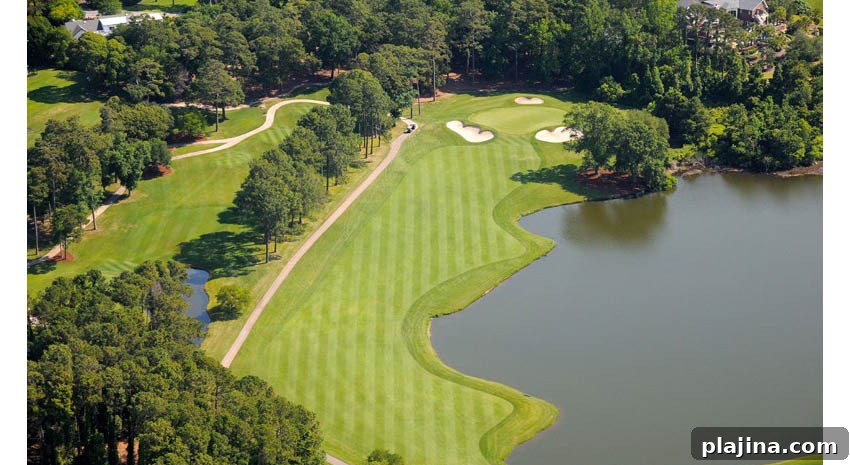
If you’re superstitious, beware hole 13. The Dunes’ signature hole demands a perfectly centered tee shot down the dogleg right around Lake Singleton—home to some very large alligators—and then a near-perfect second shot to cut the corner over water. Even conservative layups must carry a little water; ambitious golfers attempt to cut as much as possible to leave a short chip. The green features a large tier that runs from left front to back, and putting from the opposite side is nearly impossible. Neil was the wolf on this hole and passed on me for Wayne; my tee shot found the left fairway, but our second shots ended up in the lake. After drop-and-hit, Wayne and I scrambled to make it over and I carded a lucky seven to win the hole.
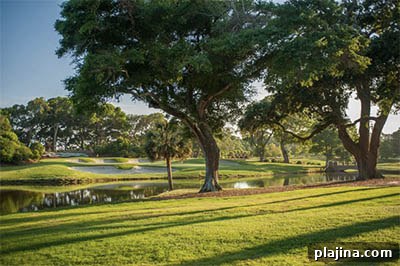
Hole 18 © THE DUNES GOLF & BEACH CLUB
HOLE 18 | 430 YARDS, PAR 4
The finishing hole delivers. The tee tends to push drives left, which is where John Kelley and I found ourselves—among trees and pine straw—while Wayne and Neil landed near the center of the fairway with near-professional tee shots. With nothing to lose, I ripped a shot that cleared the water in front of the green only to slam into the forward right bunker; the ball kicked out onto the fringe. Amid the sound of balls splashing and sand flying from other greenside bunkers, I hit a clutch putt for birdie to close out the round.
The Dunes Golf & Beach Club
9000 N. Ocean Blvd.
Myrtle Beach, SC 29572
tel 843 449 5236
dunesgolfandbeachclub.com