
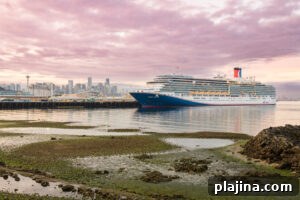
Seattle consistently ranks among the nation’s greenest cities. The city began mandating recycling as early as 2009 and has since expanded its environmental agenda to include renewable energy, bans on certain single-use items, and increased public electric vehicle charging infrastructure.
Those sustainability efforts extend to the Port of Seattle and its cruise terminals. In 2009 the city introduced shore power at Pier 91, enabling ships to turn off diesel engines while docked and connect to the municipal electrical grid. Shore power was later added to Pier 66 in October 2024, and as of the 2025 season every cruise ship berth in Seattle can access onshore electricity.
Shore power use has already produced measurable benefits. In 2025—the first season when shore power was available at all berths—68 percent of cruise calls plugged into shore power. That substitution avoided approximately 6,444 tonnes of CO2e and 1.74 tonnes of diesel particulate matter, according to Stephanie Jones Stebbins, managing director for Maritime at the Port of Seattle.
To put that in context, cruise ships typically remain at berth for eight to ten hours to disembark and embark passengers, resupply, and prepare for the next sailing. Historically, ships relied on onboard engines during this time, which generated greenhouse gases, air pollutants, and noise. Using shore power lets vessels run essential systems—lights, elevators, climate control—on cleaner grid electricity, including renewable sources where available.
Carnival Luminosa docked at Pier 91 © Iandewarphotography | Dreamstime.com
Seattle has also enacted a shore power mandate for homeported cruise ships: beginning with the 2027 season, all homeport vessels must plug into shore power while berthed at city piers. Seattle City Light, the municipal utility, estimates this requirement will cut diesel emissions by about 80 percent and reduce greenhouse gas emissions by roughly 66 percent for those vessels.
Port efforts go beyond shore power. In partnership with cruise lines and other ports, the Port of Seattle is studying ways to decarbonize Alaska-bound cruising. The aim is to have four sustainably powered ships operating in the Alaska corridor by 2032 and to develop the Pacific Northwest to Alaska Green Corridor, with an eventual goal of zero emissions by 2050.
As part of that strategy, the port is researching alternative fuels and demonstrations, including a biofuel project with Carnival Corporation. These pilot programs are intended to surface the technical, operational, and supply-chain challenges of replacing fossil fuels at scale—critical steps toward achieving near-zero emissions.
Most cruise lines calling on Seattle are taking steps to reduce their environmental footprint. Operators report improved voyage efficiency that lowers emissions, and many ships now use advanced wastewater treatment systems that exceed international standards to reduce impacts on marine ecosystems.
Additionally, cruise lines have largely phased out single-use plastics and increasingly source food responsibly, working with local suppliers and small growers when feasible. These initiatives complement the Port of Seattle’s broader sustainability objectives and support its ambition to be the greenest port in North America, according to Stebbins.
Stebbins emphasizes that sustainability matters to cruise passengers who travel from Seattle to Alaska’s remarkable natural landscapes. Minimizing environmental impacts helps preserve those places for future generations and aligns passenger expectations with responsible travel practices.
“How we care for our environment within a cruise context matters,” she said.
“Norwegian Bliss” docked at Pier 66 © David Johnson | Dreamstime.com
Seattle’s broader tourism infrastructure also reflects sustainability goals. Waterfront Park, opened in September 2025, spans roughly 20 acres, includes nearly 1,000 trees, and treats an estimated 7.5 million gallons of stormwater annually—approximately the volume of 15 Olympic-size swimming pools.
The Seattle Aquarium, located near Pier 66, is pursuing sustainability through a $170 million expansion designed to reduce freshwater and saltwater consumption and operate as a zero-waste facility. Tim Kuniholm, senior director of public relations and strategic partnerships at the aquarium, says the project will strengthen the institution’s ability to communicate why minimizing the impacts of cruising and port operations matters.
“The ocean is responsible for every breath we take,” Kuniholm noted. “Without the ocean, there is no us.”
SEATTLE SAILS
Nearly 300 cruises depart from Seattle during the April through October season, operating from two primary terminals: Pier 91 and Pier 66. Pier 91, the larger complex, offers two berths and serves as home port for Carnival Cruise Line, Celebrity Cruises, Holland America Line, Princess Cruises, Cunard and Royal Caribbean; Virgin Voyages and MSC Cruises planned to join Pier 91 in 2026.
Pier 66 has a single berth and hosts Norwegian Cruise Line and Oceania Cruises. Most sailings from Seattle last seven to ten days and head to Alaska, stopping at popular ports such as Ketchikan, Juneau, and Skagway. Some itineraries include calls in Victoria and Vancouver, British Columbia, while longer voyages may continue beyond Alaska to additional destinations.
For example, a September 2026, 40-night Cunard itinerary aboard Queen Elizabeth visits Alaska, then sails down the California coast to Mexico, transits the Panama Canal, and continues to Caribbean ports before ending in Miami. Other sailings originating in Seattle bypass Alaska for destinations like Hawai‘i, Japan, Australia, or New Zealand; with few exceptions, those longer itineraries are one-way and call at multiple countries.