
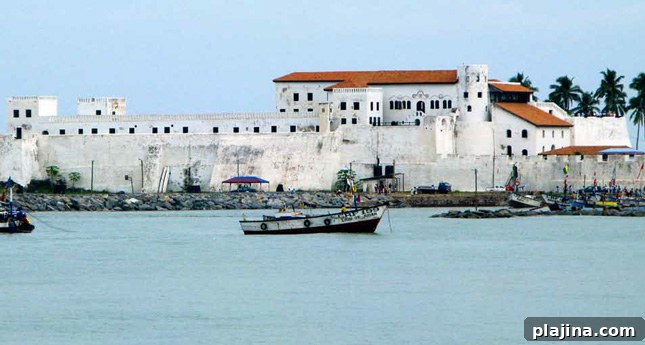
The echoes of history—both triumphant and tragic—resonate across Ghana. In the inland city of Kumasi, descendants of the Ashanti Kingdom uphold rich traditions with ceremony and pride. Along the coast, a line of whitewashed forts bears witness to a darker past: millions of enslaved Africans were held and shipped from these shores, and their descendants now live throughout the Americas and beyond.
Many visitors return to Ghana to trace family roots. At Elmina Castle, built by the Portuguese in 1482, I joined a group of African Americans whose visit felt more like a pilgrimage than a sightseeing trip. A knowledgeable local guide led us into the cool, humid dungeons where captives were branded, shackled and held before being forced onto ships. We then followed the path into the courtyard and through the rusted gate known as the “door of no return.”
Dungeon where slaves were held before boarding ships bound for the Americas © Demerzel21 | Dreamstime.com
Atlantic waves crashed against the rocks beneath the fort’s walls. Staring at the sharp horizon, it is impossible not to imagine the awful voyage that awaited those who passed through that door—many of whom did not survive the crossing.
Nearby Cape Coast, a short drive from Elmina, contains one of the largest and most imposing forts on the coast. Built by the Swedes and captured by the British in 1665, this fortress exported large numbers of enslaved people to the New World. Ghana’s collection of coastal forts and castles is now recognized as a UNESCO World Heritage site. Some stand in ruin, others have been restored; a few still serve official purposes—Christiansborg Castle in Accra, for example, is part of the government’s complex—while many operate as museums that confront visitors with a painful chapter in human history.
For more than three centuries, foreign powers referred to this region as the Slave Coast. After abolition in the early 19th century, exploitation shifted to natural resources and the area became known as the Gold Coast until Ghana gained independence.
Gold is one of the country’s natural riches, but not the only one. During colonial times cocoa and rubber trees introduced from the Americas thrived. Ghana remains a leading cocoa producer—responsible for roughly one-fifth of the world’s supply—so it’s quite possible the chocolate you enjoy contains Ghanaian cocoa.
Large swaths of indigenous rainforest were logged for hardwood, leaving only fragments of the original forest. These remaining forest reserves are major attractions. Kakum National Park, about three hours west of Accra, offers a compelling way to experience the West African rainforest in dense, verdant form.
While Kakum supports abundant wildlife, thick vegetation often limits sightings of larger mammals like elephants, buffalo and leopards. The park’s main attraction is the canopy walkway system—suspended bridges about 160 feet above the forest floor—where you can observe troops of colobus and Diana monkeys and a vibrant variety of tropical birds at eye level.
African elephants in Mole National Park © Marcin Bartosz Czarnoleski | Dreamstime.com
For more reliable wildlife viewing, head to Mole National Park in the north. Pronounced “Mo-lay,” Mole is about a six-hour drive from Kumasi. Accommodation near the park, such as small lodges on the boundary, can be basic but offer excellent wildlife experiences—some overlook busy waterholes where elephants and other animals often appear. Keep doors closed at night; local baboons are known to be cheeky opportunists.
Beyond historical sites and wildlife reserves, the true heart of Ghana is its dynamic urban life. Ghanaian cities are vibrant, loud and full of color. Daily schedules often flex around traffic and weather, so adopting a relaxed, go-with-the-flow attitude helps you enjoy city life here.
One of the most immersive urban experiences is Kejetia Market in Kumasi, a sprawling marketplace of some 11,000 stalls, where the mix of sights, sounds and scents offers an intense introduction to local life.
The Manhyia Palace Museum provides cultural context and calm in Kumasi. As the official seat of the Asantehene—the king of the Ashanti people—the museum displays royal artifacts and photographs that tell the story of the Ashanti Kingdom. When the king holds public audiences, the spectacle of traditional robes, drumming and ceremony is unforgettable.
Accra, Ghana’s capital, showcases the modern face of the nation. It was here the British flag was lowered and Ghana’s independence was declared. Black Star Square, facing the ocean, is the focal point of Independence Day festivities on March 6 each year. Nearby, the Kwame Nkrumah Memorial Park & Museum honors Ghana’s founding father with statues, fountains and exhibits that celebrate national history.
Kwame Nkrumah Memorial Park & Museum © Demerzel21 | Dreamstime.com
The Centre for National Culture, adjacent to the memorial park, is the best place to shop for authentic souvenirs. Popular items include djembe drums, Kente cloth, carved stools and masks, brass figures made with traditional lost-wax casting, and other handcrafted goods that reflect Ghana’s artistic heritage.
Ultimately, the most lasting souvenir from Ghana is the memory of the place itself. The country leaves a deep impression—on history, on culture, and on visitors’ views of the world.
Ghana Info to Go
International flights arrive at Kotoka International Airport, roughly six miles north of central Accra. Taxis into the city are inexpensive, though vehicles and comfort levels vary. Transfers by private limousine or airport shuttle are available at higher cost. Kumasi Airport currently handles daylight domestic flights while upgrades proceed to extend its operational hours and international capacity.
Where to Stay in Ghana
Golden Tulip Kumasi City, Kumasi Opened in 2008, Golden Tulip is a leading hotel in Kumasi set among tropical gardens. Rain Tree Street, Kumasi. $$$$
Kempinski Hotel Gold Coast City, Accra A prestigious modern hotel in downtown Accra featuring guestrooms with contemporary African design elements. Gamel Abdul Nasser Avenue, Accra. $$$$
Labadi Beach Hotel, Accra A seafront property with colonial touches and a convenient location near the International Trade Centre. 1 La Bypass, Accra. $$$$
Restaurants in Ghana
Country Kitchen, Accra A no-frills local favorite serving classic Ghanaian dishes such as fufu (mashed cassava), jollof rice and boiled yam. Second Ringway, Roberto Road, Accra. $$
Noble House, Kumasi A popular spot for Indian and Chinese cuisine in Kumasi, well-regarded by locals and visitors alike. Ahodow Roundabout, Kumasi. $$$
Sankofa Restaurant The flagship restaurant of a major Accra hotel, offering an eclectic menu of local and international dishes with fresh seafood options. Mövenpick Ambassador Hotel, Cantonments Ridge, Accra. $$$