
In Accra, Ghana, where public investment in recreational spaces is limited and green areas are rare, local design firm DeRoche Projects created a clay tennis court aimed at local youth, many of whom had never had the chance to play before. The court and its surroundings are intended for more than sport: they form a shared community space and a lush green example of how design can foster inclusivity, sustainability and social transformation.
The clay court marked DeRoche’s first use of a precast rammed earth system, an innovative approach developed by the firm. Since opening last year, the Backyard Community Club’s court has addressed questions of civic quality, environmental stewardship and cultural identity while serving the neighborhood.
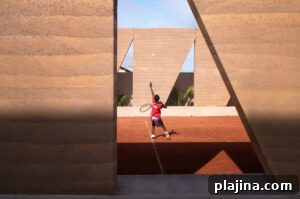
© Julien Lanoo
Located on a compact plot in the Osu neighborhood, the Backyard Community Club is more than a sports facility. In a short time it has become a youth hub where children and young adults learn tennis, cultivate gardens and receive mentorship. The project intentionally links sport with ecological practice, creating a public model that supports social exchange, environmental responsibility and sustainable resource use.
The lure of learning tennis, receiving a first racket and growing food in gardens beside the courts draws participants in. With those hands-on activities, the club effectively operates as an outdoor school: learning happens on the clay, along shaded walkways and among the planted beds where new practices and livelihoods are taking root.
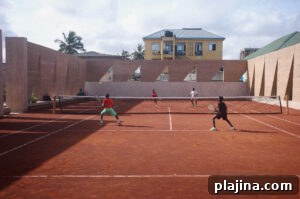
© Julien Lanoo
“The Backyard Community Club is about more than tennis; it’s about creating a platform for youth, mentorship and community,” said Glen DeRoche, architect and founder of DeRoche Projects. “For the clay court we developed a custom precast system that functions as both structure and expression, pushing construction toward the goal of a purpose-built community space. The architecture is deliberately open-ended, blurring the lines between sport, gathering, learning and rest. Education happens on the court, on the shaded walkways and in the vegetation where new life is emerging.”
Built to international standards, the clay court supports professional-level doubles play while offering young athletes under 18 a high-quality training environment. A shaded, built-in bench lets players and spectators observe, rest or review drills. Additional site features—changing rooms, shaded seating, outdoor prep areas and a barbecue area—were integrated to serve multiple uses. Showers are simply constructed and naturally lit, providing amenities often absent even in wealthier neighborhoods.
When not used for tennis, the green areas serve the community for exercise, vegetable exchanges and evening events. The site also attracts experienced players from other neighborhoods for adult tournaments and hosts sports education programs for youth groups.
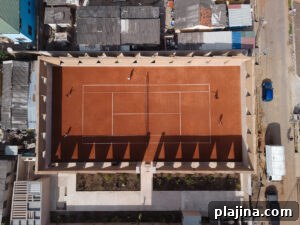
© Julien Lanoo
Backyard Community Club proposes an alternative to conventional sports facility design by favoring local materials, local know-how and social purpose. From the start, DeRoche Projects collaborated with local builders, athletes and educators, combining community input with technical advice on rammed earth construction.
Because clay courts require substantial water to maintain playability, the project uses a borehole and redirected stormwater runoff to irrigate the court and landscaped areas. This reduces demand on municipal water and supports drought-tolerant planting. Ancillary buildings are designed to function without air conditioning or mechanical extraction, relying on passive ventilation and ample daylight to minimize energy use and dependence on the grid.
Traditional rammed earth is slow, labor-intensive and weather-dependent, limiting its use at larger scales. DeRoche addressed these constraints through off-site precasting, improving quality control, achieving tighter structural tolerances and allowing parallel workflows between site preparation and panel production.
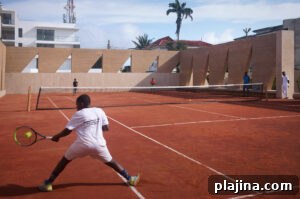
© Julien Lanoo
The outcome is a modular, climate-responsive and replicable system adapted to Ghanaian transport, labor and climate conditions. More than a construction technique, it represents a framework for building from the ground up using locally sourced materials.
By deploying precast rammed earth modules at this scale, Backyard Community Club demonstrates how material-driven design can promote sustainable urban life while preserving cultural identity and environmental values. The project offers a practical model for future community-focused developments in Accra and beyond.
The city of Accra and the Osu neighborhood are lively, colorful destinations with many shops, restaurants, galleries and music venues. For visitors to Ghana, a visit to the Backyard Community Club provides a chance to see a welcoming community of youth and adults engaged in sport, learning and cultivation.