
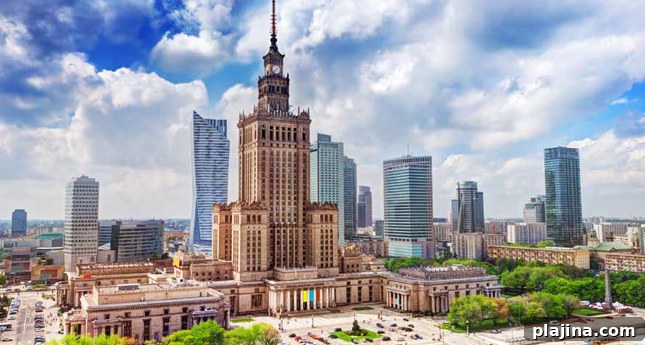
“Before World War II, Warsaw was considered more beautiful than Prague or Budapest,” said Joanna Maria Olejek, a translator who lives in the heart of the city. But the arrival of the Nazis changed that: they destroyed roughly 85 percent of Warsaw, targeting its most important cultural landmarks. Afterward, Stalin’s regime imposed a uniform communist aesthetic on the rebuilding effort. The city’s horizon of multi-storied apartment blocks and functional high-rises suggests a skyline that has been shaped more by necessity than by drama.
Visiting with my brother Jim last April, after he screened his latest film at a festival, I discovered that Warsaw’s true vitality is found on the streets. Stylish restaurants and bars attract a growing number of international visitors and business travelers. New property developments are everywhere; cranes punctuate the skyline above high-rise condos and office buildings, some designed by renowned architects. Importantly for travelers, Poland still uses the zloty, so Warsaw remains significantly more affordable for Americans than many Eurozone capitals.
When the Iron Curtain fell in 1989, analysts favored Hungary and Czechoslovakia to rebound fastest from communism. Poland, often grouped with riskier markets, surprised many by making strategic moves—joining the European Union in 2004 and deepening trade ties with Germany. The results speak for themselves: Poland’s economy is now several times larger than neighboring Ukraine’s and it was one of the few major European economies to avoid recession during recent financial crises.
At the Warsaw Uprising Museum, Jim and I traced the sites Hitler’s forces destroyed in the summer of 1944. Polish resistance fighters rose up as German forces were retreating and the Soviet Red Army loomed nearby. The uprising lasted weeks and cost many civilian lives. The Red Army did not intervene decisively, and Hitler responded by ordering the systematic destruction of Warsaw’s cultural treasures, demolishing palaces, churches and public buildings.
POLIN Museum of the History of Polish Jews © Jacek Kadaj | Dreamstime.com
By 1944 the horrors of Nazi persecution had already devastated Warsaw’s Jewish population. The Warsaw Ghetto saw widespread starvation, deportations and mass murder; of some 380,000 Jews confined there, very few survived. The Ghetto Uprising that followed featured roughly 750 Jewish fighters who resisted for a month. Today the POLIN Museum of the History of Polish Jews stands in that area. Opened in 2013, POLIN focuses on the long history of Jewish life in Poland rather than dwelling solely on the Holocaust. It tells a millennium-long story of communities that once spoke Yiddish and contributed richly to Polish culture. Before World War II, about 3.3 million Jews lived in Poland; today the community, though much smaller, is slowly rebuilding.
The pre-war Nozyk Synagogue still stands in Grzybowski Square and was renovated with help from donors including Ronald Lauder. It remains an active synagogue and an important part of Jewish life in Warsaw. Nearby is a Yiddish theater and Prózna Street, where a surviving tenement facade—used as a backdrop in Roman Polanski’s film The Pianist—recalls the city’s wartime ruins.
Warsaw’s citizens have worked to reconstruct the city and revive its historical identity. The Royal Castle, reconstructed and reopened in 1984, recalls the residence of Poland’s monarchy from the 14th to the 19th centuries. Its restored chambers display tapestries, chandeliers and portraits of former monarchs; the Lanckoroński Collection includes two works attributed to Rembrandt.
The Old Town was carefully rebuilt in the 1980s with a cobblestone square and narrow lanes that evoke the 17th century. The painted merchant houses lining the square are a faithful recreation, and the area invites visitors to linger over local beer or a glass of krupnik, a honey-flavored vodka. Because of the meticulous reconstruction, Warsaw’s Old Town is a UNESCO World Heritage site.
Castle Square in the Old Town © Scanrail | Dreamstime.com
For boutique shopping, walk along Mokotowska Street, where you’ll find glassware, amber, jewelry and hand-embroidered linens. Note that many shops close on Sundays. Recommended stops include Lilou for designer jewelry and Maciej Zień for home goods and linens.
For a casual, authentic lunch we discovered Karmnik, a favorite for both locals and visitors. The menu features traditional Polish comfort dishes—pierogies, herring in oil, potato pancakes and stuffed cabbage in a tomato-cream sauce that evokes family recipes. For a more upscale experience, Atelier Amaro, Warsaw’s first Michelin-starred restaurant, serves inventive Polish cuisine; reservations are essential. Expect creative dishes and tasting menus that spotlight modern interpretations of local ingredients. After dinner, try a tatanka—apple juice mixed with Żubrówka vodka—and head to Foksal XVIII for an energetic night out.
Łazienki Park © Zheimo | Dreamstime.com
When the weather warms, spend an afternoon in Łazienki Park, Warsaw’s largest green space. Stroll wide tree-lined avenues, picnic beneath willows and enjoy free Sunday Chopin concerts near his monument from mid-May through September. Listening to Chopin in the park underscores a simple truth: despite enduring some of humanity’s darkest chapters, Warsaw has rebuilt, reclaimed its culture and become a vibrant, cosmopolitan capital in Eastern Europe.
Warsaw Info to Go
International flights arrive at Frédéric Chopin Airport, approximately six miles from the city center, with convenient connections by train, bus or taxi. A rail link connects Terminal A’s station with the city; a new bus terminal serves arrivals as well. Licensed taxis wait outside the terminal; a ride to the center typically costs around $11. Trains also connect Warsaw with major European cities.
Where to Stay in Warsaw
Hotel Bristol Centrally located along the Royal Route, this Art Deco hotel offers elegant interiors and historic charm. Originally opened in 1901, it now belongs to a luxury hotel collection. Krakowskie Przedmiescie 42/44
InterContinental Warsaw Rising 43 floors above the city, the InterContinental features a top-floor pool, a popular restaurant and spacious rooms. Emilii Plater 49
Warsaw Marriott Hotel Located opposite the main train station, this large hotel includes fitness facilities popular with both guests and locals, an Olympic-sized pool and comprehensive gym equipment. Aleje Jerozolimskie 65/79
Restaurants in Warsaw
Atelier Amaro A tasting-menu restaurant offering contemporary Polish dishes. Agrykola 1
Karmnik A cozy Old Town spot known for hearty Polish fare and a friendly atmosphere. Piwna 4A
Restaurant Stary Dom Warm, wood-accented interiors and classic Polish comfort food make this a reliable choice for a chilly evening. Pulawska 104/106