
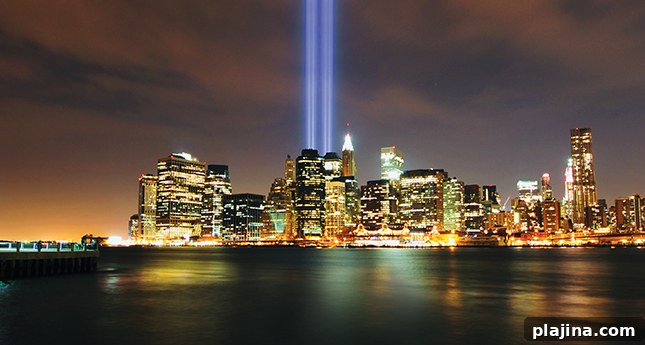
9/11 Memorials
On that infamous Tuesday when nearly 3,000 lives were taken and the nation was plunged into grief, recovery felt distant. Yet while September 11th shattered a sense of safety, it could not erase the resilience of the American spirit. A decade later, memorials across the country stand as testament to that resilience and as places for remembrance: we will heal, but we will never forget.
Shanksville, Pennsylvania, is a small, quiet town with a population of 245 and roots reaching back to 1798. For centuries its daily life remained largely untouched by national events. That changed dramatically on Sept. 11, 2001, when United Airlines Flight 93—carrying 40 passengers and crew and four hijackers—crashed into a field near the town at 10:03 a.m. Unlike the other hijacked planes that morning, Flight 93 never reached its presumed target because the passengers fought back. Their phone calls to loved ones recorded their courage: “We’re going to fight back,” “We’re going to take control,” “It’s up to us.” Sounds of struggle and then silence followed.
The crash site, now called Sacred Ground, honors those who sacrificed themselves. After a design competition that drew about 1,000 entries, a winner was chosen and construction began. Phase 1, including the memorial plaza and a Wall of Names, was dedicated in September of the tenth anniversary year. Plans include a Tower of Voices—93 feet tall—housing 40 wind chimes to represent the 40 voices heard on the plane, and a series of 40 grove plantings lining the path to the Sacred Ground.
On the anniversary eve there are musical tributes and wreath-laying. At dusk candles are lit for every victim. On Sept. 11 a memorial service traditionally begins at 9:30 a.m., marking the moment the passengers began their resistance; at 10:03 a.m. the Bells of Remembrance ring as each name is read aloud. “A common field one day,” reads the memorial’s mission statement, “a field of honor forever.”
At nearly the same time Flight 93 passengers were resisting, American Airlines Flight 77 was flown into the Pentagon in Arlington County, Virginia. The impact at 9:37 a.m. tore through the building’s outer rings, ignited massive fires and caused a partial collapse. Fifty-nine passengers and crew and 125 people inside the Pentagon lost their lives.
By September of the following year, repairs had been completed and the America’s Heroes memorial opened, featuring photographs, biographies, a wall etched with names and a tribute panel. A larger Pentagon Memorial, completed in 2008, spans nearly two acres and honors the 184 victims with 184 illuminated benches arranged by age—from a three-year-old child to a 71-year-old man. The benches facing the Pentagon mark victims who were working in the building; benches oriented toward the sky mark passengers and crew on the plane. A wall along the memorial rises from three inches to 71 inches, echoing the age range of those commemorated.
The Pentagon observes an invitation-only ceremony for families, and afterward the memorial reopens to the public. At 9:37 a.m., a countywide moment of silence marks the moment of impact.
In New York City, the morning began with American Airlines Flight 11 hitting the North Tower at 8:46 a.m., followed by United Airlines Flight 175 striking the South Tower at 9:03 a.m. Fires engulfed floors and trapped occupants above the impact zones; rooftop exits were inaccessible. Companies such as Cantor Fitzgerald and Marsh lost hundreds of employees. Faced with unbearable choices, many victims were forced into tragic decisions. Within hours both towers collapsed, along with a third building, causing catastrophic loss: over 2,000 people killed, including 343 firefighters and dozens of police officers, and 16 acres of smoldering rubble.
Architect Michael Arad, who witnessed the attacks from Manhattan and spent sleepless nights walking the city, entered the design competition for a memorial at Ground Zero. In 2004 his proposal, named Reflecting Absence, was chosen from more than 5,000 entries. Arad’s concept emphasizes absence and the boundary between life and loss. The design centers on two vast square reflecting pools set within the footprints of the original towers. Each pool—about an acre in size and 30 feet deep—features 30-foot waterfalls on all sides, creating North America’s largest manmade waterfalls. The cascading water begins as countless strands and merges mid-fall into a single curtain.
At the base of each pool is a square void, a visible absence that cannot be fully perceived from above. Arad described the void as “an abyss,” a representation of the persistent emptiness left by those lost. Bronze panels surrounding the pools carry the names of all victims from that day and those who died in the 1993 World Trade Center attack. Instead of a simple list, names occupy individualized islands of space—some letters etched, others raised—and are grouped according to relationships requested by victims’ families: colleagues, friends and loved ones, including those who were aboard the planes.
Memorial Plaza contains more than 400 trees planted in an irregular pattern to evoke a forest. Among them stands the Survivor Tree, a pear tree recovered from the rubble badly burned and later nursed back to health; once eight feet tall after the disaster, it now soars to around 30 feet and serves as a symbol of resilience.
While the memorial provides quiet reflection, the larger World Trade Center site has become a hub of renewal and activity. The 9/11 Memorial Museum, with a substantial underground footprint, was planned to open alongside the memorial. New construction includes office towers, a performing arts center and a transit hub. The tallest tower planned—Freedom Tower—was designed to rise to 1,776 feet, symbolically surpassing the fallen buildings and embodying renewal.
The memorial opened to the public after its dedication, with controlled access during ongoing construction. Early predictions that lower Manhattan would never recover proved premature: in the decade following 9/11 the neighborhood saw hotels, restaurants, shops, galleries and cultural venues return, supported by substantial investment and renewed civic life.
Beyond the three main crash sites, many communities created memorials where victims lived. In Bucks County, Pennsylvania, where 18 residents died, families and local volunteers established the Garden of Reflection in a donated four-acre section of a 62-acre park. A large steel fragment from the World Trade Center marks the path to the garden. Within, glass panels etch the names of all 2,973 victims along a Remembrance Walk; county victims’ names appear on hand-cast glass overlooking a circular pool with twin fountains and two square voids symbolizing the Twin Towers. Nine red maples commemorate each lost resident of the township, oak rows signify endurance, and a spiral walk features 42 lights representing children who lost a parent in Pennsylvania. The memorial’s theme is “After darkness … light.”
From New Jersey’s Liberty State Park, visitors face a direct view across the Hudson to Lower Manhattan. New Jersey lost 746 residents on 9/11, second only to New York. The state’s memorial, Empty Sky, consists of two parallel walls matching the width of the fallen towers, with victims’ names etched on the brushed stainless steel interiors. Walking the path between these walls brings visitors to the view of Manhattan, now changed but still a place of reflection and remembrance.
Flight 93 National Memorial — www.nps.gov/flni
Pentagon Memorial — www.whs.mil/memorial
9/11 Memorial, WTC Site — www.911memorial.org
Bucks County Garden of Reflection 9-11 Memorial — www.9-11memorialgarden.org
New Jersey 9/11 Memorial Foundation — www.nj911memorial.org
Downtown Alliance — www.downtownny.com