
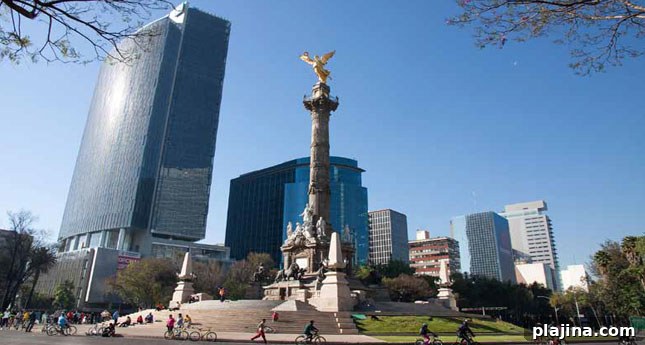
Although Mexico City is only a few hours by plane from many parts of the United States, it remains unfamiliar to many Americans because of outdated impressions. While the city did experience serious security problems in the 1990s, its homicide rate today is lower than that of Washington, D.C. Air quality has improved significantly since those years of heavy pollution; the skies are blue much of the time, public transport has been modernized with electric buses, and classic VW Beetle taxis no longer dominate the streets.
In recent years Mexico City has undergone visible and sustained improvements. The historic center has been repeatedly cleaned and restored, Alameda Park received a complete renovation, and new private developments have refreshed the urban landscape. The city committed $23 million this year to upgrade sidewalks and prioritize pedestrians, and the popular free bike-share program has expanded alongside newly built cycling lanes. On Sundays thousands of residents and visitors take advantage of streets closed to motor traffic for long rides and family outings.
Today it is accurate to call the Federal District one of the world’s great urban travel destinations. The city offers attractions many other destinations cannot match, including four UNESCO World Heritage sites and a vibrant cultural life. Its food scene is exceptional across the board, from street tacos and neighborhood markets to innovative fine-dining restaurants that appear on international best-of lists.
Mexico City is also highly connected by air, making it attractive for meeting planners and leisure travelers alike. Benito Juárez International Airport handles hundreds of daily flights from roughly two dozen airlines, and a convenient monorail links the terminals. Passenger traffic has increased steadily, with well over a million travelers passing through each month. The airport sits just a short drive from the city center, and official prepaid taxis offer quick transfers to most hotels for about $20 or less.
Three major convention centers draw large events to the capital. Centro Banamex provides more than 100,000 square feet of exhibition and meeting space across 25 rooms and a large hall. The International Convention Center at the World Trade Center adds roughly 65,000 square feet, and Expo Bancomer in the suburban Santa Fe district contributes approximately 60,000 square feet in a modern business park that resembles Silicon Valley more than a colonial-era neighborhood.
Hotel capacity in Mexico City is substantial and expanding, with numerous international brands alongside strong domestic chains such as Fiesta Americana and Camino Real. Many hotels are clustered along the corridor between Alameda Park and Polanco, close to museums, parks and top restaurants. A second hotel cluster sits in the Santa Fe office park outside the central city.
Camino Real Polanco Mexico has been a local landmark since 1968 and has appeared in films such as The Matador. The property features 712 guestrooms, extensive outdoor event spaces with pools and gardens, 23 meeting rooms and a ballroom that can accommodate about 1,700 guests.
A Sheraton Maria Isabel Hotel & Towers meeting room © Sheraton Hotels & Resorts
The Presidente InterContinental Mexico City, overlooking Chapultepec Park, offers 661 guestrooms and 19 meeting rooms. Hyatt Regency Mexico City, on the Polanco edge of Chapultepec, matches the Sheraton as one of the city’s largest hotels by room count with 755 guestrooms and more than 28,000 square feet of event space across 16 meeting rooms. The Sheraton Maria Isabel Hotel & Towers stands on Paseo de la Reforma near the U.S. Embassy and corporate offices, with 755 guestrooms, 29 meeting rooms and a ballroom seating up to 1,500.
Hilton Mexico City Reforma features a two-level convention center totaling about 45,000 square feet of meeting space, including a ballroom for 1,500 attendees. The 458-room hotel sits just a few miles from the airport at the entrance to the historic center on Paseo de la Reforma, making it a convenient choice for business and conference travelers.
Mexico City has more museums than any other city in the Americas, and the museum scene continues to grow. A notable recent addition is a contemporary art museum established by Eugenio López of the Jumex family in a building designed by architect David Chipperfield. The museum keeps admission affordable to encourage broad access.
The country’s largest aquarium, Aquarium Inbursa, opened recently as a new family attraction. Backed by investor Carlos Slim Helú, the multi-level aquarium houses thousands of marine animals in well-designed galleries featuring sharks, piranhas, sea turtles, jellyfish and rays, with plans to expand further. It sits near other popular cultural destinations, adding to the concentration of arts and leisure options in the area.
Since taking office in 2012, Mayor Miguel Ángel Mancera has prioritized tourism promotion, and the effort has produced measurable results. Visitor numbers rose substantially, with a notable share coming from the United States. The city markets its culinary and cultural offerings widely and also reaches out to visitors with Mexican roots living abroad.
Many tourists are pleasantly surprised by how accessible Mexico City feels on the ground. Although the wider metropolitan area includes roughly 21 million people, the population inside the city’s formal limits is closer to 9 million, comparable to cities such as London. The neighborhoods most travelers explore—centered around Alameda, Chapultepec and Polanco—are compact and easy to navigate, resembling Manhattan’s walkable scale more than the vast complexity of Tokyo.