
In spring, when Seoul finally sheds the grip of its long, harsh winter, many of the city’s roughly 10 million residents take to the extensive hiking and biking trails that wind through nearby hills and mountains or run alongside the Han River. These level riverside paths are especially popular with families and casual cyclists.
In earlier decades, Seoul’s outdoor culture coincided with poor air and water quality. As South Korea industrialized and urbanized rapidly in the 1960s and 1970s, millions migrated to Seoul and vehicle ownership and factory emissions rose sharply. Like many fast-growing Asian cities, Seoul suffered from congested streets, smoky diesel vehicles and inadequate wastewater treatment, producing air and water conditions that were harmful to public health.
Today, Seoul’s environment is markedly different. The city has become one of the world’s leading “green” cities after years of concerted public and private efforts to reverse environmental decline. The municipal government and major Korean technology companies have implemented policies and infrastructure projects that transformed much of the city’s concrete landscape into cleaner, quieter and greener urban space.
That transformation required sustained effort. During the country’s rapid economic rise, expanding car ownership and industrial activity created persistent pollution challenges. For example, car ownership grew significantly in the early 2000s, contributing to traffic congestion and emissions; in 2005 South Korea ranked among the world’s larger greenhouse gas emitters. Addressing these problems became a priority for Seoul’s leadership.
Under Mayor Oh Se-hoon, the Seoul Metropolitan Government pursued an ambitious program to improve air and water quality and confront climate change. Using public funds and private partnerships, the city recorded notable improvements: by late 2010 Seoul reported its highest air-quality measurements since monitoring began in 1995. Measures included reduced fares on the extensive subway and bus network, expansion plans for commuter rail lines, and a sweeping conversion of public vehicles to cleaner fuels. In 2008, Seoul’s taxi fleet was converted to liquefied petroleum gas; by 2010 most city buses had been switched from diesel to compressed natural gas, and Seoul became the first city to place full-size electric buses into commercial service on a regular route. These steps formed part of the SMG’s “Clean and Green Seoul” program, one of the municipality’s core initiatives.
Seoul is a key player in South Korea’s “Master Plan for Low Carbon Green Growth,” a national initiative extending to 2030. The city aims for an entirely eco-friendly public transport fleet composed of high-efficiency hybrid and electric vehicles, supported by an extensive network of charging stations. Korean companies are also active in developing electric vehicle technologies, and the city has pursued international collaboration on deploying these vehicles abroad.
Beyond transportation, Seoul’s green agenda covers a broad range of targets: cutting energy consumption and greenhouse gas emissions; creating green jobs in industries like hydrogen fuel cells, solar technology and waste management; retrofitting large buildings to meet green standards; adding dedicated bike lanes to encourage cycling; replacing conventional streetlights with energy-efficient LEDs; expanding high-speed rail services; and increasing research investment in advanced technologies such as nanotechnology and biotechnology.
Air pollution once regularly choked the city. Industrial expansion, vehicle emissions, lax early regulation and transboundary pollution combined to create frequent smog and high levels of particulate matter. By the early 2000s, measured concentrations of fine particulates were alarmingly high and clean-air days were limited.
Programs introduced to reduce vehicle use and promote cleaner modes of transport delivered measurable benefits. A 2006 initiative letting drivers choose days to forgo downtown driving, with incentives such as parking and toll discounts on days they do drive, attracted significant participation. As a result of comprehensive policies, particulate levels fell and the number of clean-air days rose substantially.
Seoul’s river and stream projects are among its most visible environmental successes. The Hangang (Han River), which flows through the city, and the much shorter Cheonggyecheon stream have undergone extensive restoration, reshaping how residents interact with urban waterways.
The long-term Hangang Renaissance, launched in 2007, focuses on restoring water quality and riverside ecosystems while creating public amenities. New riverside parks, fountains and expanded bicycle and jogging paths have revitalized the riverfront. Improved wastewater treatment and stricter enforcement against illegal dumping have allowed fish and plant life to return: freshwater species now thrive, observation platforms let visitors watch fish migrate, and recreational activities such as boating and water sports are common sights.
Along stretches of riverbank, restored wetlands, willow groves and reed beds provide habitat for birds, insects and amphibians. Native aquatic plants have been reintroduced and invasive species controlled, producing richer biodiversity. Signs of water-quality improvement in upstream reservoirs have encouraged optimism: species that require clean water have reappeared, indicating meaningful progress in watershed health.
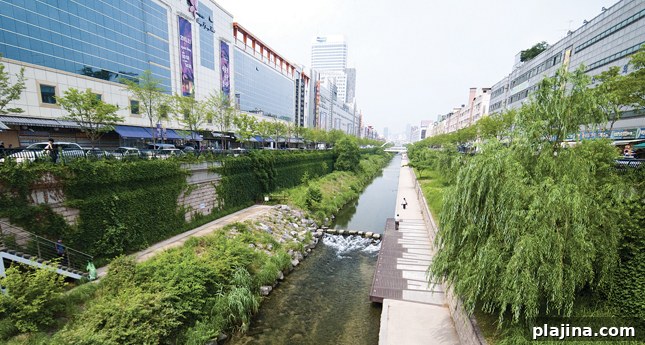
The Cheonggyecheon restoration is an especially striking example of urban renewal. A historic downtown stream that had been paved over and capped by an elevated roadway during mid-20th-century redevelopment, Cheonggyecheon returned to daylight in a major project completed in 2005. Removing the elevated highway and restoring the stream not only created a linear park with walking paths, native plantings and sculpted bridges, but also helped cool downtown temperatures and reduce vehicle-related pollution in adjacent neighborhoods.
The restored Cheonggyecheon uses an innovative system of pumps and gates to maintain clean flowing water. Along its banks, carefully designed seating, lighting and landscaping create a pleasant urban refuge. Some reconstructed 19th-century stone bridges add historical character, while new pedestrian and vehicular crossings provide modern, sculptural focal points. At night, illuminated bridges and features create a striking urban landscape.
Since co-hosting the 2002 FIFA World Cup, Seoul’s urban design and architecture have increasingly embraced sustainable and aesthetic principles. New green buildings, public spaces and landscape projects helped Seoul earn recognition as World Design Capital in 2010. While challenges remain, the combined impact of improved air and water quality, expanded green public spaces and cleaner transportation networks has reshaped the city. Today, walking or cycling along Han River trails under clear skies and rows of newly planted ginkgo trees offers an unmistakable sense that Seoul has become cleaner, greener and more livable.