
Catching my first glimpse of Palawan from the air, I understood why the province calls itself the “Last Ecological Frontier” of the Philippines. The long, narrow, jungle-clad island appears primeval, jutting from the Sulu Sea with a mist-shrouded mountainous spine and waterfalls cutting through the slopes. Even from 23,000 feet, the main island and its surrounding islets look immense. The archipelago stretches roughly 280 miles from the Mindoro Strait down toward Borneo, a chain of emerald islands fringed by vivid coral reefs.
Only about an hour’s flight from Manila, I landed in hot, humid Puerto Princesa, Palawan’s largest town with roughly 250,000 residents. The town is surprisingly tidy considering it is carved out of dense jungle. Main streets bustle with scooters, vendors and small markets, and a modest selection of hotels and restaurants. Puerto Princesa mainly functions as a gateway to the activities Palawan is known for — diving, boating, nature hikes and leisurely island time.
My first stop was offshore at Dos Palmas Island Resort, a one-hour boat ride across the glassy Hondo Bay. En route, a resort staff member explained the island’s conservation mindset. “In Palawan, we have a love affair with nature and are very strict about maintaining our ecological values,” he said. That commitment is evident in policies like the 1992 logging ban, adopted not because logging lost profitability but to protect the island’s reputation as an eco-destination. The same ethos is visible in Puerto Princesa: Operation Cleanliness and strict anti-litter laws have earned the city international recognition for cleanliness. Repeat littering offenses carry heavy fines and penalties, which locals cite as a reason the streets stay clean.
Palawan’s modern sensibilities contrast with its rugged past. With a coastline stretching about 1,200 miles between the South China Sea and the Sulu Sea, the island sat along historic Chinese and Spanish trade routes, was once a refuge for pirates, and witnessed violence during World War II. It was once famed for old-growth hardwoods like mahogany, narra and amagong—woods that were aggressively harvested for furniture-making. Those natural riches, together with abundant fisheries, attracted migrants from across Asia and produced a cultural mosaic that today includes 81 ethnic groups. Several indigenous communities remain, such as the Tau’t Bato, who live in caves in remote southern Palawan. Parts of the island feel more akin to nearby Borneo than the Philippine mainland, and some isolated groups were not encountered by outsiders until recent decades.
My stay at Dos Palmas was comfortable rather than rugged. The small private island is one of thirteen in the bay and among the most luxurious, featuring modern cottages and overwater suites with ample amenities and air conditioning. Off-grid realities have inspired island innovations: a designated Dos Palmas Eco Zone supports sustainability programs, organic gardens and on-site facilities that generate power and potable water. I enjoyed strolling through coconut groves, swimming in a freshwater pool, and relaxing at the outdoor bar.
I also visited the resort’s dive shop and explored shallow reefs five minutes by boat from the pier. Visibility exceeded 120 feet, so clear it felt like swimming through air. I encountered stingrays, seahorses, tuna and a kaleidoscope of reef fish amid vibrant corals — an underwater safari. A memorable site was Helen’s Gardens, named for a local woman who helped convince fishermen to protect the reefs.
As travel brochures promise, there is a strong sense of frontier in Palawan. Covering about 6,575 square miles with some 1,780 islands, it is the Philippines’ largest province by area and the least densely populated, with roughly 641,000 people. Guidebooks commonly describe Palawan as thinly populated, with hundreds of uninhabited islands and few roads or services, and those descriptions are borne out in many areas.
I tested that reputation when I set off with a private driver on a long overland crossing to the Bacuit Archipelago and the El Nido Marine Reserve in the north. But first I visited Palawan’s signature attraction: the Puerto Princesa Subterranean River, a UNESCO World Heritage Site.
The most dramatic part of that trip is not the river itself but the 20-minute ocean crossing from Sabang across a choppy patch of the South China Sea. I joined a small banca — a dugout with bamboo outriggers and a loud engine — and negotiated waves that recalled cinematic ocean scenes. The mouth of the limestone cavern appears tranquil, more like a lagoon than an entrance to an underground river. Inside, however, the river reveals formations sculpted over millennia. Our flotilla traveled about three river miles beneath soaring caverns while bats swooped overhead and our guide pointed out rock formations that resembled natural gargoyles. At the farthest point we switched off lights and experienced total darkness, feeling water drip and hearing bat echoes — an eerie but spectacular scene, like a real-life Jules Verne adventure.
From Sabang I continued through the day and night to reach El Nido village. The drive was an adventure: potholed roads, puddles, ravines and small landslides negotiated beneath a canopy of rainforest interrupted periodically by towering white limestone cliffs. Rice paddies and water buffalo appeared in clearings, and small hamlets revealed children playing and families busy with daily tasks. At night the landscape became an inkwell punctuated by the warm glow of cooking fires and lantern light from thatched homes, giving a sense of timelessness.
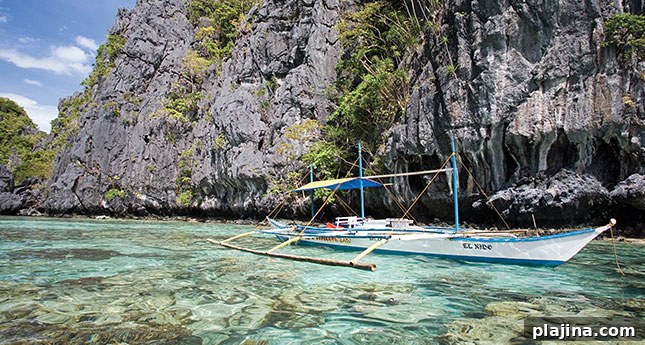
Bacuit Bay and El Nido’s islands are among the Philippines’ most spectacular scenes. Limestone cliffs crown many islands, which offer white-sand beaches, leaning coconut palms and brilliantly blue waters. The sleepy village of El Nido serves as the launch point for exploring the protected marine reserve, where I spent several days diving, kayaking, beachcombing and enjoying the comforts of El Nido Resort on Miniloc Island.
Water defines the El Nido experience. I logged numerous dives around nearby islets, but the scenery is accessible to non-divers, too. From the resort pier, snorkelers can feed schools of fish that create dazzling surface activity. Relaxation options abound — beaches, spa treatments and plentiful food — yet my favorite excursion was a half-day sea kayaking trip to the famed Big Lagoon and Small Lagoon.
These two lagoons are among the Philippines’ most photographed natural spots: vast turquoise basins encircled by sheer cliffs covered in lush vegetation and home to birds and monkeys. Paddling across shimmering waters of green and blue, I watched rainbow-hued fish dart below while long-tailed macaques and hornbills called from the cliffs above. The combination of dramatic landscape, clear water and abundant wildlife made it easy to appreciate why Palawan carries its ecological reputation.
As we paddled, my guide reflected on the island’s conservation efforts. “You can see why Palawan is called the ‘Last Ecological Frontier’ of the Philippines,” he said. I could only agree.
Info To Go
Guided adventure operators offer a range of Palawan itineraries, including multi-day snorkeling and kayaking trips and shorter packages that include the Subterranean River and Puerto Princesa. Travelers should book through reputable providers and confirm details, pricing and connections from Manila when planning a visit.