
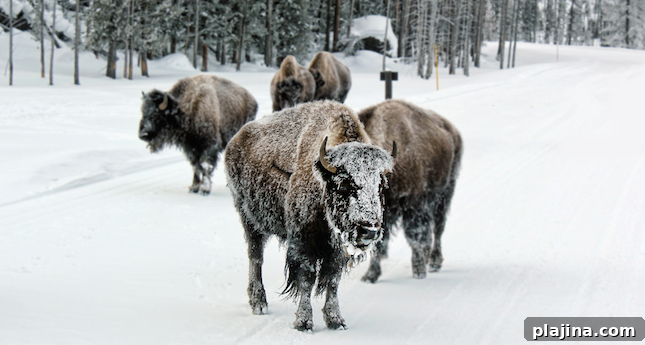
Ghost trees, mirrored sheets of ice and bright yellow monkey flowers — these extraordinary winter sights are real, and Yellowstone National Park is one of the best places to witness them. In the park’s geothermal areas, steaming hydrothermal mist freezes on branches and trunks, creating ghostly rime-coated trees. Near hot springs, hardy monkey flowers can bloom even in deep winter, their vivid petals contrasting with snow and steam. Herds of bison often develop icy beards as snow and spray cling to their fur, and once-refrozen lake and pool surfaces can become so smooth they act like mirrors, reflecting distant ridgelines and sky.
Yellowstone’s winter environment produces other unusual phenomena as well. When superheated water erupts into subzero air, some droplets instantly crystallize and fall as fine ice pellets — a spectacle sometimes described as “geyser rain.” Strong winds sculpt drifting snow into naturally formed sculptures that shift and change with each storm. These fleeting, otherworldly features are best experienced up close on guided outings: knowledgeable winter guides lead snowshoeing and cross-country skiing treks that explore geothermal basins, frozen waterfalls and quiet, snowbound valleys. For those who prefer a warmer option, full- and half-day tours are available aboard heated snow coaches, offering comfortable access to prime viewing areas.
When choosing where to stay, consider the park’s historic winter lodges. Old Faithful Snow Lodge & Cabins provides convenient access to geyser basins and winter trails, while Mammoth Hot Springs & Cabins offers a base near terraced hot springs and the northern park roads. Both properties combine rustic charm with modern amenities suitable for cold-weather visits.
Plan any winter trip with safety and seasonal conditions in mind. Weather and road closures are common; guided trips provide expertise on safe routes and how to appreciate geothermal features without risking exposure to scalding water or unstable ground. Dress in layers, bring traction and cold-weather gear, and allow extra travel time when navigating snow-covered roads.
In winter, Yellowstone’s contrasts — steam against blue sky, bright wildflowers against white drifts, and animal life adapted to harsh conditions — create a landscape that feels at once fragile and elemental. Whether you explore on foot, ski or by snow coach, the park’s unexpected seasonal wonders make a winter visit both memorable and uniquely beautiful.