
From the window of the seven-passenger charter plane, I can see only a narrow ribbon of tarmac surrounded by untamed wilderness. There is no terminal, not even a shelter.
“If no one’s here to meet me, you won’t just leave me, will you?” I ask the pilot, my voice revealing my unease at the thought of being left in the blazing midday South African sun in a landscape full of predators. Weeks earlier Marcia Gordon of Extraordinary Journeys, specialists in luxury bespoke African safaris, had reassured me: “You’ll be fine. You’re going to have the experience of a lifetime.” Now, as the plane descends, doubts creep in about what that lifetime experience might entail.
“I spotted your transport on landing,” the pilot replies. I let out a relieved breath, step off the plane and into &Beyond Ngala, a 37,100-acre unfenced private reserve within Kruger National Park. The air is heavy with unfamiliar scents, and what strikes me most is the quiet. Except for a welcome breeze and the occasional bird call, the landscape is blessedly—if eerily—silent.
My destination is Ngala’s Tented Camp, a main lodge and a handful of cabins lining the seasonal, currently dry Timbavati River. Don’t be misled by the term “tented camp.” My cabin, one of only six (soon to be nine), feels like a five-star hotel room, albeit with screened canvas walls and a canvas roof. The mostly open-air main lodge is equally refined, with comfortable seating by a fireplace and woodstoves to warm the dining area on cooler nights. It’s sophisticated, yet unmistakably wild. By day I share the camp with roaming warthogs, thieving vervet monkeys and shy impalas; at night predators prowl and the silence is broken by their chases and calls. “After dark, you’re not to walk outside without an escort,” warns Presence, the camp manager, as she leads me to my tent.
I’m partnered with two couples, guide Dylan Davies and tracker Adam Mabunda for twice-daily game drives across the bushveld—the grassy, shrubby, often thorny savannah of northeastern South Africa. “Embrace everything,” Dylan advises. “If you spend five days focusing on one leopard, you’ll miss giraffes, zebras and birds; if you chase a lion, you might miss a rhino calf.” We follow his counsel and are richly rewarded. Over three days I tick off the Big Five—African buffalo, leopard, lion, white rhino and African savannah elephant—along with wildebeest, giraffe, zebra, hyena, jackal, mongoose, hippo, kudu, nyala, bushbuck, waterbuck, warthog, baboon, leopard tortoise, scrub hare, a deadly black mamba and swarms of termites on their nuptial flights. I contemplate starting a life list for the exotic birds I’m spotting.
Each drive, in open, tiered-seating Land Cruisers, sharpens my senses. I begin to notice subtle movements in the woodland, tracks on the sandy road, dung piles and patterns in the grass. When birds sing I look skyward and to the treetops. Dylan’s encyclopedic knowledge enriches every sighting; I’m surprised by how a young bull elephant can seemingly tiptoe through the bush and vanish. “You can hide an elephant behind one bush,” he quips.
One afternoon we encounter a huge bull elephant in musth, a hormonally charged state of heightened aggression. We smell his glandular and urinary secretions before we see him. He’s displeased at our presence: he spreads his ears to appear larger and then suddenly charges. Dylan floors the accelerator, and we pull safely away, though it takes my heart a long time to settle. “He’s like a young man who’s had too much to drink and wants to pick a fight,” Dylan explains. “His testosterone has built up and he doesn’t know how to handle it.”
Being in a private reserve allows us to go off-road. When Leanne, guiding another group from our lodge, radios that she’s found a leopard kill, we weave through the bush and reach the carcass—but not the cat. “Hear those monkeys?” Dylan asks, pointing to the sharp alarm calls. “That means she’s nearby; it’s a matter of finding her.”
As twilight yields to night, we locate the full-bellied female leopard tucked into a grassy pocket of the dry riverbed. Adam fits a red filter to the spotlight to reduce glare in her eyes. “There are very few places you can view leopards,” Dylan says. “They’re secretive, shy and cunning. To be invited into their world is incredibly special.” We stand in silent awe, less than 15 feet away, mesmerized and deeply grateful for the intimate encounter.
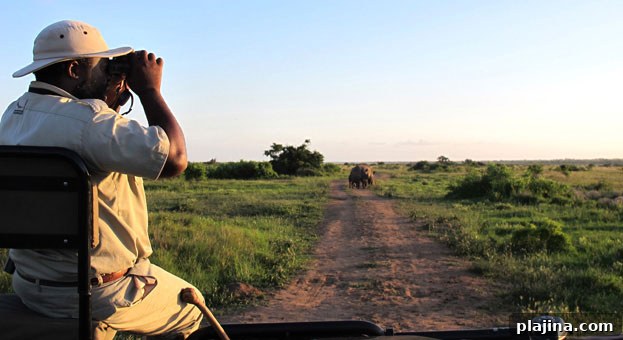
One morning we watch zebras, wildebeest and giraffes grazing while a troop of baboons plays in the trees. We track a female white rhino with two calves—one about six months old, the other roughly five years—and Dylan explains the conservation efforts that helped the species recover from the brink of extinction, though poaching remains a threat. That afternoon we find ourselves in the midst of a herd of more than 300 buffalo when the radio crackles with news of lions. Approaching quietly, we stop less than 15 feet from a large male, three females and a juvenile male resting on the grass. Dylan peers through binoculars and recognizes an immunization mark. “I know this lion,” he whispers. “This isn’t an existing pride, it’s a pride forming. This male is one of nine brothers born here five years ago; he may be returning with some siblings to claim territory.” A female wanders almost within arm’s reach and my pulse quickens. “These animals aren’t tame, but they are habituated to vehicles,” Dylan says. “If we don’t surprise them, they’ll accept our presence.” We linger until thunder rumbles and lightning streaks the sky.
After three days at Ngala I transfer to &Beyond’s Phinda Forest Lodge, located in a 56,800-acre fenced private reserve in Maputaland, northern KwaZulu-Natal. Phinda spans seven distinct habitats—from rare dry sand forest to vast marshland and mountains—and I hope to see endangered black rhinos and cheetahs. My guide Sam and tracker Josiah favor a focused approach: today we concentrate on black rhinos, lions and cheetahs, bypassing impala, zebra and wildebeest herds.
Missing the other species is made up for when we encounter a female cheetah with two cubs. We follow as she stalks an impala herd, only for the herd to pick up her scent and drift away. Later we come between two lionesses considering dinner; one pads so close to our Land Cruiser my heart races. “Don’t move,” Sam orders, and we hold still. It feels dangerously close, yet Sam, like Dylan, assures us we were never in real danger. That evening he surprises us with Champagne and hors d’oeuvres under the stars—a memorable twist on the customary sundowner.
The next morning Josiah spots a track from an African python; Sam deems it too old to pursue on foot. We arrive at the marsh as fog lifts to reveal undulating grassland rippling with shades of green and gold sparkling with water. We pause to watch ducks, hornbills, black-winged plovers and a flock of pelicans. We find another cheetah with cubs and a female black rhino with an endearingly awkward calf, and later have a close encounter with a belligerent male black rhino. During a snack break one of my companions nearly steps on a Mozambique spitting cobra. “Its spit can blind you,” Sam warns. We try to locate a pair of leopards in the woodlands; Sam and Josiah detect fresh signs and insist we stay in the vehicle while they track the pair. They don’t find them that afternoon, but return after dark when the male emerges and settles within view—proof that patience often pays off.
On my final evening we head out in search of elephants and stumble upon a scene that feels like Shangri-La. Beneath an azure sky and soft golden light, two bull elephants graze in a vibrant green valley shared with zebras, wildebeest, buffalo and rhinos. On the hillside giraffe heads rise above the trees. We watch in reverent silence, then seek the giraffes before the light fades. We find at least a dozen, including heavily pregnant females and two young males sparring with neck blows. We toast our fortune as the sun paints a Technicolor sunset. Driving back to the lodge beneath a three-quarter moon and a scatter of stars, I hope for one last close encounter with lions or leopards and smile, realizing my initial fears have been replaced by awe.
South Africa Info To Go
International flights from the United States arrive at Johannesburg’s Oliver Reginald Tambo International Airport (JNB). Flight times are roughly 90 minutes from Tambo to Ngala, about 80 minutes from Ngala to Phinda, and around 100 minutes from Phinda back to Tambo. Extraordinary Journeys arranges flights and transfers.