
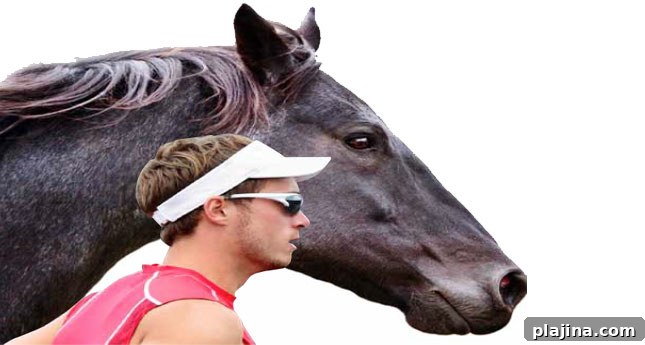
This is not a level playing field, and that’s precisely the point. On flat ground there would be no contest: four legs will always outrun two. It wouldn’t be man versus horse so much as “man watches horse disappear over the horizon.”
Put this in context: a fit long-distance runner averages about 9 mph, while a horse can sustain a canter of up to 17 mph. Matching them head-to-head sounds absurd. Bars exist to explore the absurd, and a question like “Can a human beat a horse in a race?” won’t be dismissed outright. Fueled by camaraderie and drink, the question shifts from “can” to “how.”
That debate found its most productive home at the Neuadd Arms Hotel in the small Welsh town of Llanwrtyd Wells in 1980. No formal minutes were recorded, but the conversation likely weighed the strengths and weaknesses of both competitors: a horse is larger, stronger and faster but can be unwieldy; a human, though slower, is nimble and adaptable.
To create a metaphorical level playing field, all that was needed was an uneven, twisting course—terrain that would slow a horse while presenting less of an obstacle to a human.
Fortuitously, the hills, bogs, narrow farm tracks and tricky river crossings around Llanwrtyd Wells provided the perfect setting for such a showdown. Hotel owner Gordon Green quickly saw the idea’s potential and organized a race, first held in 1981 and run annually ever since.
Although promoted as a marathon, the event covers roughly 22 miles. Hundreds of runners enter, competing against as many as 50 horses. Some runners tackle the entire distance solo; others form three-person relay teams to share the effort.
For the first 24 years, the answer seemed clear: humans could not beat horses. Year after year the mounted competitors dominated, often finishing more than half an hour ahead of the leading runner.
Organizers adjusted the rules to even the odds. Runners were given a 15-minute head start, and horses had to stop at the midway point for a mandatory veterinary check. Over time those changes narrowed the gap until, in 2004, Huw Lobb finally proved that two legs can prevail over four. He finished just over two hours, crossing the line two minutes before the first horse.
Florian Holzinger repeated that achievement in 2007. Since then, horses have generally retained the edge. Yet each year, hopeful runners gather on the start line aiming to join the small list of human winners.
Even when a runner does win, skeptics may claim the outcome was engineered. The truth is that the physical contest is only part of the picture. Desire, strategy and navigation matter as much as speed and endurance.
A horse’s chief advantage is its rider. Absent human guidance, a horse encountering difficult terrain might simply graze or wander off course. Runners, by contrast, must endure breathless effort, battered joints and mud-splattered clothing while maintaining direction and pace.
Which leads to another question worth asking: who’s smarter? The race is not just a measure of raw speed, but of judgment, teamwork and the ability to adapt to landscape and circumstance. That mixture of elements is what keeps the contest compelling year after year.