
The winter of 1962 left many Washingtonians unhappy when the city’s extensive streetcar system was replaced by buses. In recent years, efforts to revive a modern version of the trolley—the DC Streetcar—have progressed, aiming to return rail-based transit to key corridors and spark renewed investment.
Planners envision as much as 37 miles of streetcar lines connecting neighborhoods across all eight wards, a network intended to encourage economic development along its routes. While the program has encountered controversy and delays, testing continues on the bright red cars along the inaugural H Street/Benning Road line as the project moves forward.
Elliott L. Ferguson, president and CEO of Destination DC, notes that other transportation gaps are also being addressed, including the Metrorail Silver Line extension to Washington Dulles International Airport. Construction is in Phase Two and the extension was scheduled for completion in 2018, reflecting the region’s ongoing commitment to expanding transit access.
“Washington, D.C., is in the midst of major revitalization, with more than $8 billion in development underway,” Ferguson says. “While the city will always be known for its historic landmarks, it is also transforming. Both leisure and business travelers will find more to enjoy in D.C.—new hotels and convention space, dozens of restaurants, and new cultural attractions such as the Smithsonian’s National Museum of African American History and Culture.”
Artist’s rendering of the National Museum of African American History and Culture © Freelon Adjaye Bond Smithgroup
The National Museum of African American History and Culture’s move from shared exhibition space into its own building completes the circle of Smithsonian museums fronting the National Mall. Meanwhile, the National Museum of American History is undergoing a significant refurbishment of its west wing, adding new galleries, performance space and an education center. Other institutional changes include the Textile Museum’s relocation to The George Washington University Museum and the planned reopening of the Corcoran Gallery of Art.
Beyond the Mall, CityCenterDC has emerged as a major mixed-use development in downtown Washington. Spanning 2.5 million square feet across 10 acres, the complex includes condominiums, apartments, offices, event space, shops and restaurants, and sits within easy reach of two major Metro stations and the Convention Center. The project, currently in phase one, has achieved Gold certification under LEED Neighborhood Development, and plans call for the opening of the Conrad Hotel as part of later phases. Upscale retail already on site includes notable fashion and boutique names, with additional luxury tenants planned.
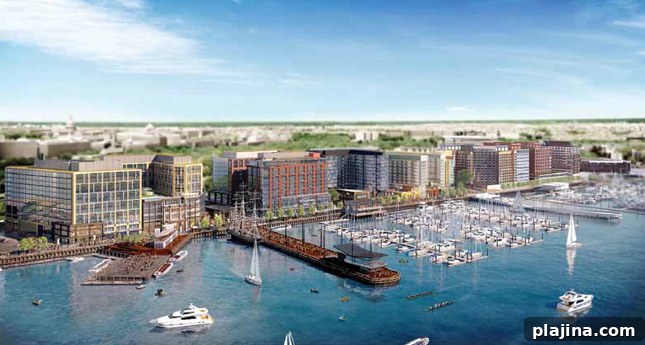
Another major waterfront revitalization is The Wharf, which will transform roughly one mile along the southwest Potomac River near the city’s monuments and Smithsonian museums. The development will stretch from the Municipal Fish Market to Fort McNair and will include a concert hall, convention facilities, nightlife venues, a ferry landing, water recreation, retail shops, galleries, hotels, offices and residential space—creating a lively destination for locals and visitors alike.
The Watergate Complex © Dave Newman | Dreamstime.com
The Watergate Hotel is also being revitalized in a $125 million renovation. Reopening will reveal refreshed interiors by designer Ron Arad, with furnishings chosen to complement Luigi Moretti’s iconic 1961 architecture. The hotel will offer a whiskey bar, spa, meeting facilities, fine dining and 340 guestrooms, many with Potomac River views.
Whether or not Pierre L’Enfant envisioned today’s mix of streetcars, high-end hotels and bustling cultural centers when he laid out the plan for the capital in 1791, current developments are reshaping how residents and visitors experience the city—making Washington a dynamic, modern metropolis while honoring its historic character.
SCENIC DRIVES
Within an hour of the District, Maryland’s Frederick County offers a picturesque drive with access to several historic covered bridges. To reach them, take the George Washington Memorial Parkway north to I-495, then I-270 north to Frederick. The local visitor center provides maps to the Roddy Road, Loy’s Station and Utica Mills bridges. While in town, stop on Main Street for lunch at local favorites and explore the shops and historic downtown.
Just beyond the District’s borders are some of the East Coast’s most celebrated scenic drives, including Skyline Drive in Shenandoah National Park. From Washington, take I-66 west into Virginia, exit onto U.S. 29 south toward Warrenton, then follow U.S. 211 west to the Thornton Gap entrance to the park—about a 72-mile drive from the city. Skyline Drive spans 105 miles along the crest of the Blue Ridge Mountains and is a designated National Scenic Byway. Travel the route slowly to enjoy the numerous overlooks and consider stopping for a short hike, such as the 1.4-mile roundtrip trail to Dark Hollow Falls near Milepost 51.