
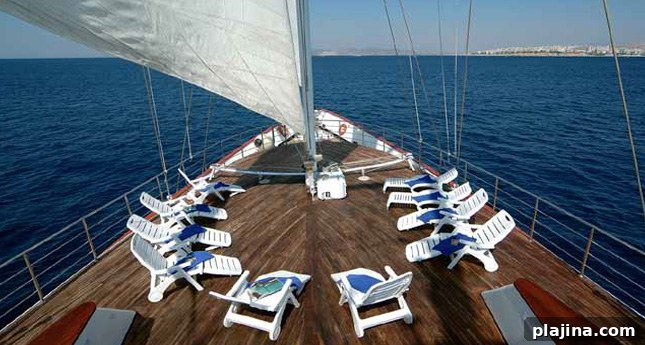
Most cruise lines introduce at least one distinctive voyage each year that lets travelers explore a lesser-known region in depth. Sometimes the destination itself is extraordinary, as with AdventureSmith Explorations’ Cuba People-to-People Cruise, beginning this December. Aboard the three-masted, 49-passenger schooner Panorama, AdventureSmith will sail round-trip from Miami to five Cuban ports, including Havana—marking the first such American cruise to those ports in roughly 50 years. For travelers eager to visit Cuba before more mainstream lines add the island to their 2016 itineraries, this represents a rare opportunity.
Unique itineraries aren’t limited to remote or newly accessible countries. Even well-traveled regions can be presented in fresh ways. In Hawai’i, where Norwegian Cruise Line dominates large-ship inter-island service, Un-Cruise Adventures offers a contrasting experience: week-long, yacht-style voyages on a deluxe 36-passenger vessel. Their itinerary moves guests between the Big Island and Molokai, with stops on Lāna‘i for hiking and Maui for night snorkeling—small-ship experiences that emphasize immersion over mass tourism.
Mekong River © Viking River Cruises
Viking Cruises, a leader in European river cruising, has expanded into Asia to offer immersive journeys through distinct waterways. Viking now operates cruises on China’s Yangtze River and through the Mekong Delta in Vietnam and Cambodia on a near-weekly basis. Seeking a deeper regional experience than the day-calls offered by larger ocean ships, we booked Viking’s Magnificent Mekong cruise and land tour. The program provided access to inland sites and cultural encounters, guided by knowledgeable local staff, and included visits to cities, archaeological treasures, and riverside communities, as well as schools and factories in the rapidly changing Mekong Delta.
Viking’s 15-day Mekong itinerary runs from Ho Chi Minh City in southern Vietnam to Hanoi in the north, with extended stays in Phnom Penh and Siem Reap in Cambodia. Few cruise-and-land programs in the region match its scope. The package includes the week-long river cruise with all shore excursions, as well as land travel and accommodations in high-quality five-star hotels. Our tour director, Lam Thanh Ut, accompanied the group throughout, and the itinerary emphasized cultural immersion—aptly reflecting a Vietnamese proverb: “A day of travel brings a basketful of knowledge.”
We began in Ho Chi Minh City (formerly Saigon) in April, a month of intense heat and humidity. After two nights at the Sofitel Saigon Plaza and a city tour, we drove to My Tho on the Mekong Delta and boarded the 56-passenger RV Viking Mekong for an eight-day cruise. The wide, muddy Mekong evoked the Mississippi at first glance, but the region’s fishing boats, floating markets, and riverside farming villages were unmistakably Southeast Asian. The Mekong supports roughly 300 million people, hundreds of ethnic groups, abundant fish species, and vast rice paddies tended by water buffalo.
The RV Viking Mekong is a colonial-style boutique riverboat built for Mekong cruising by Pandaw River Cruises. With 28 compact cabins—simple in design without suites or balconies—the vessel offers efficient comfort rather than the more spacious accommodations found on Viking’s European longships. Our main gripe was insufficient air-conditioning during the Delta’s April heat; otherwise the en-suite showers were refreshing and service was attentive and friendly. The boat provided everything we needed to explore the region comfortably.
RV Viking Mekong © Viking River Cruises
The voyage focused on shore excursions. Our introduction came the first afternoon with a visit to the Cai Be floating market, where boats sold puffed rice candies, snake wines, and even pythons displayed for sale. Market after market followed as we navigated the channels. The next morning we took sampans to Sa Đéc, wandered street markets, and had tea in the Lovers’ House, a setting tied to the film The Lover (1992), which had been shown aboard the ship the night before. Later we toured a large brick factory on the waterfront, visited a floating catfish farm, and met a local family in their stilt house on Evergreen Island.
Crossing into Cambodia, we spent several days in Phnom Penh. Local guides took us on cyclos—bicycle taxis from the colonial era—to the Royal Palace and the National Museum. These visits were balanced by an optional, sobering tour of the Killing Fields that recalls the atrocities of the Khmer Rouge era.
From Phnom Penh, the ship traveled up the Tonlé Sap Channel to Kampong Trolach. There we switched from ox carts to an air-conditioned bus en route to Udon Monastery, one of Cambodia’s largest Buddhist centers. A visit to a village of silversmiths preceded our return to the ship at Preak Kdam, after which we had free time back in Phnom Penh.
Continuing upriver, we arrived at Chong Koh and visited a traditional Khmer village known for cotton and silk weaving. At Kampong Cham we explored the ruins of Phnom Pros and Phnom Srey—the Twin Holy Mountains. One of the trip’s most memorable moments for many travelers was a visit to an orphanage housing 87 children, where we spoke with the kids and selected some of their original artworks as keepsakes.
After disembarking in Phnom Penh, we traveled by road to Siem Reap, the gateway to Angkor Wat, and stayed three nights at the Sofitel Angkor Phokeethra. Guided tours took us through a series of ancient temple complexes, offering one of Southeast Asia’s most impressive concentrations of monumental religious architecture.
From Siem Reap, Vietnam’s national carrier flew us to Hanoi, a city that surprised with its mix of colonial-era alleys and modern history, including the wartime “Hanoi Hilton.” Our hotel, the historic Sofitel Legend Metropole—opened in 1901—has hosted international leaders and celebrities and features an underground air-raid bunker from the Vietnam War that is now open for tours.
Between a week cruising the Mekong with visits to villages, markets, schools, and factories, and another week exploring cities and ancient monuments, the journey offers a thoroughly absorbing two-week experience. For travelers seeking a blend of riverside life, cultural encounters, and archeological wonders, a Mekong cruise-and-land tour provides an unparalleled itinerary.