
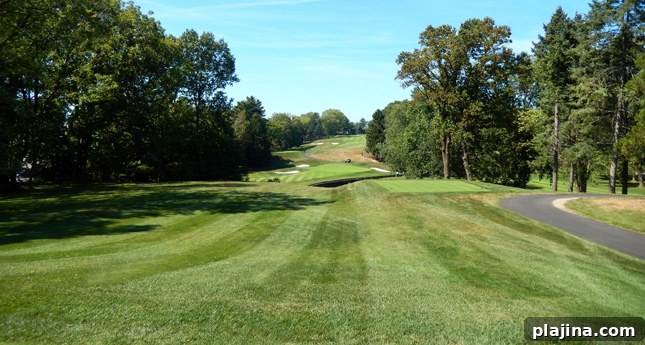
One of the most notable comeback stories in golf is how the Union League of Philadelphia rescued the worn and struggling Torresdale Frankford Country Club in 2014. The course, originally designed by famed architect Donald Ross, had declined over the years: membership shrank, maintenance suffered, and changing local demographics left the property vulnerable to development.
The Union League—the respected private city club founded on Abraham Lincoln–era principles and devoted to preserving tradition—stepped in to save this historic course. Their acquisition began a new chapter for the site, now known as The Union League Golf Club at Torresdale, and extended the Union League’s legacy into the golfing community.
The club’s roots trace back to two early Philadelphia golf organizations: Torresdale Golf Club, established in 1896, and the Frankford Club, founded in 1897. For nearly 25 years the two operated as separate nine-hole courses located only a few miles apart, during golf’s early days in the United States.
In 1921 Torresdale Golf Club purchased the current property and built a new nine-hole layout. Around the same time, the Frankford Club was seeking a new home, and the two clubs soon merged. That collaboration led to the commissioning of Donald Ross to design the combined course—an inspired and lasting decision. A new clubhouse was built, and the club prospered for decades before challenges emerged in the late 20th and early 21st centuries.
Under the Union League’s stewardship, nearly $8 million was invested to restore Torresdale into one of the region’s finest facilities. The Union League drew new members from across the Philadelphia area while retaining the club’s existing base, creating a healthy and active membership for the revitalized golf club.
The League engaged Stephen Kay, a restoration architect experienced with Tillinghast-, Ross-, Travis- and Emmet-designed courses, to lead the renovation work. Kay has restored more than a dozen Ross courses in his career. His team narrowed some overly wide fairways back toward Ross’s intended widths—some had become as wide as 30 yards—and restored original fairway lines, while removing or pruning trees added in the 1960s and ’70s that had obscured the course’s character.
Leadership and staff from the Union League helped guide the transition, including director of golf Sean Palmer and club manager Sandee Cataldi. That experienced team, along with dedicated grounds crews and members, helped shepherd the course through an ambitious renovation, marking one of the area’s most exciting golf developments.
The club hosted Global Traveler’s annual Advisory Board Meeting on Sept. 16, where economic trends were discussed and voting took place for airline and hotel awards. Earlier that day, members of the board and guests played the course as final construction pushed toward the clubhouse reopening on Oct. 7. The first groups to tee off included Christopher Ottuanick, Mark Lane, Wayne Tallman, Mike Donahue, the author, Edward Jefferson and Carlos Cappuccio.
HOLE 1 | 343 yards, par 4
This opening green once sloped dramatically front to back, causing balls to roll off the back unless stopped by an imperfection. Kay reconstructed the green by cutting sod into labeled pieces, reassembling them like a puzzle to soften the surface while preserving its original character. Each piece was rebuilt in sequence so the green would knit together naturally as it re-established.
The hole provides a strong start. Bigger hitters can challenge the creek short of the green with a fairway wood from the tee. On the round described, a drive found a fairway nook near the creek bridge, while a misplayed chip drifted toward out of bounds near the driving range. A safe recovery led to a bogey.
HOLE 8 | 505 yards, par 4
Significant work opened views and restored sightlines on this long, demanding par 4. Trees behind the green that once blocked the clubhouse view were removed. Historically, Ross positioned the green before the creek, but changes in 1963 moved the green to add length after Grant Avenue was widened and hole 17 was altered. Kay and his team reset the fairway grades using historic photos, including 1939 aerials, to guide restorations close to Ross’s original intent.
The ideal tee shot favors just left of center to set up a reachable second into a green that sits below the fairway. On the described round, a well-struck fairway wood found the front collar of the green and two-putt par. The caddie noted that Hole 8 is considered among the most difficult par 4s in Philadelphia.
HOLE 17 | 207 yards, par 3
Once a longer hole, this historic hole became a par 3 after road widening and construction altered the layout. Two players hit excellent shots—one finding the green collar with a fairway wood and the other flying over and chipping to within inches—while another player missed left and wound up taking a bogey. The hole’s changes reflect the course’s evolving history and the team’s careful restoration choices.
HOLE 18 | 400 yards, par 4
A memorable finishing hole, this par 4 reveals the clubhouse as you approach the green and demands precise shots. The ideal drive favors the right side of the fairway for a clear angle into the green. In the renovation, Kay enlarged this green to reflect Ross’s original scale; greens had been reduced over the years due to wartime and maintenance practices. Hole 18 is a scorecard-defining challenge—Kay notes that golfers hoping to finish in the 80s will likely need only a bogey here.
Many other holes received careful work, and as the renovation settles and the turf matures, a return visit will reveal additional improvements and restored subtleties that recall Ross’s vision.
The Union League Golf Club at Torresdale
3801 Grant Ave.
Philadelphia, PA 19114
el 215 637 7500
ulgolf.org