They’re less than six miles apart, linked by an invisible thread of history that runs through narrow streets, Moorish ruins, Renaissance squares and medieval stonework. The Andalusian cities of Baeza and Úbeda, in the province of Jaén, are both UNESCO-listed for their outstanding ensembles of Renaissance monuments. Yet a single step in either city quickly shows that Renaissance architecture is only part of the story.
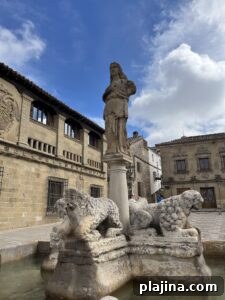
The Fountain of the Lions © Aoife O’Riordan
Baeza is often praised for having some of the best-preserved examples of Italian Renaissance architecture in Spain, but the city’s history reaches back to Roman times. In Plaza del Pópulo stands the Fountain of the Lions, an Ibero-Roman ruined fountain topped by what many historians identify as Imilce, the Iberian wife of the Carthaginian general Hannibal.
Among Baeza’s most intriguing buildings is the Jabalquinto Palace, a 16th-century Isabelline Gothic residence built for a cousin of King Ferdinand II as a gift for his wife, María Marquis. The palace façade is dense with coats of arms signaling the family’s status, while other exterior carvings reveal bold and sometimes risqué imagery. The building later became a monastery and today forms part of a university—an ironic twist when imagining monks passing those explicit designs every day.
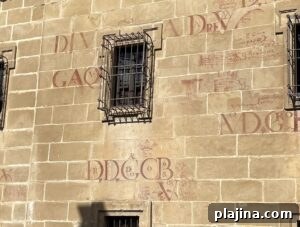
© Aoife O’Riordan
As you walk Baeza’s streets, you’ll also notice faded red letters painted on some buildings. Centuries ago, university students used bull’s blood to create these markings, a vivid reminder of the long-standing rivalry between Baeza and neighboring Úbeda. Some of the graffiti is bawdy and humorous; one memorable depiction once showed a prominent Úbeda official in an unflattering pose, preserving the students’ contempt for their rivals in a way that still draws a smile today.
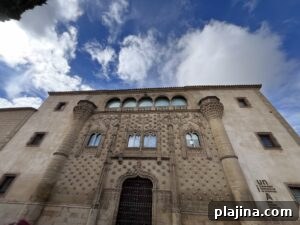
Jabalquinto Palace © Aoife O’Riordan
Other notable Renaissance landmarks in Baeza include the Cathedral of Natividad de Nuestra Señora, the Chapel of St. Francis and the Villalar Arch. Each site showcases the city’s architectural richness, with layers of history visible in stone and ornament.
Just a short drive away lies Úbeda, a compact city with 48 listed monuments and more than 100 buildings of interest, most displaying Renaissance style. Úbeda’s past is multi-layered, shaped by proto-historical settlements, Roman foundations, Arabic influence and medieval growth.
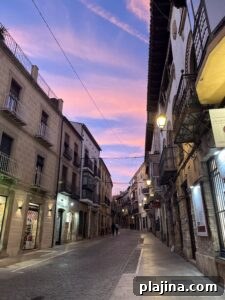
Úbeda © Aoife O’Riordan
Vázquez de Molina Square is the heart of Úbeda’s Renaissance heritage, surrounded by churches, chapels and palaces from the 16th century. One former palace in the square now houses a Parador hotel while preserving the original foundations. The square is also home to the Chapel of the Savior, a surprising monument that at first glance appears to be a simple church but is actually the funerary chapel of Francisco de los Cobos, secretary to Emperor Charles V. Inside, decorative themes draw less on Catholic iconography and more on classical references, displaying sculptures and motifs that echo ancient Greece and celebrate philosophy and humanist learning.
The main church, the Basílica de Santa María de los Reales Alcázares, also anchors the square and offers another layer of the city’s spiritual and architectural legacy.
In both Baeza and Úbeda, the coexistence of Christian, Islamic and Jewish influences is palpable. As you wander their streets, explore their plazas and enter their monuments, that layered cultural history reveals itself in stone, ornament and urban layout, offering a compact but profound journey through Andalusia’s past.