
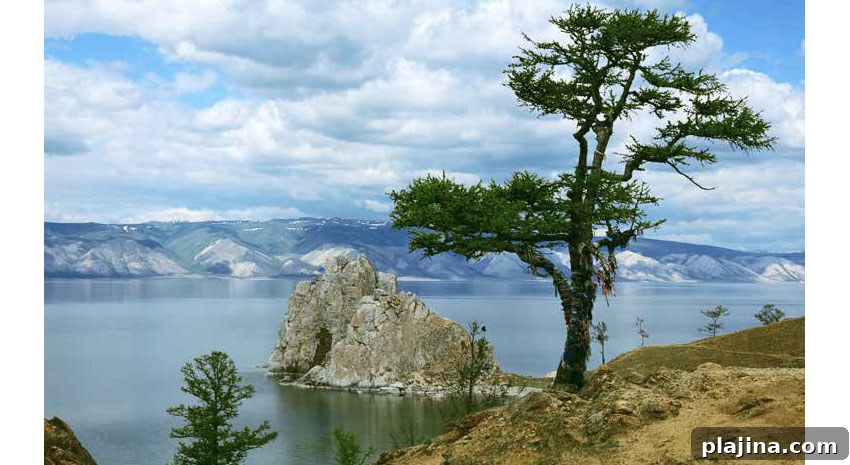
TIME STANDS STILL WHEN YOU EMBARK on the Trans-Siberian Railway. The experience evokes a journey little changed since the 19th century: steam has given way to electric engines, but the steady rhythm of wheels on rails, the gentle sway of the carriages and the endless scroll of Russian landscapes remain the same.
There is also a curious temporal distortion aboard: throughout six nights and seven time zones, clocks on the train and at many stations remain set to Moscow time. That makes operational sense, but as you travel east the discrepancy between clock time and local daylight grows, underscoring the vast distances you are crossing.
Another aspect of the journey is the enforced slowness. Limited internet access and long stretches between stops mean plenty of unstructured hours. Against that backdrop, the memorable moments — striking scenery, unexpected conversations, and key stopovers — stand out all the more.
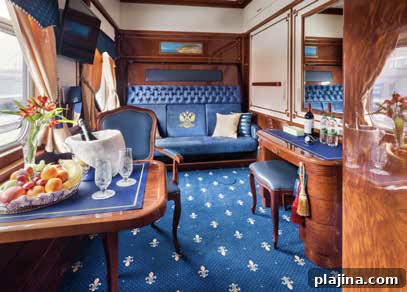
An Imperial Suite © GOLDEN EAGLE LUXURY TRAIN
The Trans-Siberian is not a single train or fixed itinerary but a network of routes and services, ranging from ultra-luxury to basic commuter-style compartments. At the top end is the Golden Eagle luxury train, which operates a limited summer season. Cabins are en suite with showers, dining is refined, expert lectures are offered onboard, and the bar area often provides WiFi. Such comfort carries a premium: two-week fares can range from roughly $16,000 to $74,000 for the Imperial Suite.
At the opposite extreme, third-class tickets on standard trains cost roughly $200 for the full journey if you ride end-to-end. These berths are spartan: no private showers, shared toilets, and close quarters with fellow travelers.
Many travelers find a practical compromise in first-class compartments on the Rossiya service. A two-berth compartment is typically around $1,800 (excluding hotel nights at stops). Cabin attendants — often authoritative and efficient women — run the onboard routine. Building a cordial rapport with them goes a long way toward a comfortable trip.
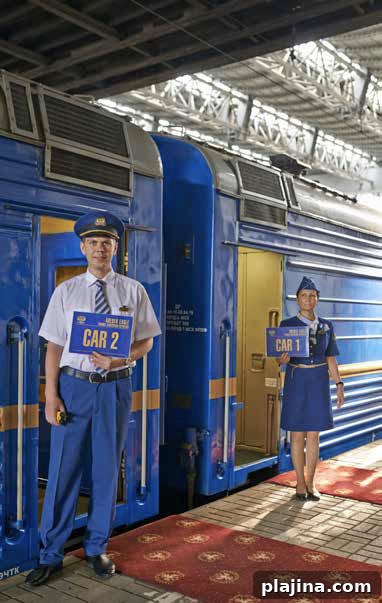
Golden Eagle luxury train attendants © GOLDEN EAGLE LUXURY TRAIN
Most international visitors travel eastbound, beginning in St. Petersburg or at Moscow’s Yaroslavsky Station. The classic itinerary ends in Vladivostok on Russia’s Pacific coast, but two other popular routes terminate in Beijing — one via Mongolia and Ulaanbaatar, the other via Harbin in northeastern China.
Each of the main routes requires about six nights non-stop, though tourists typically break the trip into stops that can stretch the overall journey to two weeks or more. One of the first major stops is Yekaterinburg, near the Ural Mountains that mark the traditional boundary between Europe and Asia. The city blends modern high-rises with pre-Soviet architecture, including the notable Kharitonov Palace.
Continuing east, Irkutsk is the gateway to Lake Baikal, the world’s deepest freshwater lake, holding roughly 22 percent of the planet’s unfrozen freshwater. Listvyanka, the nearest lakeside settlement, sits about an hour from Irkutsk by bus and is a practical base for exploring the shoreline.
Baikal supports unique wildlife, including the endemic Baikal seal. Seals are visible at the aquarium in Listvyanka, but to observe them in their natural habitat it’s worth booking a guided excursion to the Ushkaniye Archipelago in the lake’s center. Such trips typically take several days and depart from Irkutsk.
Beyond Irkutsk the routes diverge. The Mongolian branch heads south through Ulaanbaatar and across the vast Gobi Desert to Beijing. The alternative route to Beijing stops at Harbin, a city known for its Russian-influenced architecture and its winter ice festival. Harbin’s historical character and seasonal festivals make it an intriguing stopover.
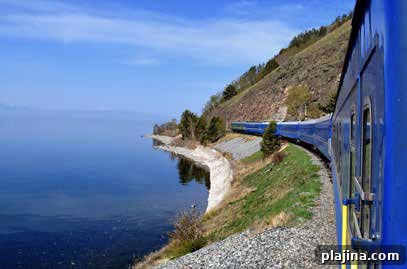
A train on the railway along Lake Baikal © GOLDEN EAGLE LUXURY TRAIN
On the all-Russian line, travelers sometimes pause in Khabarovsk, where the Amur and Ussuri rivers meet. The final leg to Vladivostok crosses remote terrain that once supported Siberian tigers; sightings are exceptionally rare, but the sense of wilderness is real.
Vladivostok, once a closed naval port until the late 1980s, marks the traditional eastern terminus. It is a working port city rather than a tourist showcase, so many visitors use it as a practical endpoint before flying onward. The Rossiya service typically departs Moscow on odd-numbered dates and leaves Vladivostok on even-numbered dates, offering a reliable schedule for planning connections.
Trans-Siberian Railway Info to Go
The classic Trans-Siberian trip runs eastbound from Moscow to Vladivostok. Most international travelers arrive at Moscow’s Sheremetyevo Airport, which is located northwest of the city. Trains depart from Yaroslavsky Station in Moscow’s rail network. Vladivostok’s railway terminus is in the city center, while Vladivostok International Airport lies about an hour’s drive to the north and provides flights back to Moscow or to destinations such as Seoul. For journeys to China, trains arrive at Beijing Railway Station; Beijing’s international airports serve onward flights from the capital.