
Last year, 4.7 million visitors came to see one of America’s most spectacular natural wonders, Grand Canyon National Park. With only 48 hours available during a road trip across Arizona, I decided a short detour to this UNESCO World Heritage site was worth it. The canyon had been on my bucket list for decades, so I resolved to at least peer over the rim and take a brief hike into the abyss.
Arriving at the Grand Canyon Visitor Center, I headed straight for Mather Point and walked a short section of the Rim Trail. The first view stopped me in my tracks. The canyon’s immensity is staggering, and its rock walls reveal layers of earth tones — ochre, gray, ivory and touches of green — cascading down to the Colorado River. The canyon winds for 277 miles, the river threading the bottom, with depths reaching about 6,000 feet and widths up to 18 miles. Roughly 90 percent of park visitors take in the views from the South Rim, as I did.
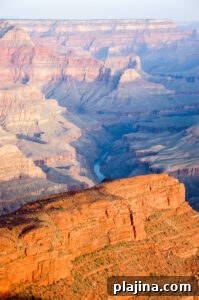
© SUTTHIRAT WONGSUNKAKORN
| DREAMSTIME
Walking along the rim is mostly easy, and the park shuttle along the seven-mile Hermit Road makes it simple to visit multiple overlooks. I hopped off at several of the nine viewpoints to admire one of the planet’s most dramatic examples of arid-land erosion. Maricopa Point looks out over the site of an old copper and uranium mine from 1891. Powell Point features a memorial to John Wesley Powell, the 19th-century explorer of the Colorado River. Hopi Point offers expansive vistas that are ideal for sunrise and sunset viewing. Hermit’s Rest, the road’s terminus, was designed by architect Mary Colter to resemble an old miner’s cabin. From there the Hermit Trail descends steeply into the canyon; I saved that challenge for another day and opted to hike part of the popular Bright Angel Trail instead.
At 9.5 miles, the Bright Angel Trail can be deceptively demanding for an occasional hiker. Attempting a down-and-back in a single day is risky; park materials recommend allowing two days. The difference in elevation and temperature explains why: the trailhead is at about 6,860 feet, while Bright Angel Campground at the bottom sits near 2,480 feet — a drop of roughly 4,380 feet. Park signs advise that climbing out takes about twice as long as hiking down. Hikers going uphill have the right of way, and so do mule trains guided into the canyon; more than once I pressed against the canyon wall to let beasts pass by.
Temperatures climb as you descend. I started on a crisp March morning with ample water, snacks, sunscreen, a wide-brim hat, trekking pole, well-broken-in boots and layered clothing. Gradually I shed layers — coat, long sleeve, zip-off pant legs — and by the 1.5-mile Rest House I seriously considered turning back. Even a modest round trip consumed nearly four of the precious 48 hours I’d set aside to experience the Grand Canyon.
For a gentler pace, I explored Kolb Studio, a family home and photography studio built in 1905. The Amazing Kolb Brothers exhibit highlights how Ellsworth and Emery Kolb used photography to bring early visitors to the canyon and help it gain national recognition. The Yavapai Geology Museum, perched on the canyon edge, features large windows that frame the view and exhibits explaining the layers of sandstone, limestone and shale formed over hundreds of millions of years. Hopi House, also from 1905 and designed to echo Hopi architecture, displays Native American arts and crafts.
Visitors with additional time can join free ranger programs, rent bikes to ride 13 miles of roads and Greenway trails, or book whitewater rafting trips, guided bus excursions and air tours by helicopter or fixed-wing aircraft.
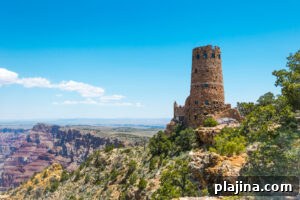
© MARYNA KONOPLYTSKA | DREAMSTIME
On my final morning I drove 23 miles from Grand Canyon Village to Desert View near the park’s east entrance. The Desert View Watchtower, another Mary Colter design inspired by Ancestral Puebloan structures, overlooks the point where the Colorado River makes a dramatic 90-degree bend. The site also includes a stone memorial to the 128 passengers who lost their lives when two airliners collided over the canyon in 1956. It was a sobering note at the end of an otherwise uplifting two-day visit, one that reminded me how awe-inspiring and humbling Grand Canyon National Park can be.
INFO TO GO
The nearest commercial airport to the South Rim is Flagstaff Pulliam Airport, about 80 miles away. Grand Canyon National Park Airport provides limited service approximately seven miles from the park. Phoenix and Las Vegas are farther: roughly 231 miles and 278 miles away, respectively. Amtrak serves Flagstaff with connecting bus service to the canyon, and the Grand Canyon Railway runs daily trains from Williams, Arizona. The park’s official resources list authorized companies that offer tours and shuttle pick-ups from cities across the Southwest.