
Airport hotels have a close, symbiotic relationship with the airports they serve. When an airport experiences growth in flight activity and passenger traffic, nearby hotels benefit directly. With global business and leisure travel on the rise, airport hotels are enjoying a period of strong expansion.
Although airports have existed since the early 20th century — Albany International Airport (1928) is the oldest municipal airport in the United States — the modern branded airport hotel emerged in 1959 with the opening of the San Francisco Airport Hilton. Today, roughly 2,300 airport hotels in the U.S. provide about 313,000 guestrooms. As domestic travel grows, investors and developers increasingly view airport hotels as an attractive opportunity. Industry data from 2014 showed record room sales for U.S. airport hotels in the first four months of that year, a sign of heightened demand.
Rapid airport expansion and rising business travel across emerging markets in Asia, Latin America and the Persian Gulf have driven a surge in new airport and city hotel projects. Major hubs such as İstanbul, Dubai, Jakarta, Bangkok and Singapore — each handling more than 40 million passengers annually — reported double-digit growth in passenger numbers. Total global passenger traffic continues to climb, with industry organizations reporting year-over-year increases that support new hotel construction near airports.
Many developing countries now have large hotel pipelines. For example, recent planning activity showed hundreds of hotel development projects across Brazil and Mexico, and international brands such as Ibis, Holiday Inn Express and Comfort Inn & Suites are prominent in new airport hotel pipelines worldwide. In China, planned expansions at several busy airports include dozens of hotel projects, and some global chains have announced significant growth plans for the market.
Convenience remains a leading reason travelers choose airport hotels. Frequent travelers often prefer to stay on-site or nearby to avoid morning traffic and reduce stress before early departures. For business travelers attending conferences in congested urban areas, an airport hotel with shuttle service or a direct terminal connection can be an efficient option that saves time and logistics costs.
While proximity to terminals and a quiet atmosphere are still important, airport hotels now offer a wide range of amenities comparable to resort and city hotels. Many properties include gourmet restaurants and bars, meeting and conference facilities, fitness centers and pools, business centers, laundry services, complimentary breakfast and Wi-Fi, family-friendly play areas, and even small cinema rooms or curated events such as wine tastings.
Le Méridien Cairo Airport links to the terminal via a private walkway. © Starwood Hotels & Resorts
Certain airport hotels stand out for design, location and direct terminal access. Le Méridien Cairo Airport, opened recently and designed by WATG, features a lotus-inspired form and a private walkway connecting it to the terminal. With two restaurants, meeting rooms and a full fitness center, the property aims to attract regional business gatherings where staying at the airport is both convenient and cost-effective for groups.
Crowne Plaza Changi Airport in Singapore, designed by WOHA and opened in 2008, is often cited among the world’s best airport hotels. The property connects to Terminal 3 via an all-weather link-bridge and uses a perforated aluminum façade to provide shading. Public spaces highlight regional materials and flora, and the hotel offers several dining options, meeting spaces and an outdoor pool, creating a calm oasis within a busy transport hub.
Crowne Plaza Changi Airport © Crowne Plaza Changi Airport
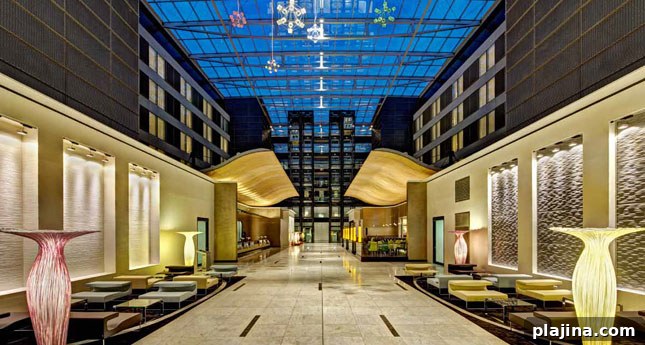
Major European hubs also support strong airport hotel business. During a recent busy half-year, Frankfurt Airport handled tens of millions of passengers and nearby properties such as Hilton Frankfurt Airport and Hilton Garden Inn Frankfurt Airport benefited from high occupancy. Both hotels occupy space in The Squaire complex, which offers direct connections to Terminal 1 and the airport’s train station, and provide extensive meeting, dining and fitness facilities for business and leisure guests.
At London Heathrow’s Terminal 5, Sofitel London Heathrow is a popular choice for international travelers, offering multiple dining venues, an ESPA spa and fitness center, a large number of meeting rooms and a theater that accommodates corporate events. In Vancouver, The Fairmont Vancouver Airport places guests a short walk from U.S. departures and features restaurants and runway views, earning recognition as a top airport hotel in North America.
The Westin Detroit Metropolitan Airport, built within the World Gateway Terminal, includes a private TSA checkpoint that connects the hotel lobby with terminal gates, minimizing wait times for guests. With an expansive atrium, reflecting pool, multiple meeting rooms and an indoor pool, the property caters primarily to business travelers seeking convenience and premium amenities.
New North American properties emphasize design and technology. The Grand Winnipeg Airport Hotel by Lakeview and the Renaissance Edmonton Airport Hotel highlight upgraded in-room technology, contemporary fixtures and convenient terminal access. In Europe, Dorint Airport-Hotel Zürich won praise for its innovative design, geothermic heating and cooling systems, LED lighting and versatile meeting facilities.
Airport hotels can also offer resort-style experiences near coastal or leisure destinations. Pullman Marseille Provence Airport Hotel, a short drive from the airport, provides a South of France ambiance with outdoor dining, a pool, tennis facilities and modern meeting rooms, serving both business travelers and tourists exploring the region.
Looking to the future, high-profile projects continue to raise the bar for airport hotels. New developments include a Westin at Denver International Airport featuring a rooftop pool, extensive conference facilities and connections to high-speed rail to downtown, demonstrating how design and functionality combine to create valuable, high-performing properties. Growth plans also include more lifestyle-focused brands: Marriott’s Moxy hotels target younger travelers with contemporary design, sustainability features and technology-driven services, and are expanding at several European airports.
Luxury and full-service brands are also extending their airport presence. Upcoming openings include a new five-star hotel near Qatar’s Hamad International Airport, slated to offer extensive meeting space, dining, wellness facilities and high-end guest rooms to serve international business and leisure travelers.
Overall, as global passenger traffic continues to grow and airports expand, airport hotels are evolving from simple transit accommodations into fully featured destinations. With strategic location, innovative design and a broad range of services, these properties are positioned to meet the needs of both business and leisure travelers while contributing to the broader economic ecosystem surrounding major airports.