
Architect Tom Doak said it best: “You will never play golf somewhere like this again.”
Those words became a mantra while we toured New Zealand’s premier courses. Reading them now makes me want to hop on a 12-hour Air New Zealand flight to Auckland. It’s a long trip, but attentive crew, excellent New Zealand wines and food, and the idea of waking up across the international date line in a different season make the journey worthwhile.
A short flight to Napier clears the travel haze, and a 35-minute drive to The Farm at Cape Kidnappers gives you time to adjust to the climate and scenery. The final 15-minute drive from the resort gate through grazing pastures builds anticipation. Cape Kidnappers, one of the most celebrated courses in the world, invites the inevitable question: Can it live up to the hype? As the late architect Robert von Hagge observed, great courses strike “an equal balance of tactical excellence and beauty.” A golfer spends only minutes hitting the ball; the rest of the time is theater.
Two decades after opening, Cape Kidnappers still delivers both tactical challenge and visual drama and remains ranked among the world’s top 50 courses. Maintaining that status requires work: during the COVID-19 period, Tom Doak oversaw the stripping and replanting of fairways and greens to restore their original hard-and-fast character.
Technically a seaside layout, the par-71 track stretches to 7,147 yards and features grassy fringes rather than classic links turf. After an inland front nine, the course follows peninsulas and headlands to cliffs that drop 500 feet to the Pacific waves of Hawke’s Bay. Yet the front nine is no mere warm-up; it contains elevation changes, carries over ravines, complex greens and the occasional surprise such as the blind tee shot on the 544-yard, par-5 fourth hole.
Many have seen the dramatic drone photos of the back nine, but the views are equally arresting from ground level.
When the wind blows the fairways—with steep drop-offs on both sides—appear to shrink, a frequent test here. Often it’s better to find a greenside bunker than to push a ball into the high grass or down a ravine.
The Farm at Cape Kidnappers is a five-star lodge with two restaurants, a spa, 22 rooms and suites, and a private cottage. Managed by Rosewood and paired with sister property Kauri Cliffs, the resort sits within a 6,000-acre working sheep and cattle station. The property, protected by predator-proof fencing, also hosts the world’s largest gannet colony, where visitors can observe more than 25,000 birds up close.
Cape Kidnappers is open year-round; greens fees range from approximately $230 to $649, depending on season.
Hole 6 “Gulley”
225 yards, par 3
This longer par-3 has danger left. Three deep bunkers guard the left front of the elevated green, and a steep grassy bank behind the hazards drops into a valley. The approach includes a memorable cart ride across a long bridge spanning the wooded ravine.
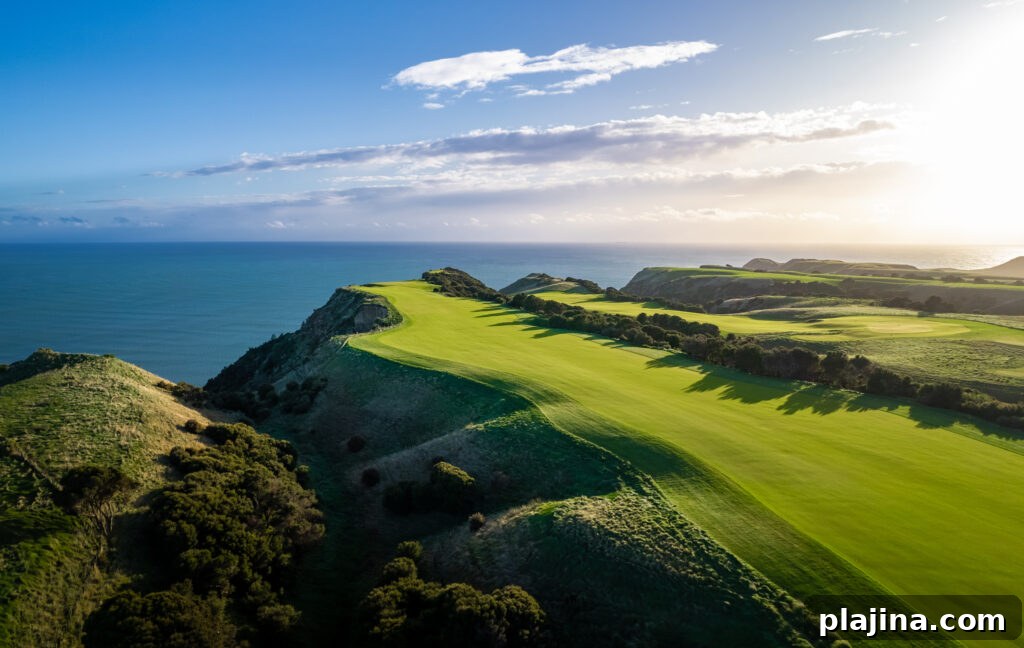
Hole 15 © Cape Kidnappers
Hole 7 “14 Flags”
453 yards, par 4
Ranked the second-hardest for men and third for women, this hole requires a strong drive to crest the fairway and leave a manageable downhill approach to a shallow, aggressively bunkered green that falls away at the back.
Hole 12 “Infinity”
460 yards, par 4
While the Pacific provides a stunning backdrop at the aptly named 10th, the undisputed signature comes two holes later. This tee shot invites length: a big drive into a generous landing area sets up a short iron to a narrowing fairway and an “infinity” green backed by Hawke’s Bay.
Hole 13 “Al’s Ace”
130 yards, par 3
The course’s shortest hole is deceptively simple. Perched near the cliff edge, its green is exposed to wind and on calm days can still feed shots off the left into deep bunkers below.
Hole 15 “Pirate’s Plank”
650 yards, par 5
Legend says Doak hesitated to use this narrow finger of land, yet it remains the course’s toughest hole and one of its most memorable. The fairway narrows to about 40 yards, bordered by a more-than-400-foot drop on the left and a 65-foot fall on the right. The green tilts away on three sides at the cliff edge but offers run-up options in front.