
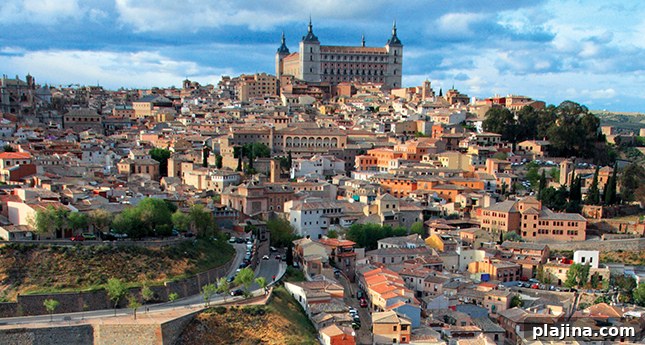
How many American children are captivated by the Spanish Renaissance painter El Greco? Probably not many. A simple way to change that is to take them to Toledo—Spain’s historic city that inspired the artist.
Not Toledo, Ohio. The much older Toledo, a short high-speed train ride from Madrid.
Early one morning we check the departure board at Madrid’s Atocha Station, descend to the platform and board a sleek train. Thirty-five minutes later we step into one of Spain’s most picturesque cities. It’s easy to see why Domenikos Theotokopoulos, known as El Greco, settled here in the 16th century.
One of his best-known works, View of Toledo, now hangs in the Metropolitan Museum of Art in New York. If you can’t see the original before visiting, bring a postcard of the 400-year-old masterpiece.
From the station we take a cab to the southern bank of the Tagus River and stop at a viewpoint beside the road. Hold up the postcard and compare it to the panorama before you. If the kids exclaim “Wow!” their interest in El Greco is probably sparked.
We stand high above the river, which winds through a deep valley surrounding the city on three sides. Four centuries after El Greco painted his cityscape, the silhouette of Toledo remains instantly recognizable.
Tiled roofs cling to steep slopes, and a maze of narrow streets threads between them. The cathedral’s bell tower rises prominently and, atop the main hill, the Alcázar fortress—guarding Toledo since Roman times—presides over the scene.
It’s easy to imagine knights and horsemen racing across the stone bridges and through the city gates. With that sense of adventure, we cross the river and enter the old town.
We leave the taxi outside the city walls. The streets here were never designed for modern traffic. The city has several fortified gates; the most striking is Puerta del Sol (Gate of the Sun), a 14th-century Moorish structure with a horseshoe arch that recalls the city’s long Arab heritage.
Nearby is the Mezquita del Cristo de la Luz (the Mosque of Christ the Light), one of Spain’s oldest surviving Moorish monuments. The site’s layered history sums up Toledo: a Visigoth church once stood here, and in the 10th century Musa Ibn Ali built a mosque whose name appears in Arabic on an outside wall. Inside, a forest of horseshoe arches has survived largely intact.
Legend says that when King Alfonso VI entered the mosque after conquering Toledo in 1085, he discovered a crucifix concealed behind stonework, illuminated by a candle that had burned throughout Muslim rule—hence the building’s present name.
We continue through ever steeper, narrower streets, squeezing past the occasional vehicle and pressing close to the walls when necessary. Soon we reach the heart of the city: the Cathedral of Toledo.
The cathedral stands on a site that previously held a mosque and, before that, a Visigothic church—every corner of Toledo reveals historical layers.
Inside, the cathedral offers an array of visual wonders. Behind the altar, the Baroque spectacle El Transparente shimmers as sunlight streams through an opening in the ceiling. The Capilla Mayor’s immense altarpiece depicts scenes from Christ’s life framed in intricate gilding. Even the choir stalls provide entertainment with wooden carvings that range from the macabre to the cheeky.
Back on the streets, the medieval labyrinth opens up again and we pass shops offering Toledo’s two signature products: marzipan and steel.
Here you can still commission a suit of armor or buy a traditional sword. At Fabrica Zamorano, a short walk from the cathedral, blades are forged the old-fashioned way: watch the metal heated to white-hot and be shaped and sharpened by skilled artisans.
For marzipan, Confitería Santo Tomé, run by the same family since 1856, remains the town’s best-known confectioner and a handy spot for a sweet pick-me-up during a long day of sightseeing.
We move into the Jewish Quarter, where the streets become even more intricate. That feeling of wonder intensifies at El Transito Synagogue. From the outside it appears unassuming, but inside it resembles an Arabian fairy-tale palace—Muslim craftsmen carved a sequence of symmetrical, decorative patterns into the walls. When the synagogue later served as a church, its Jewish and Muslim influences stayed intertwined, a reminder of the city’s complex religious history.
Religion drew El Greco to Toledo, and the city itself soon became as important an inspiration as his faith. He lived here for the final 37 years of his life and created some of his greatest works in this setting.
We follow a group of schoolchildren into the Church of Santo Tomé. Their chatter fades into hushed silence as they stand before The Burial of the Count of Orgaz, painted by El Greco between 1586 and 1588. It’s a powerful depiction of death, vivid with color and life at once.
A short walk away is the Museo del Greco, devoted to the artist’s work. Gradually we recognize the hallmarks of his style: vibrant color palettes and slightly elongated figures.
The museum’s centerpiece, View and Plan of Toledo, reinforces how little the city’s outline has changed. Standing amid the architecture and art, visitors often leave with a lasting appreciation for Toledo and a new interest in El Greco’s work.
Info To Go
The nearest international airport is Madrid Barajas. Toledo makes an excellent day trip from Madrid, connected by high-speed rail with frequent departures. Tickets from Madrid’s Atocha Station are affordable, and children typically receive discounts.
Lodging
Hotel Cigarral de Caravantes
This intimate, 22-room hillside hotel offers panoramic views that recall El Greco’s landscapes. Carretera de Circunvalación 2, tel 34 925 283680.
Hotel Fontecruz Toledo
Housed in the former Renaissance residence of Empress Eugenia de Montijo, this luxurious hotel includes Roman and Arab ruins in its basement spa. Plaza del Juego de Pelota 7, tel 34 902 444099.
Parador de Toledo
Perched on a ridge overlooking the city, legend says this hotel occupies the vantage point El Greco used for View of Toledo. The property features spacious rooms, a sunny terrace and a seasonal pool. Cerro del Emperador, tel 34 925 221850.
Dining
Com.Es Cafetería & Restaurante
With a lively interior and a menu that blends international favorites like burgers and pizzas with local dishes, it’s a family-friendly choice. Calle Sierpe 4, tel 34 925 257560.
Madre Tierra
A welcoming vegetarian restaurant on a narrow street behind the cathedral, known for fresh, healthy fare. Bajada de la Tripería 2, tel 34 925 223571.
Restaurant e Locum
Set in a 17th-century house near the cathedral, this popular spot is famous for its sweets, including Toledo marzipan. Calle Locum 6, tel 34 925 223235.