
Long before Bill Murray and Scarlett Johansson were “lost in translation,” Tokyo built a reputation for being enigmatic. Having lived in nearby South Korea for more than a year, my husband and I felt confident we could navigate the city on our first visit in December.
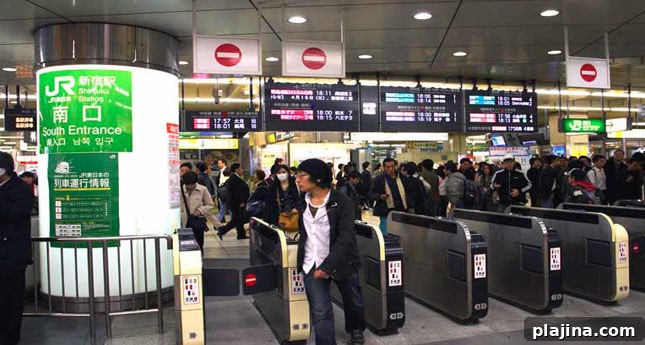
That confidence evaporated the moment we stepped into Shinjuku Station, suitcases in hand, unsure how to buy a ticket. Rivers of commuters flowed in every direction as we hunted for English on the subway map. Only later did we learn this is the world’s busiest transport hub: nearly 4 million people move through its 36 platforms every day.
We didn’t stay lost for long. A young Japanese businessman named Ryo noticed our confusion and offered help. We only needed to travel two stops, but without his assistance we might still have been the only stationary people amid a moving tide.
Japan’s long history of cultural independence helps explain the relative scarcity of English signage, even in a 13-million-person capital. Yet during our three-day stay we discovered that Tokyo’s quirky attractions and polite, helpful residents easily bridge language gaps.
Akihabara Electric Town, once a niche enclave for electronics enthusiasts, has reinvented itself as a major tourist draw. Government-backed promotion transformed its manga stores, arcades and gadget shops into an emblem of “Cool Japan.”
On a Sunday afternoon the sidewalks brimmed with teenagers trading maid cards (maids—modern café attendants who chat and serve—are a contemporary echo of older entertainment roles). Girls in oversized bows and petticoats strolled the pedestrian boulevard, while Sailor Moon look-alikes tried to entice passersby into manga stores.
We wandered through a maze of pachinko parlors and claw-machine arcades, dazzled by flashing lights. Nearby shops sold everything from wiring to novelty dolls to comic books. A maid called from a second-floor balcony, then retreated when I raised my camera.
We ducked into a small lunch counter and pointed at menu items we couldn’t read. It turned out to be a soba noodle shop with clear-broth bowls that resembled plain spaghetti. On the way out we heard diners say, “Gochiso-sama deshita,” which our guidebook translated as “It was a real feast.”
My husband repeated the phrase with tongue planted firmly in cheek. The owner smiled appreciatively.
Uneo Park © Lucian Milasan | Dreamstime.com
Not all of Tokyo pulses with neon. In Ueno Park on the city’s northeast side we found a quiet refuge of hidden temples, koi ponds and brilliant winter foliage—red, yellow and orange trees providing a spectacular surprise in December. Elderly cyclists pedaled by while a group shuffled through a traditional dance in socks and slippers.
Beyond the park lies Yanaka, a neighborhood that preserves the old merchant-class atmosphere. Narrow alleys reveal small coffee shops, traditional houses and food stalls. At a street vendor near Yanaka Cemetery—the final resting place for about 7,000 residents—we warmed our hands with cups of thick, sweet hot saké, a comforting, almost baby-food–like drink.
The cemetery was largely empty except for a fat orange cat asleep atop a gravestone. Wooden sotoba grave markers clattered in the breeze. At the far end of the grounds, a father taught his son how to clap and pour water at a Shinto shrine, practicing rituals rooted in Japan’s ancient animist traditions. Strips of paper bearing fortunes fluttered around the temple entrance.
Stunning views from Park Hyatt Tokyo’s New York Bar © Park Hyattt Tokyo
Another calm refuge is the Park Hyatt Tokyo, where we spent our final night wrapped in colorful yukata robes, sipping green tea and watching traffic from our 43rd-floor window. The hotel, set high in a Shinjuku skyscraper, was famously featured in Sofia Coppola’s film Lost in Translation.
The Park Hyatt exceeded the film’s promise. Rooms are furnished in soothing earth tones with green marble, granite and Hokkaido water-elm paneling. In addition to deep in-room tubs, the Club on the Park spa offers wet and dry saunas, whirlpools and rain showers with Aesop toiletries. A private elevator rises to a glass-enclosed pool and fitness center with views that can extend to Mount Fuji.
After cocktails at the 52nd-floor New York Bar, we dined at Kozue, the hotel’s Japanese restaurant, for the culinary highlight of our trip. Seated by the window, we watched the glow of radio towers and holiday displays. At a nearby table a group of businessmen alternated bows, hugs and toasts with foamy glasses of Asahi.
My husband, ever the adventurous diner, ordered the blowfish set—an eight-course menu showcasing one of the world’s most poisonous fish, prepared only by licensed chefs. I selected seasonal dishes: seared mackerel sushi, crispy yams and deep-fried persimmon with cheese. Each course arrived on a piece of lacquerware from the restaurant’s extensive 4,000-item collection.
Several hours later, pleasantly dazed by saké and rich flavors, our kimono-clad server asked, “Did you enjoy your meal?”
I leaned back and answered, “It was a real feast.”
Tokyo Info to Go
International flights arrive at Narita International Airport (NRT) and Haneda International Airport (HND). Narita is about 35 miles from central Tokyo; a taxi can cost more than $225 and take two hours or longer, while the Narita Express runs hourly, takes roughly 60 minutes and costs about $32. Haneda is only about nine miles from the city center and also offers train and taxi options. Subways and commuter trains are generally the most affordable—and often the fastest—ways to get around the city.
Where to Stay in Tokyo
Claska Stylish rooms designed by leading Tokyo designers, featuring original furniture and distinctive architectural touches. 1-3-18 Chuo-cho, Meguro-ku $$$$
Park Hyatt Tokyo Occupying the top floors of a Shinjuku skyscraper, the Park Hyatt blends minimalist design with luxurious comfort. 3-7-1-2 Nishi-Shinjuku, Shinjuku-ku $$$$
Sukeroku No Yado Sadachiyo A traditional Edo-style inn where guests sleep on tatami mats, soak in a cypress tub and enjoy elaborate meals. 2-20-1 Asakusa, Taito-ku $$$$
Restaurants in Tokyo
Kozue Contemporary Japanese cuisine served in a spectacular setting on the 40th floor of the Park Hyatt Tokyo. 3-7-1-2 Nishi-Shinjuku, Shinjuku-ku $$$$
Sukiyabashi Jiro The celebrated sushi master Jiro Ono crafts sushi in an intimate, 10-seat restaurant. Tsukamoto Sogyo Building B1F, 2-15 Ginza 4-chome, Chuo-ku $$$$
Swallowtail Butler Café A female-oriented take on themed cafés where personal butlers serve afternoon tea and address patrons as “Your Highness.” Masakazu Building B1F, 3-12-12 Higashiikebukuro, Toshima-ku $$$