
The palatial grounds of the Taj Mahal are more than a monument to exquisite craftsmanship and eternal love; they also hold a series of subtle optical effects that captivate over a million visitors each year. Those visual surprises help the Taj Mahal remain a top destination on many travelers’ lists.
Declared a UNESCO World Heritage site in 1983 and named one of the New Seven Wonders of the World in 2007, the Taj Mahal was commissioned in 1631 by Mughal emperor Shah Jahan in memory of his beloved wife, Mumtaz Mahal. The primary mausoleum was completed in 1648 as her final resting place and as a symbol of his devotion. Over time, the site evolved to include a long reflecting pool, formal gardens, and two symmetrical outbuildings: a mosque and a guesthouse.
Visitors enter the mausoleum with reverence, often barefoot or wearing soft shoe covers to protect the marble and honor local customs. Inside the main chamber, you see two ornate cenotaphs set within marble screens inlaid with semi-precious stones; these are decorative. The actual graves of Shah Jahan and Mumtaz Mahal lie in crypts directly beneath the floor. Sunlight filters through perforations in the marble, producing delicate shafts of light, while the interior’s acoustics are so precise that a single musical note can seem to reverberate several times within the tomb.
The monument also plays clever tricks on perception as you move around it. From the Great Gate, the Taj Mahal’s scale is immediately imposing, yet as you walk closer the structure can appear to shrink rather than grow—a counterintuitive effect that surprises many visitors.
Every element of the complex reflects an emphasis on balance and durability. The four minarets that frame the mausoleum look perfectly vertical from a distance, but on closer inspection they tilt slightly outward. That intentional lean was a protective measure: if a minaret were to fall in an earthquake, it would fall away from the central tomb. These carefully applied design choices reveal the architects’ skill and practical foresight.
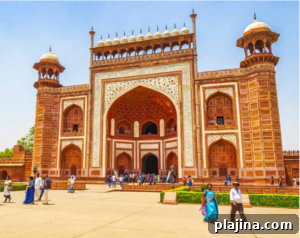
PHOTO: © © ARKADIJ SCHELL | DREAMSTIME.COM
Seating areas line the complex beside the famous reflecting pool, which draws crowds eager for the ideal photograph. Whether you stroll through the manicured gardens or rest in the arched recesses along the southern Great Gate, the site’s calm atmosphere encourages quiet observation and reflection.
Taking the time to sit and watch the monument reveals one of its most enchanting visual effects: the marble façade appears to change color based on the time of day. Although the white Makrana marble is naturally ivory-toned, morning light can lend it a pale pink cast, while evening light can turn it a soft, milky blue. At midday the marble reflects strong sunlight and looks luminous white, and during sunset it may take on warm orange-bronze tones as it absorbs the fading light. These shifting hues contribute to the Taj Mahal’s sense of living beauty.
For visitors seeking a truly memorable experience, a night visit during the full moon offers an unforgettable perspective. On five nights each month—two nights before and after the full moon and the full moon night itself, excluding Fridays and the month of Ramadan—the Taj Mahal opens for limited 30-minute nighttime slots. Bathed in moonlight, the domed silhouette mirrored in the long pool creates an especially tranquil and magical scene. That quiet, luminous view often becomes the highlight of a lifetime visit.
INFO TO GO
The Taj Mahal stands about 130 miles southeast of Delhi in the city of Agra. Most international travelers arrive at Indira Gandhi International Airport in Delhi. From there, the fastest way to reach Agra is by train from New Delhi Station, which is roughly a 20-minute taxi ride from the airport and takes about two hours to Agra. From Agra’s station a short taxi or tuk-tuk will bring you to the Taj Mahal ticket office. Alternatives include a private car (about 2.5 hours) or a public bus (around five hours). Once at the ticket booth, gas- and diesel-powered vehicles are restricted from the complex; visitors proceed on foot or use the site’s electric shuttles to the East Gate entrance. The Taj Mahal is closed every Friday. The best months to visit are October through March, when monsoon risk is low and daytime temperatures are milder for walking the grounds.