
An Asian city with a global outlook and strong regional ties, Taipei is steadily defining a modern identity amid powerful neighbors.
As the political capital for Taiwan’s population of 23 million, Taipei City is also the island’s economic and cultural hub. The city itself is home to about 2.7 million people; together with neighboring Keelung and New Taipei City, the greater Taipei metropolitan area contains roughly 7 million residents.
Located in northern Taiwan, Taipei sits on a former lake bed crossed by the Danshui, Xindun and Keelung rivers, which connect the city to the Taiwan Strait and local ports. The nearby Yangming Mountains, hot spring resorts and a network of hiking and biking trails are all within an hour of downtown, offering easy access to outdoor recreation.
Modern Taipei is friendly and easy to navigate. The Mass Rapid Transit (MRT) system opened in 1996 and has expanded to multiple lines with additional extensions planned. The city benefits from efficient public transport that complements an extensive bus network and plentiful taxis.
Taiwan markets itself as the “Heart of Asia.” Its proximity to mainland China, Japan, Korea and Southeast Asia has anchored the island’s role in regional and global trade for centuries.
The island attracted European powers in the 17th century, and later waves of migration from Fujian and Hakka communities helped shape Taipei’s culture. Japanese rule from 1895 until 1945 left an imprint on infrastructure and urban form. After World War II, the Kuomintang (KMT) government made Taipei the seat of its administration. Many of China’s national treasures were brought to Taiwan during that period and are now housed in the National Palace Museum.
The jadeite cabbage at the National Palace Museum © Taipei City Govt.
In the 1950s and 1960s, Taiwan transitioned from an agricultural economy to a manufacturing powerhouse in a period often called the Taiwan Miracle. From the late 1980s onward, labor-intensive manufacturing shifted to lower-cost regions, while Taiwan expanded its strengths in technical services, design engineering and information technology, becoming a world-class center for high-tech manufacturing.
Taiwanese companies produce a significant share of the world’s notebook and tablet computers, motherboards, servers and other IT components. Foxconn, headquartered in the Taipei area, is the world’s largest electronics manufacturer and produces devices for major global brands. Leading Taiwanese technology names include Asus, Acer and HTC.
The United States is one of Taiwan’s top trading partners. Taiwan’s Ministry of Economic Affairs established the Taiwan-U.S. Industrial Collaboration Promotion Office to foster cooperation in green energy, biotechnology, intellectual property and telecommunications.
Cross-strait economic ties have developed in recent years. The Economic Cooperation Framework Agreement (ECFA) and increases in direct flights have facilitated trade and tourism between Taiwan and mainland China, contributing to a rise in visitors from the mainland.
Shifting from a gray industrial past to a greener, high-tech future, Taipei has been investing in environmental improvements and urban livability. City initiatives promote green walls on construction sites, widespread recycling, more trees and parks, and better cycling infrastructure. The YouBike public bike-sharing program makes short trips convenient and encourages active transport.
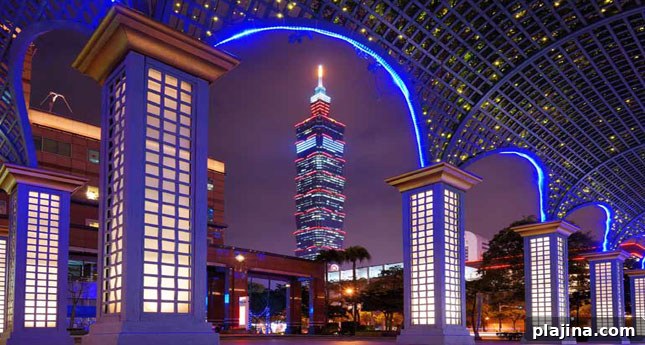
The Economist Intelligence Unit’s Asian Green City Index rated Taipei highly for public transport, incentives for eco-friendly construction, green roofs and urban green space. A notable symbol of the city’s environmental ambitions is Taipei 101, a landmark in the Xinyi financial district that earned LEED Platinum certification and stands as one of the world’s tallest green buildings.
Designed with bamboo and traditional motifs in mind, Taipei 101’s blue-green glass façade is organized into eight tiers and illuminated with changing lights each evening.
Fruit stand at a night market © Paulwongkwan | Dreamstime.com,
Hospitality offerings have expanded with modern hotels such as W Taipei, Le Méridien Taipei and Okura Prestige, while several new properties are opening to meet rising visitor demand. Taipei’s growing inbound tourism is supported by visitors from Southeast Asia, mainland China and Hong Kong, drawn by the city’s reputation for dining, shopping and vibrant street life.
Taiwanese cuisine reflects regional influences—Shanghainese, Hakka and southern Chinese elements blended with local tastes. Excellent Japanese restaurants and lively night markets offer a wide range of snacks and dishes, making Taipei a food-lover’s destination.
Investment in the arts and cultural reuse of historic buildings has given the city new creative districts. In Zhongshan, the former American consulate is now SPOT Taipei Film House, a restored mansion and multipurpose arts venue screening mainly art-house films.
Huashan 1914 Creative Park © Taipei Huashan 1914
Huashan 1914 Creative Park repurposes brick factory buildings into galleries, studios, exhibition spaces and pop-up shops. The site hosts craft fairs, markets and concerts, and its open lawn and plaza make it a popular gathering place.
The Songshan Cultural and Creative Park, redeveloped from the former Songshan Tobacco Plant, houses the Taiwan Design Museum and multipurpose venues. These cultural projects reflect Taipei’s commitment to preserving heritage while fostering contemporary creative industries.
Plans to revitalize riverfronts and open green spaces, including improvements to the Tamsui River ahead of major international events, aim to make the city more attractive for residents and visitors alike.
Things to Do in Taipei
Visit the Shilin District, located between the Keelung River and the hills, where the largest night market and the National Palace Museum are top attractions.
The National Palace Museum, set amid landscaped grounds north of the city, holds one of the world’s most significant collections of Chinese art. With more than 680,000 items in its holdings, the museum displays only a portion at any time but offers impressive exhibits of ancient bronzes, ceramics and delicate carvings. One famous piece is the jadeite cabbage, often the focus of long lines. The museum is open daily and extends evening hours on certain days; visiting outside peak hours reduces crowds.
Shilin Night Market is lively most nights and stretches over several blocks. Open from early evening until after midnight, it’s an ideal place to sample local specialties such as scallion pancakes, oyster omelets, meat skewers, fried snacks and more adventurous items like stinky tofu. Shaved ice topped with fresh fruit is a popular dessert and a refreshing way to enjoy local produce.
If you don’t make it to Shilin, other popular markets include Raohe Street Market and Linjiang Street Market, each offering a distinctive mix of food and shopping.
Taipei: Just the Facts
Time Zone: GMT +8
Phone Code: Country code: 886, City code: 2
Currency: New Taiwan dollar
Entry/Exit Requirements: U.S. citizens may visit for up to 30 days without a visa; passports should be valid for six months beyond the stay.
Official Language: Mandarin Chinese; Hokkien and Hakka dialects are common, and some English and Japanese are also spoken.
Key Industries: Electronics, communications and information technology, tourism
Taipei Info to Go
Most international flights arrive at Taipei Taoyuan International Airport (TPE), about 30 miles from downtown. Taxis to the city typically take around 50 minutes; buses provide frequent service to major destinations and hotels. Within the city, the MRT is efficient and affordable, while buses and taxis offer additional convenient options. Carry a map or have your destination written in Chinese for drivers when needed.
Checking in with Chao Hsin-Ping
Commissioner, Department of Information and Tourism, Taipei City
What draws business travelers to Taipei?
Taipei’s busy calendar of exhibitions and meetings attracts business travelers regularly. Major trade events like Computex Taipei and the Taipei International Auto Parts & Accessories Show bring international delegates and stimulate hotel demand, dining and local services. Business visitors provide significant economic benefits and help promote Taipei’s strengths—food, culture, hospitality and convenient transport—on the global stage.
What are the strengths of Taipei’s creative industries?
Taipei’s neighborhoods reflect a rich mix of history, culture and entrepreneurship. Creative professionals have helped energize commercial districts, opening shops, studios and cultural spaces that contribute to a distinctive urban character and vibrant street life.
What recent infrastructure improvements support Taipei’s role as a regional hub?
Direct-flight agreements have linked Taipei’s Songshan Airport with key regional airports in Shanghai, Tokyo and Seoul, reinforcing Taipei’s position as an East Asian aviation hub. The city is also advancing major construction and redevelopment projects to support future growth.
What are current focuses for Taipei business travel?
Experiential tourism is a growing priority, encouraging visitors to engage more deeply with local culture, cuisine and creative scenes rather than simply checking attractions off a list.
Where to Stay in Taipei
Grand Hyatt Taipei Adjacent to the Taipei World Trade Center, this large business hotel features numerous rooms and dining options. 2 Songshou Road, Xinyi District $$$$
Villa 32 A refined retreat in the Beitou hot spring area offering private hot spring rooms and suites. 32 Zhongshan Road, Beitou District $$$$
W Taipei A stylish hotel with contemporary design and thoughtful amenities. 10 Zhongxiao E. Road, Section 5, Xinyi District $$$$
Restaurants in Taipei
Alleycat’s A relaxed spot for oven-baked pizzas, craft beers and alfresco dining in a creative neighborhood. 1 Bade Road, Section 1, Zhongshan District $$
Din Tai Fung Famous for exquisite xiao long bao, this popular spot is efficient and consistent, drawing crowds who enjoy watching the chefs prepare dumplings. B1 Sogo, 77, Section 6, Zhongshan N. Road, Shilin District $
Shin Yeh 101 A restaurant known for modern and traditional Taiwanese cuisine; the Taipei 101 location is a flagship requiring reservations. 85-1F Taipei 101, 7, Section 5, Xinyi Road, Xinyi District $$$
Read more about Taipei’s YouBike program on official city sources and local transit guides.