
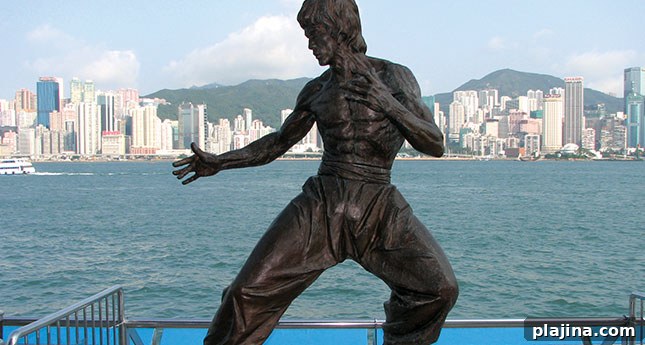
Bruce Lee watches over the harbor. With his back to the glass-and-steel skyline of Hong Kong Island, which rises like an irregular wall across the pungent breadth of Victoria Harbour, he stares unblinkingly from a granite pedestal. Cast in bronze, his body is taut and ready—muscles coiled, legs poised, arms held for defense or attack.
On the Avenue of Stars, the paved promenade that extends into the water, six elderly people—two men and four women—mirror a similar calm readiness. Set to the soft strains of Chinese music, they shift weight from foot to foot in unison. One arm lifts while the other lowers; the raised palm twists; they step forward, then lean back. Each movement is deliberately slow, performed with controlled grace.
That morning ritual repeats across public squares and parks throughout the densely populated Kowloon district. For a few minutes the city’s tempo slows: the rush of traffic, the clatter of market stalls, radios leaking from open windows and the bark of street dogs all fade into the background. Attention tightens on each purposeful gesture. For those brief moments, the strains of modern life and the aches of age are soothed by tai chi.
Outsiders often dismiss tai chi as a gentle, slow-motion version of Chinese martial arts—a pleasant pastime for energetic seniors. In truth, tai chi is a diverse tradition with roots that stretch back centuries into China’s mist-shrouded highlands. It branches into five principal schools, and from them a wide variety of styles has evolved. Some emphasize athleticism and combat, while others prioritize elegance and meditation.
The Yang style is the most widely practiced, known for its evocative posture names—White Crane Spreads Its Wings, Parting the Wild Horse’s Mane—and for sequences that flow from one pose to the next. Short forms of 16 postures may take two minutes to complete; longer sequences that contain more than a hundred postures can last around half an hour.
On that humid morning, the six Kowloon practitioners move through their lengthy sequence without breaking a sweat, breathing deeply and evenly. Each twist and turn engages specific muscle groups; the entire routine aims to keep the body both supple and strong.
But tai chi yields more than physical benefits. It cultivates intense concentration, merging mind and body in a single focused activity. That union of mental discipline and physical control was likely formative for the young Bruce Lee.
Although Lee was born in San Francisco, his parents returned to Hong Kong when he was still an infant, settling in Kowloon. As a teen he drifted into street fights, and his father sought a disciplined practice to steady him. Bruce was introduced to the Wu style of tai chi, a foundation that helped shape the distinctive kung fu he would later bring to the screen. When his cinematic fight scenes are slowed down, the influence of tai chi’s fundamentals becomes unmistakable.
At the foot of Bruce Lee’s statue, the dual nature of tai chi is visible. A traditional junk sails across the harbor against a backdrop of towers and bright billboards, underscoring a modern China built on contrasts. As the elderly group winds down their routine, the bronze figure remains poised—balanced between serenity and force, between youthful energy and a sense of timeless calm.