
The world is an unpredictable place. Despite our efforts to create order—calendars, borders, and social hierarchies—human-made systems can be fragile. Dates can shift in meaning, countries can change, and positions of privilege can evaporate, leaving people exposed and disoriented.
If that sounds abstract, you probably haven’t played table tennis in Ethiopia.
My sense of dislocation began the moment I arrived in Addis Ababa. I set my watch three hours ahead of GMT, but the disorientation ran deeper than a simple time change. Ethiopia follows the Ge’ez calendar, which is roughly seven years and nine months behind the Gregorian calendar used in most of the world. While the rest of the world marked 2013, Ethiopia was still in 2006.
Heading north to Lalibela, the difference felt less like hours or years and more like centuries. Everywhere I looked there were scenes that could belong to another era: men wrapped in traditional robes gathered at rock-hewn churches, mules shouldering heavy loads along mountain tracks, and women seated by open fires tending fragrant stews in clay pots.
Then, wandering down a narrow lane, I heard an incongruous, familiar sound that whisked me back to boarding school weekends and a simple pastime that banished boredom. Ping, pong, ping, pong.
Table tennis—commonly called Ping-Pong—has surprisingly genteel origins. In the late 19th century, English country-house gatherings often ended in the library. When after-dinner conversation flagged, books were arranged across a table to form a net, books served as paddles, and a Champagne cork acted as a ball. The improvised matches provided amusement and a degree of civilized competition.
Over time, manufacturers standardized the game: purpose-built tables and nets, rubber-surfaced bats replacing books, and hollow celluloid balls replacing corks. With rules formalized and equipment manufactured, table tennis spread far beyond country-house libraries—to Asia, the Americas, and even a narrow alleyway in Lalibela.
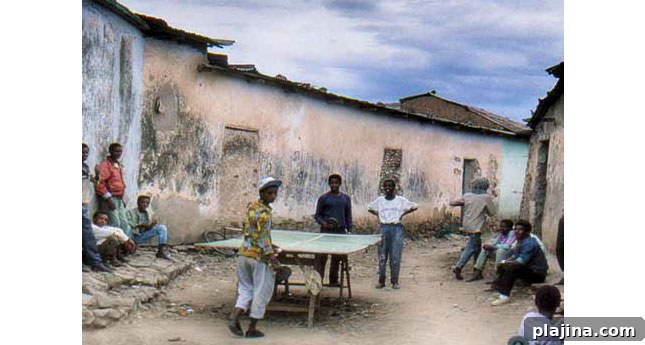
Two boys were playing when I arrived; twenty more were watching. Their game paused as I drew near. After a brief silence, one of the onlookers explained they were holding the “African Union Championships.” Then he asked where I was from.
“England,” I said.
There was a collective sigh, then I added, “But I grew up in Kenya.”
“Kenya!” The mood changed instantly. I was invited to the table, hands were shaken, friendly slaps landed on my back, and a bat was thrust into my hand. Someone drew a rough Kenyan flag in chalk beside a dozen Ethiopian flags on the wall by the table.
Table tennis is played passionately across Ethiopian towns and villages, often with improvised equipment. In that way it echoes its improvised country-house beginnings. But when an outsider takes part, a different element usually appears: national pride.
There was a lengthy debate about who should represent Ethiopia against me, representing Kenya. Eventually a lanky boy stepped up and the stakes were revealed: a dollar a game, winner takes the pot, loser pays.
Kenya did not prevail. Not once, not twice, but many times. My years of schoolroom practice counted for little. With each loss went my money and a little of my pride.
Yet when you find yourself adrift in a captivating place, surrounded by people with whom you share little beyond a moment, sport can bridge the divide. It strips away background and status; it focuses attention on the immediate—on the rally, the serve, the return. In that narrow present, nationality, time and custom fade. All that matters is the game.