
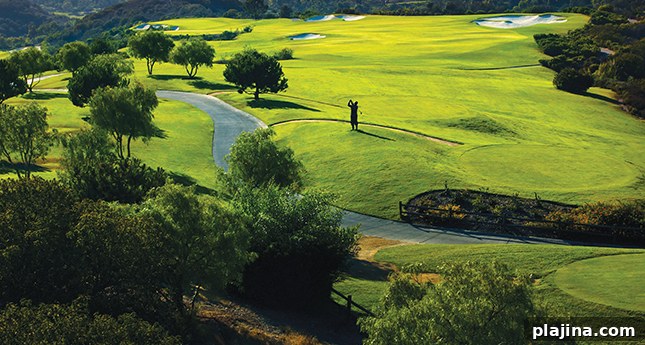
The Grand Del Mar in San Diego, voted by Global Traveler readers as the Best Hotel in the United States, owes much of its distinction to The Grand Golf Club, an exceptional amenity that significantly enhances the resort experience. Designed by Tom Fazio and originally opened in 1999 as part of the Meadows Del Mar private residential community, the course became part of The Grand Del Mar Resort in 2003.
Set within Los Peñasquitos Canyon Preserve, the course features varied elevation, diverse bunker styles and meticulous maintenance that give it the feel of an elite private course. It is private in practice as well as in name — access is limited to members and hotel guests.
The private club atmosphere is reinforced by a top-notch forecaddy program. Each group is paired with an experienced forecaddy who helps read putts, offer course strategy and handle bunker raking and other duties. Our forecaddy, Wes, added to the round by advising on club selection, pacing putts and providing friendly banter, which improved our overall enjoyment of the course.
The hotel itself is grand in scale and design. Dining at Addison offers an elegant evening experience; Chef Bill Bradley was featured in Global Traveler’s “Bon Vivant” profile in November 2007. No expense was spared in the resort’s construction, and that attention to detail and finish is apparent throughout the property. Guests can relax by the pool, catch a shuttle to nearby beaches, or visit the ornate on-site chapel — a distinctive venue worth seeing during a stay.
Hole 1 (383 yards, par 4)
Wes briefed us on the layout and the course’s subtleties before we teed off. A statue of golf legend Bobby Jones stands near the tee; Jones remains the only golfer to win the true Grand Slam (British Amateur, British Open, U.S. Open and U.S. Amateur) in 1930. The first tee offers a downhill view and a narrow landing area. The optimal drive sits left-center in the fairway. My own tee shot found the slope and rolled toward the right, ultimately coming to rest near the cart path under a tree guarding the right side of the green. A misplayed chip and a narrowly missed putt turned my hole into a bogey.
Hole 3 (565 yards, par 5)
At 565 yards, this par 5 sits at the base of rolling terrain and features a tight fairway. From the tee, avoid three bunkers positioned just before the dogleg — two left and one right — as the hole then climbs gradually toward one of the course’s longest greens. Take note of false fronts and a prominent hump running through the green that can complicate approach shots and putting lines.
Hole 4 (480 yards, par 4)
Rated the toughest handicap hole, this dogleg-left demands strategic shot placement. Bunkers flank the fairway on both sides, and missed targets often find rough or ravines. About 100 yards out the fairway slopes dramatically down toward the green. With careful play you can bump-and-run onto the green, though there is a bunker guarding the left side that must be respected.
Hole 5 (378 yards, par 4)
This narrow hole intimidates from the tee. The fairway slopes significantly from right to left, and shots that land left risk bouncing into dense brush and trees. One teammate’s drive followed that exact path and disappeared into the undergrowth. I managed a solid drive and approach to save par, while others who aimed right weren’t visible again until the next hole.
Hole 11 (212 yards, par 3)
Though not the most scenic, this par 3 was one of the most fun holes of the round. My tee shot finished on the rear portion of the green. One player found the right bunker but produced an excellent bunker shot to set up a short two-putt par; another came up short and chipped close for a long putt; and one overshot into the trees and required a recovery that made for entertaining shots all around. The variety of recovery plays made this hole memorable.
Hole 12 (600 yards, par 5)
The course’s longest hole, this 600-yard par 5 is a true test. The tee shot carries over a small pond to a landing area where accuracy is essential. The second shot often calls for a fairway wood and substantial distance to set up an approach while avoiding moguls, bunkers and a fairway that slopes from left to right. Every shot on this hole must be executed with care.
Hole 16 (515 yards, par 5)
Previously a par 4, this hole was lengthened by 115 yards and converted to a par 5, increasing its difficulty. Despite being the shortest par 5 on the course, it still requires accuracy. The fairway runs downhill with a slight dogleg to the right. Shots favoring the left side will often roll back toward the center, while aggressive attempts to reach the green in two risk natural growth areas and water hazards that can come into play on overly long shots.
Hole 17 (242 yards, par 3)
This 242-yard par 3 plays like a long hole for most golfers. A substantial water hazard stretches across the front of the green and much of the bailout area, catching many tee shots. Safer play typically aims to the right side, though balls that bail out there can still find greenside traps. Back tee placements add another layer of difficulty because the green is tiered and requires precise distance control.
The Grand Golf Club
The Grand Del Mar
5200 Grand Del Mar Way
San Diego, CA 92130
tel 858 314 1930