
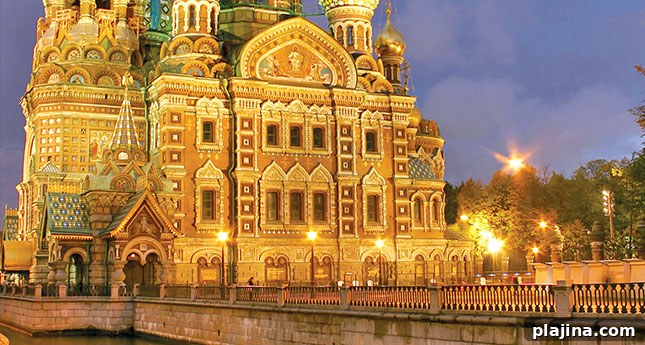
White days or white nights? Your impression of St. Petersburg depends on the season you choose. Visit in winter, when daylight is brief and the city is softened by a pristine blanket of snow, and you encounter the melancholy that inspired Dostoevsky’s novels and Tchaikovsky’s music. The Neva may be frozen, canals rimmed with ice and streets wrapped in cold mist — Russia’s northern metropolis at its most atmospheric.
In summer everything changes: the sun barely sets and the city glows under continuous translucent light. Fountains sparkle in imperial gardens, people lounge on the banks of the Neva, and the streets and canals take on a festive, luminous quality. Summer in St. Petersburg feels like a long celebration.
No matter the season, the city’s crowning attraction is the State Hermitage Museum, spread over six buildings on the Neva, including Catherine the Great’s ornate Rococo Winter Palace. Its collection ranks among the world’s greatest: masterpieces of Western and global art displayed across vast rooms and galleries. Even a brisk visit cannot capture the full depth of its holdings.
Less well known is the Hermitage Repository, a secure storage complex located about 40 minutes from the main museum. By arranging a private visit through specialist operators, visitors can gain exclusive access to rarely seen treasures, such as Catherine the Great’s golden coronation coach, and discover works not normally on public display.
The spine of the city is Nevsky Prospekt, one of the world’s great avenues, stretching for roughly two and a half miles from the Admiralty with its golden spire to the Alexander Nevsky Monastery. Along the way it threads through former aristocratic townhouses now home to designer boutiques, hotels and restaurants. Notable landmarks include the imposing Kazan Cathedral, with its sweeping classical colonnade.
A short walk north brings you to Ploshchad Iskusstv, the Square of the Arts, a harmonious public space bordered by the Mikhailovsky Theatre, the St. Petersburg Philharmonic Hall and the Russian Museum. While many visitors favor the Hermitage, the Russian Museum holds the world’s most comprehensive collection of Russian art, from ancient icons to contemporary works and installations.
Families with children will find specialized museums worth a visit. The Toy Museum houses around 1,500 exhibits from across the globe, while the Museum of Dolls offers playful, hands-on activities where visitors can create dolls from paper, straw or cloth, making it particularly engaging for younger guests.
Across the Neva, the Peter and Paul Fortress shelters several historic buildings, including the golden-domed cathedral where Peter the Great is buried. One fortress building became a rocket research facility in the 1930s and today houses the Museum of Cosmonautics and Rocket Technology, showcasing notable artifacts from the Soviet space program.
Historically, Russian rulers spent winters in the city and retreated to summer palaces scattered across the archipelago of islands that form St. Petersburg. The most splendid of these is Peterhof, Peter the Great’s seaside estate and Russia’s answer to Versailles. Visitors can reach Peterhof by coach or the regular hydrofoil service that departs from the Hermitage area.
Evenings in St. Petersburg offer high-quality cultural entertainment. The city remains a world-class center for ballet and opera; when possible, see the Kirov (Mariinsky) Ballet at its home theater for an unforgettable performance. For family-friendly shows, the Bolshoy Puppet Theatre offers imaginative productions, while the Zazerkalye Children’s Theatre stages operas and ballets, sometimes with English-language performances. The State Circus provides universally understood spectacle — acrobats, trapeze artists and animal acts — that transcend language barriers. Note that some venues have different pricing for foreign adults and locals, and children are often admitted for free.
The question of when to visit remains open: winter or summer? Each season brings its own magic. Autumn delivers rich colors and cooler air, and many locals argue that spring, when the city awakens after winter, is the finest time of year. Ultimately, St. Petersburg is a city for all seasons, offering compelling reasons to visit any time of year.
LODGING
GRAND HOTEL EUROPE
Stay in a historic palace with modern comforts. Opened in 1875 and restored after the Soviet era, Grand Hotel Europe blends imperial grandeur with contemporary luxury. A major renovation in the early 2000s restored many original features while enhancing amenities to meet today’s expectations. Positioned for sightseeing and formal events, it is a prestigious choice for travelers seeking refined accommodation.$$$$
GRAND HOTEL EUROPE
Nevsky Prospekt, 1/7 Ulitsa Mikhailovskaya
tel 7 812 329 6000
HOTEL DOSTOEVSKY
Well placed for families and shoppers, Hotel Dostoevsky is close to the Hermitage and a short walk from Nevsky Prospekt. The building houses a shopping mall and dining options, while the hotel’s superior rooms offer desirable street views. For budget-conscious guests, mall food courts provide affordable alternatives. Comfortable and convenient, this hotel suits visitors who want to be at the center of city life.$$$
HOTEL DOSTOEVSKY
19 Vladimirsky Prospekt
tel 7 812 331 3200
PETRO PALACE HOTEL
A comfortable, slightly more affordable option near major attractions, Petro Palace provides spacious rooms by local standards and family-friendly facilities. The hotel’s location makes it easy to reach the Hermitage, St. Isaac’s Cathedral and the shops along Nevsky Prospekt. Amenities include family-friendly dining and an indoor heated pool that’s popular with children.$$$
PETRO PALACE HOTEL
14 Ulitsa Malaya Morskaya
tel 7 812 571 3006
DINING
BORSALINO
Italian cuisine in St. Petersburg may seem unexpected, but the city’s cosmopolitan founding spirit lives on in restaurants like Borsalino. Located in the historic Angleterre Hotel, the restaurant showcases refined Italian dishes prepared by a skilled chef. The menu is polished and memorable — from perfectly executed pasta to standout desserts — making it a top choice for a special meal.$$$$
BORSALINO
St. Isaac’s Square, 24 Ulitsa Malaya Morskaya
PODVORYE
For traditional Russian flavors in a rustic setting, Podvorye near Pavlovsky Park offers hearty regional cuisine. Housed in a log-style building that evokes rural Russia, the menu features classics such as borscht and beef stroganoff, served in a relaxed atmosphere away from the city center. A good choice for visitors seeking authentic local dishes.$$$
PODVORYE
16 Filtrovskoye Ave., Pavlovsk
tel 7 812 466 8544
RUSSKAYA RYUMOCHNAYA No. 1
The name means “Russian Vodka Room No. 1,” and while vodka is part of the experience, the restaurant’s main draw is its broad presentation of Russian culinary traditions. The menu revisits recipes from different eras and social classes, from peasant-style stews to elaborate dishes once served to the elite. It’s an atmospheric spot to explore historic and regional specialties.$$
RUSSKAYA RYUMOCHNAYA No. 1
4 Konnogvardeisky Bulvar
tel 7 812 570 6422
INFO TO GO
International flights arrive at St. Petersburg’s Pulkovo-2 Airport (LED), approximately 10 miles south of downtown. Practical transport options include the Airport Express Bus for a roughly 40-minute ride at modest cost. Once in the city, the metro is an affordable and efficient way to travel; trains typically run every two to three minutes, with slightly longer gaps during early morning and late-night hours.
Plan accordingly for seasonal weather and allowances for longer lines at major attractions during high season. With its extraordinary museums, palaces and cultural life, St. Petersburg rewards visitors year-round.