
When Wilbur and Orville Wright lifted their hand-built, powered aircraft off the sand on Dec. 17, 1903, their goal was simple: achieve sustained, controlled flight and return safely to the ground by design rather than by accident. From that modest first hop at Kill Devil Hills, N.C., aviation has progressed in fits and bounds—sometimes in measured steps, sometimes in dramatic surges of innovation that reshaped how we fly.
Early aviators were not focused on extreme speed; stability and control were the priorities. The demand for faster, more capable aircraft grew rapidly as military needs intensified. By World War II, speed, climb rate and maneuverability had become vital to aircraft design and performance.
Design innovations such as swept wings and jet propulsion emerged, and Germany developed early high-speed fighters like the Messerschmitt Me-163 rocket fighter and the Me-262 jet fighter. These aircraft could outpace many Allied designs and showed the tactical advantages that jets could deliver. The Allies responded: Britain pushed the Gloster Meteor into service, using Rolls-Royce Welland engines, while the United States accelerated its own efforts to field jet-powered fighters.
On Oct. 1, 1942, at Muroc Dry Lake in California (now Edwards Air Force Base), the United States took a major step forward. Robert M. Stanley, a civilian test pilot for Bell Aircraft Corporation, flew the Bell XP-59A, the nation’s first jet-powered aircraft. The XP-59A Airacomet was a single-seat, all-metal monoplane with shoulder-mounted wings and two General Electric turbojet engines.
Bob Stanley and Laurence C. Craigie with the Bell XP-59A at Muroc Dry Lake, Calif., October 1942 © Craigie family
“The XP-59A Airacomet was designed to be our first jet fighter,” says F. Robert van der Linden, Ph.D., chairman of the Aeronautics Division and curator of air transportation and special purpose aircraft at the Smithsonian’s National Air and Space Museum. Bell’s approach produced a conventional, conservative design with relatively thick, straight wings because swept-wing theory was not yet proven. The aircraft was intentionally robust to perform better at higher speeds. The early GE engines installed in September 1941 were part of a small production run based on a design by British jet pioneer Sir Frank Whittle.
The day after Stanley’s civilian test flight, then-Col. Laurence C. Craigie piloted the XP-59A on the first official military flight, becoming the U.S. Armed Forces’ first pilot to fly a jet. Craigie had followed the project closely as it was built in Buffalo, N.Y., with engines assembled in Lynn, Mass. In his own account, Craigie emphasized how similar the flying experience felt in many ways to propeller-driven aircraft, while also noting distinct differences in noise, vibration and engine behavior.
I was thrilled to have the distinction of being the first military pilot to fly it, but I knew that the airplane doesn’t care whether it’s pulled or pushed; it only wants a certain amount of thrust. On those early tests, both Stanley’s and mine, the engines were experimental. We actually measured only about 800 pounds of thrust from each of the two early I-16 engines, so the airplane was underpowered at takeoff. Once airborne, jet engines became more efficient with speed. The most striking sensation was the smoothness and quiet—takeoff with a jet lacked the noise and vibration of propeller aircraft. That was probably the greatest impression I had.
Craigie also recalled an engine-cooling system that, instead of reducing windshield fogging, accidentally vented hot air into the cockpit. Combined with the desert heat and his flight gear, it made the first military jet flight an uncomfortably warm experience.
The XP-59A program was tightly controlled and shrouded in secrecy. During transport to the test site the aircraft wore a fake wooden propeller to disguise its true nature. Security measures were so strict that even Craigie’s closest family were kept in the dark; his wife, Victoria, who followed news about jet development and sent updates to him by V-mail, learned only later that he had already flown the aircraft almost a year and a half earlier.
Jack Craigie, Laurence Craigie’s son, first encountered the Bell P-59 in Model Airplane News during World War II while his father served overseas. Like his father, Jack pursued aviation for his own passion for flight. Both men later joined the Caterpillar Club, an informal association for people who have survived parachute jumps to escape disabled aircraft.
Jack’s own emergency escape came on June 4, 1955, while escorting a younger pilot in F-84Fs. Encountering severe cloud turbulence and a sudden engine failure, he recognized the aircraft was entering a dangerous state. He ejected at about 13,000 feet. Spinning violently and experiencing extreme centrifugal force, he managed to find and pull the seatbelt handle by feel, separate from the seat, and deploy his parachute. He credits the split-second decision and persistence with saving his life.
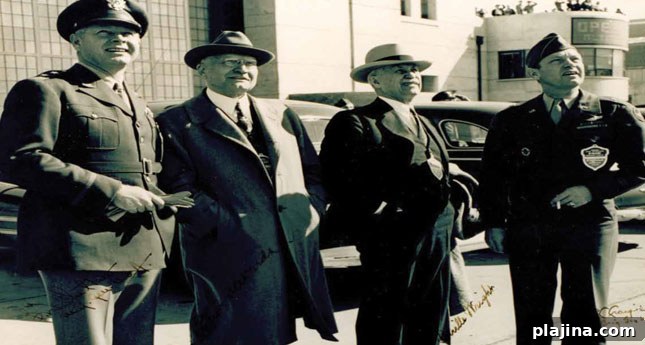
On Oct. 12, 1945, Orville Wright and Laurence Craigie stood together at Wright-Patterson Air Force Base and watched a jet fly overhead—the first time Orville had seen a jet in flight. That moment linked the earliest era of flight to the modern age. Today, commercial jet travel is routine and comfortable, yet it rests on the decades of experimentation, risk and ingenuity that pioneers and test pilots contributed.
Musician John Craigie, grandson of Lt. Gen. Laurence C. Craigie and son of Jack Craigie, reflected on the family legacy after his grandfather’s induction into the National Aviation Hall of Fame: sharing the stage with astronauts and legendary aviators helped him appreciate the significance of his grandfather’s achievements.
Lt. Gen. Laurence Craigie hang gliding at age 90 at Kill Devil Hills, the site of the first Wright brothers’ manned, powered flight © Craigie family
Shortly before he died in 1994, nearly 91 years old, Lt. Gen. Laurence C. Craigie returned to Kill Devil Hills. He strapped into a hang glider and launched from the same dunes where Wilbur and Orville first flew—closing a remarkable circle of aviation history and celebrating a lifetime spent at the leading edge of flight.