
Despite its global outlook and gleaming skyline, Singapore remains fundamentally a tropical island. City planners have consciously preserved greenery amid the concrete and glass, and there are still pockets of rainforest and mangroves that echo the landscape encountered by Sir Stamford Raffles when he established a trading outpost here in 1819.
That outpost evolved into the modern city-state Singapore is today. Can nature truly endure in one of the most densely populated places on Earth? The answer is yes — it must. Singapore’s health and quality of life depend on its natural systems, and the nation has long prioritized preserving habitats and biodiversity.
Sungei Buloh Wetland Reserve, on the island’s northern coast, is one of the most important of these preserved areas. Protecting roughly 320 acres, it serves as a crucial stopover for migratory birds and provides habitat for otters, snakes and even saltwater crocodiles.
The largest remaining stretch of primary forest sits near the island’s center, surrounding the main reservoirs and for decades housing the Singapore Zoo and Night Safari. These attractions are being integrated into an ambitious Mandai Park development. In 2019, a wildlife bridge of planted rainforest was built to reconnect forest patches previously divided by a highway. Mandai’s wider plan includes a new bird park, a rainforest park and aerial walkways. Once completed, the eco-tourism hub is expected to draw millions of visitors annually.
Occupying an island roughly half the size of greater Los Angeles, Singapore has long recognized that environmental challenges cannot be deferred. Sustainability guides urban planning, helping the city earn a reputation as one of the region’s and the world’s most sustainable cities.
In 2019 Singapore introduced a carbon tax designed to cut emissions and promote energy efficiency. Companies emitting more than 25,000 tons of greenhouse gases annually now pay a tax that funds green initiatives. While the tax initially affects electricity prices, improved energy use and investments funded by the revenue are intended to offset the impact.
One unavoidable reality of a small island is heavy reliance on imported food — more than 90 percent of Singapore’s food supply is imported. That creates a significant carbon footprint, but Singapore is addressing the issue through innovation.
Urban farming is a rapidly growing sector. Farms make use of rooftops, small land parcels and high-tech indoor systems that produce greens year-round. Some operators use vertical farming and climate-controlled, multi-level facilities to grow vegetables at scale, reducing reliance on long-distance supply chains and cutting transport emissions.
Since the 19th century, Singapore’s strategic location made it a global trading hub. Balancing that role with sustainability is a current priority.
On the island’s southwest, construction is underway on the Tuas Mega Port, a multibillion-dollar, phased project planned to open between now and 2040. The fully automated port aims for high energy efficiency and operational innovation, reflecting Singapore’s ambition to rethink the future of shipping.
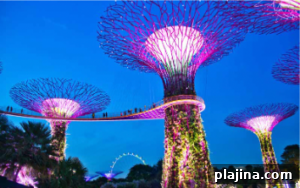
PHOTO: © JASON YODER | DREAMSTIME .COM
Singapore often resembles the futuristic visions once confined to science fiction. The 160-foot Supertrees at Gardens by the Bay are a striking example: during the evening they glow with solar-powered LED lights, creating an immersive, otherworldly landscape.
Practical innovations are equally forward-looking. To maximize limited space, Singapore unveiled an Underground Master Plan that begins with shared utility tunnels routing water, waste, power and communications beneath city streets. Longer-term plans include moving more transport infrastructure underground and repurposing natural caverns for storage and reservoirs.
Above the city, automated drones are already in use for logistical tasks. Trials using drones for shore-to-ship deliveries demonstrate how autonomous systems can serve ports and, eventually, urban delivery and passenger transport, illustrating how Singapore experiments with tomorrow’s technologies today.
CHECKING IN WITH CHRISTIAN WESTBELD
General manager, Raffles Hotel Singapore
In mid-2019 Raffles Singapore debuted the results of a two-year restoration. How did the hotel renovate while also paying homage to its iconic history?
Raffles Hotel Singapore is regarded as a national treasure. The restoration was carried out with heritage consultants to ensure careful research and preservation of the hotel’s character. The renovation introduced new guest experiences and community spaces while retaining the hotel’s historic charm.
The refreshed Raffles includes the new Raffles Arcade, featuring curated shopping, and a new spa. The redesign blends elegant, contemporary interiors with the property’s colonial-era architecture, offering multigenerational appeal while respecting heritage details.
Raffles retained signature venues such as the Tiffin Room, Writers Bar and Long Bar, and added restaurant collaborations with acclaimed chefs to broaden its culinary offerings. These additions were designed to complement the hotel’s legacy while appealing to modern travelers.
As we all know, 2020 threw a curveball at the travel industry. How has Raffles Singapore handled the pandemic?
Since reopening for bookings after the circuit breaker, the hotel has seen encouraging demand, primarily driven by staycation packages targeted at local guests. The property expanded history tours for in-house guests and adapted services to meet the preferences of domestic travelers.
Health and safety protocols based on national and industry standards were implemented, including enhanced sanitation and operational procedures to protect guests and staff.
What do you see for the future of hospitality in Singapore as travel begins to rebound?
Singapore’s strong public-health response and vaccination rollout position it well for recovery. Industry expectations point to a gradual rebound, with domestic travel and events leading the near-term recovery. Raffles has invested in digital tools — virtual site inspections, 360-degree visuals and content that communicates safety measures — to support bookings and events until international travel fully resumes.
Which local attractions and activities do you recommend for travelers to Singapore?
Recommended experiences include heritage tours that explore Peranakan culture, bicycle rides through the civic district, Gardens by the Bay and the Singapore Botanic Gardens — the island’s UNESCO World Heritage-listed site. Sentosa Island offers beaches, nature and attractions suitable for a full-day outing.
What new developments in Singapore are you most eager for?
With restrictions easing, in-person events, weddings and local gatherings are returning. The hospitality sector is focusing on digital engagement, strengthened partner communications and culinary innovation. The local dining scene continues to grow, with multiple restaurants earning regional recognition.
DIVERSIONS
Changi Airport often stands as a destination in itself. The Jewel complex, opened in 2019, features an indoor rainforest, a multi-story waterfall and family attractions that draw both transit passengers and local visitors. Changi also incorporates design features aimed at reducing environmental impact, including extensive use of natural light, recycled materials and food-waste conversion systems.
© ASHWIN KHARIDEHAL ABHIRAMA | DREAMSTIME.COM
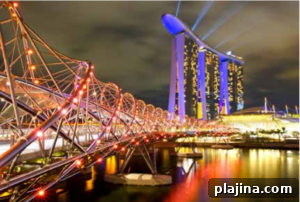
To address space constraints, Singapore completed a major land-reclamation and development project in the Marina Bay area. Marina Bay Sands and the surrounding district, including Gardens by the Bay and its Supertrees, have become defining elements of the city’s skyline and public realm. At the same time, the Colonial District and statues honoring Sir Stamford Raffles preserve the city’s historical roots amid rapid modernization.
LODGING
Raffles Hotel
A landmark of colonial elegance since 1887, Raffles Hotel reopened in 2019 after a sensitive two-year restoration that preserved its traditional ambiance.
1 Beach Road
$$$$
The St. Regis Singapore
A luxury property known for refined service, culinary offerings and signature butler service, located in a convenient area near city attractions.
29 Tanglin Road
$$$$
The Warehouse Hotel
A restored 19th-century riverside warehouse transformed into an intimate boutique hotel that blends industrial heritage with contemporary design.
320 Havelock Road
$$$$
DINING
328 Katong Laksa
A well-known casual spot for laksa, a spicy noodle soup; multiple locations across the city.
216 E. Coast Road
$$
Folklore
A restaurant celebrating Singapore’s multicultural culinary heritage with Chinese, Malay, Indian and European influences. The venue reopened with renewed service and menus.
Destination Hotel, 700 Beach Road
$$$
Zén
A fine-dining destination offering a tasting menu for special occasions, featuring creative cuisine and a premium experience.
41 Bukit Pasoh Road
$$$$
JUST THE FACTS
Time zone: GMT +8
Phone code: 65
Currency: Singapore dollar
Key industries: Banking and finance, biotechnology, petrochemicals, construction, tourism
INFO TO GO
International flights arrive at Singapore Changi Airport, approximately 12 miles northeast of downtown. The Mass Rapid Transit (MRT) system provides an efficient and affordable way to reach the city; single- and multi-ride tickets are available at stations. Taxi fares to downtown typically range from $20 to $40.
COMING AND GOING
U.S. citizens need a passport valid for at least six months beyond their planned departure date. No visa is required for stays under 90 days. Frequent visitors may qualify for expedited immigration programs.
OFFICIAL LANGUAGE
English, Malay, Tamil and Mandarin are official languages; English is the primary language for education, administration and business.