
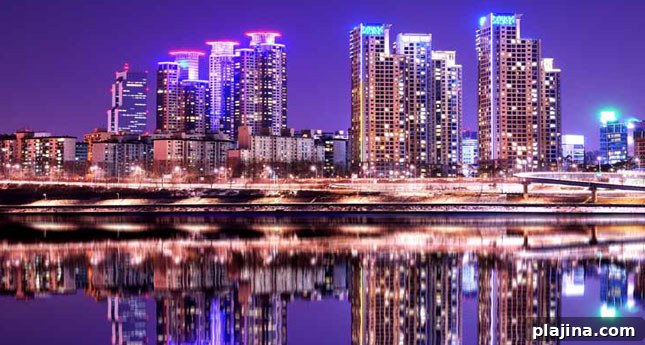
For decades South Korea’s influence quietly expanded across industries — electronics, automobiles, telecommunications, shipbuilding and construction — and eventually reached global popular culture. The tipping point came in the summer of 2012.
A catchy beat. A man in sunglasses stares into the camera and declares, “Oppa Gangnam Style!” The song exploded into a cultural phenomenon, becoming the first YouTube video to pass 1 billion views and one of the most successful viral hits ever.
Experts had long expected K-pop to break into international markets, but the sheer scale of Psy’s instant global fame exceeded predictions. Overnight, the 30-something rapper became South Korea’s most recognizable artist worldwide, reshaping perceptions of the country.
The song’s title points to a specific neighborhood of Seoul for a reason. Gangnam — literally “south of the river” (Gang means “river,” nam means “south”) — epitomizes modern Seoul: busy 24/7, sleek, high-tech and fashion-conscious. It’s an area driven by ambition and conspicuous style.
Real estate in Gangnam is extraordinarily expensive. Though the district covers only about 15 square miles, it represents roughly 10 percent of South Korea’s total real estate value and contributes around 7 percent of national GDP.
Traveling by metro, you glide beneath Seoul’s crowded streets and bypass the ring of granite mountains that encircle the city and the wide span of the Han River. Exiting at Gangnam Station, Exit 8 delivers you into the basement of a nearby skyscraper and into Samsung’s world headquarters annex known as Samsung d’light.
Samsung d’light blends retail, exhibition and research spaces across three floors, offering visitors hands-on experiences with upcoming smartphones, tablets and high-definition TVs. The venue attracts tech-savvy young Koreans and a diverse cross-section of Seoul residents, reflecting how readily the city adopts new innovations.
While Seoul embraces technology citywide, one northwest district exemplifies that drive toward the future. Until 1993, what became known as Duck Island was a vast landfill. In preparation for the 2002 FIFA World Cup, the site was cleaned up and reimagined as Digital Media City (DMC), a purpose-built hub for broadcasting, film, gaming, software and IT.
Digital Media City © Seoul Tourism Organization
In under a decade the plan was realized: futuristic towers gleam with LED displays, and hundreds of companies employing tens of thousands of people now operate there. The district’s ambition includes the 133-story Seoul Lite tower, under construction and slated to be Korea’s tallest building when completed. With plans for an aquarium, shopping mall, luxury residences and a Ritz-Carlton hotel, the tower will offer sweeping views that extend to the border with North Korea and reveal the natural terrain that has shaped Seoul — a city cradled by 37 mountains.
Historically, those mountains provided defense during Korea’s long, insular dynastic era. In the modern era, rapid development after the Korean War transformed the landscape: Seoul’s population ballooned from 1.5 million to 9 million in three decades, forcing the city to expand beyond its natural boundaries.
Today, modern infrastructure stitches the metropolis together: tunnels through mountains link major highways, and a comprehensive metro system runs beneath the surface. Still, the city’s center of gravity has shifted over the past two decades toward areas along the Han River. Emerging neighborhoods such as Gangnam, DMC and Yongsan (the latter evolving from a former U.S. military garrison into an international business district) have risen in economic significance.
Seoul’s growth eventually absorbed surrounding cities, including Suwon and the port of Incheon, forming the Seoul Capital Area. This metropolitan region covers roughly 12 percent of South Korea’s land and supports more than 25 million people, making it the world’s second-largest urban area after Tokyo.
Despite its success, Seoul faces a new challenge: population decline. Over five consecutive quarters the city’s resident numbers have fallen. Factors include an aging population, a rising number of young people choosing singlehood and childlessness, and escalating housing costs that push residents to satellite towns. It’s too early to predict whether this marks a long-term reversal of the city’s expansion, but the trend is notable.
For now, Seoul radiates confidence. It pulses with activity night and day. In Gangnam, Samsung and other innovators are developing the gadgets many of us will adopt in the coming years, while in DMC creators and producers continue to shape K-pop and other cultural exports aimed at global audiences.
South Korea’s cultural rhythm has already seeped into everyday life worldwide — and its presence seems set to grow.
CHECKING IN WITH TAMI OVERBY
Tami Overby, President, U.S.-Korea Business Council © U.S.-Korea Business Council
President, U.S.-Korea Business Council
WHAT OPPORTUNITIES DOES SEOUL OFFER AMERICAN INVESTORS?
Korea’s economy is large and diversified, with strengths across multiple sectors that make it attractive to American investors. The U.S.-Korea Free Trade Agreement (KORUS), implemented in 2012, reduced tariffs and improved market access across many industries, encouraging bilateral trade and investment. While some implementation challenges remain, KORUS aims to increase transparency and predictability, boosting investor confidence. The gradual opening of Korea’s legal market and the presence of a skilled, dedicated workforce further enhance Korea’s appeal. Ultimately, Korea’s people were central to its rapid development and remain the foundation of future growth.
WHAT CULTURAL DIFFERENCES SHOULD FOREIGN INVESTORS ACKNOWLEDGE WHEN DOING BUSINESS IN SEOUL?
Building a strong, trusting relationship with local partners is essential. Foreign investors should show long-term commitment and prioritize face-to-face meetings to foster rapport. Observing local business etiquette — for example, presenting business cards with both hands — demonstrates respect and helps establish credibility.
DO THE FLUCTUATING TENSIONS WITH NORTH KOREA AFFECT THE BUSINESS CLIMATE IN SEOUL?
Regional tensions have not deterred foreign investment or substantially disrupted markets. Bilateral foreign direct investment between the United States and Korea has continued to trend upward, and Korea remains an attractive destination for global investors. Nonetheless, organizations such as the U.S.-Korea Business Council keep a close watch on security developments and their potential effects on businesses.
WHAT ARE THE KEY DEVELOPMENTS TO LOOK FOR IN SEOUL’S FUTURE?
Korea’s economic strategy emphasizes a “creative economy” rooted in innovation, with public policies supporting entrepreneurship and increased investment in fields such as biotechnology, cybersecurity and information technology. Korea already ranks highly in patents and innovation, and new products and technologies are likely to continue emerging. Another key milestone will be potential accession to the Trans-Pacific Partnership, which would reinforce Korea’s commitment to international standards and strengthen its position as a top business destination in Asia.
Things to Do in Seoul
Despite its nonstop energy, Seoul sits just 27 miles from one of the world’s most fortified borders. The Demilitarized Zone (DMZ) dividing North and South Korea is an unusual but profoundly memorable day trip. Visitors enter at the Joint Security Area in Panmunjom under supervision from U.S. and South Korean soldiers; small huts used during the 1953 ceasefire talks straddle the border, allowing visitors a brief glimpse into North Korean territory under escort.
To experience traditional Korean life, visit the Korean Folk Village about an hour south of Seoul. More than 260 reconstructed Chosun Dynasty houses recreate rural life and customs from Korea’s past.
Gyeongbokgung Palace © Seoul Tourism Organization
Within the city, Seoul preserves remarkable fragments of its imperial history. Six royal palaces sit within high walls and provide calm retreats from the urban rush. Gyeongbokgung Palace, built in 1395 during the Joseon Dynasty and restored after centuries of damage, is the most impressive. Its peaceful grounds include the National Folk Museum; the National Palace Museum on the site requires a separate, modest fee.
The National Museum of Korea relocated to a purpose-built complex in Yongsan in 2005 and displays roughly 15,000 items, including many officially designated National Treasures. One of the city’s most iconic artifacts, Namdaemun (National Treasure No. 1), is a ceremonial gate more than 550 years old. After an arson attack in 2008, it was fully restored and reopened in 2013.
The Korean War remains central to modern history and memory; the War Memorial of Korea in Yongsan mixes memorial and museum with extensive indoor and outdoor exhibits.
The Korean War Memorial in Yongsan © Francisco Furio Marco | Dreamstime.com
Consumer culture has driven much of Seoul’s postwar growth and the city is a shopper’s paradise. Apgujeong in Gangnam represents Seoul’s luxury end, while Myeong-dong offers a pedestrian-friendly, youth-focused shopping maze. Itaewon caters to international visitors and turns into a nightlife hub after dark. For antiques and collectibles, the Janganpyeong Antiques Market near Dapsimni Station is a must-visit.
For panoramic views, N Seoul Tower atop Namsan Mountain provides sweeping vistas across the city and surrounding mountains.
Seoul: Just the Facts
Time Zone: GMT +9
Phone Code: Country code: 82, City code: 2
Entry/Exit Requirements: U.S. citizens need a valid passport; no visa is required for leisure or business stays up to 90 days. Stays longer than 90 days require a pre-arranged visa.
Currency: South Korean won
Official Language: Korean
Key Industries: IT, manufacturing, financial services, retail, construction, tourism
Seoul Info to Go
Most international travelers arrive at Incheon International Airport, about 30 miles west of Seoul. The airport is connected to downtown by an express train (about 40 minutes), buses and taxis (expect fares in the $43–$53 range). Gimpo International Airport, closer to downtown, handles domestic flights and regional services to nearby countries.
Where to Stay in Seoul
IP Boutique Hotel A well-priced, trendy option located near Itaewon’s shopping and nightlife. 737-32 Hannam-dong, Yongsan-gu
Lotte Hotel Seoul Situated steps from Seoul Plaza in the geographic center of downtown, this renowned hotel consistently ranks among Korea’s best. 30 Eulji-ro, Jung-gu
Park Hyatt Seoul A refined choice in upscale Gangnam, offering comfort and contemporary elegance. 606 Teheran-ro, Gangnam-gu
Restaurants in Seoul
Braai Republic A casual spot in Itaewon serving South African-style barbecued meats for a straightforward, flavorful meal. 63-4 Itaewon-dong, Yongsan-gu
Gaehwaok Traditional Korean cuisine prepared with fresh, regional ingredients in a quiet Gangnam backstreet. 661-18 Jeongdong Building 107, Sinsa-dong, Gangnam-gu
Woonsan Gwanghwamun A refined restaurant offering royal-style Korean banquets and an elegant dining experience. Seoul Financial Center B1, 84 1st Taepyung-no, Chung-gu
Read more about Seoul’s bangs (meaning “room”).