
This month’s column was written while I was taking part in the Jumeirah Cup — a Ryder Cup–style event where Jumeirah Hotels & Resorts’ guests from the United States and the United Kingdom competed at Scarsdale Golf Club. To add to the excitement, Jumeirah’s ambassador, Rory McIlroy, joined several groups for a few holes and offered playing tips. Rory was in New York for the U.S. Open at Bethpage Black.
Interestingly, both Bethpage Black and Scarsdale Golf Club were designed by the same man: Albert Warren Tillinghast. Known as “Tilly,” he was the son of a wealthy Philadelphian who found his calling on a visit to St. Andrews. Tillinghast became widely influential in early American golf course design, visiting more than 400 courses, advising on course maintenance and shaping the look of many premier venues. He left an enduring legacy and became known as a pioneering golf course architect.
Scarsdale reflects Tillinghast’s talent for creating memorable courses. The course was laid out to serve the growing communities in the area and to encourage local development. The clubhouse, originally built in 1921 and thoroughly renovated in 2004, is a fine example of the grand style that characterized the pre-Depression era. That era produced landmark courses such as Winged Foot, Merion, Baltusrol, Rolling Green and Bethpage Black. The front nine at Scarsdale was initially designed by Willie Dunn of Musselburgh, Scotland, a former professional at Shinnecock Hills and the winner of the unofficial U.S. Open in 1894. In the 1920s Tillinghast redesigned the course, adding the back nine; further updates in 2004 included redesigned fifth and seventh holes that enhanced the course’s appeal.
The Jumeirah Cup made excellent use of Scarsdale’s facilities. The competition was designed to showcase the course, and the event ran smoothly thanks to the efforts of Frank van der Post, COO; Thomas Civiatano, vice president of sales and marketing; and David Sparrow, vice president of sales and marketing U.K. for Jumeirah International.
Rory McIlroy, Jumeirah’s ambassador for the past two years, began playing golf at about age three and played his first full 18 holes around age six. Born in Holywood, County Down, Northern Ireland, Rory’s ascent through the amateur and professional ranks has been rapid and impressive. He trained at Holywood Golf Club under Michael Bannon, the club’s former professional, and stood out early on the 2004 Junior Ryder Cup team. In 2005 he became the youngest winner of both the West of Ireland Championship and the Irish Close Championship. After several notable European victories, Rory drew Jumeirah’s attention at the 2007 Dubai Desert Classic and turned professional in September 2007. He continued to collect wins, including the Dubai Desert Classic in February 2009.
During the Jumeirah Cup Rory led a short clinic and played a number of holes with our group, offering advice and easy conversation between showers — a welcome break during a typically rainy New York weekend.
Hole 1 (360 yards, par 4)
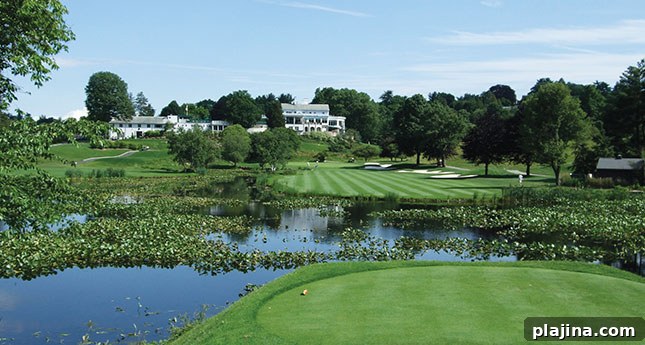
The opening hole is intimidating: water guards the left side while a large hill, trees and thick rough frame the right. A pond edged with lily pads sits left of the fairway and must be cleared regularly to keep the water healthy. Playing the first tee under the watchful eyes of the Jumeirah entourage and both teams made the moment feel particularly dramatic.
A tee shot aimed toward the center of the fairway gives the best angle into the green. The pond comes around to the left just before the green, while a bunker protects the right approach.
Hole 2 (175 yards, par 3)
This is a tricky par 3 where many tee shots find the front bunker. Shots that fly long often end up in thick fescue behind the green. During play we saw several balls miss long. From a front-trap lie I managed a par, though Team U.K. beat us with two birdies on that hole.
Hole 6 (545 yards, par 5)
This long par 5 demands an accurate tee shot to set up a manageable second. The fairway slopes from right to left, so placing your drive on the right side is advantageous. After a less-than-ideal drive that found the rough, my caddie suggested two options: play left of a tree group for a 200-yard approach, or hit a conservative 8-iron to the right side about 130 yards out. I attempted the 8-iron line but still ended up left of the tree. From there I managed a good fairway wood to the green — a 220–230 yard shot into the wind — and two-putted for par, which was enough to secure the hole.
Hole 9 (325 yards, par 4)
Accuracy off the tee is critical here. Drives must clear water and carry to the center of the fairway; balls in the left rough become muddy and difficult to play. The right side has bunkers that catch many approaches. If you find the fairway, your second shot should be a short iron — typically a 9-iron or pitching wedge. The hole is framed beautifully, with the Scarsdale clubhouse providing a scenic backdrop.
Hole 11 (160 yards, par 3)
Club selection is essential on this uphill par 3. Many players came up short or landed in the right-front bunker. I played one club extra but still ended up in tall rough short of the green; fortunately the lie was playable and I chipped close enough to save par.
Hole 14 (455 yards, par 4)
This is one of the course’s toughest holes. Length and a blind second shot make it a true risk-reward test. A long, accurate tee shot up the left side sets up the hole; anything right is blocked by a dogleg and thick trees that can force a recovery lay-up. From the drive you face roughly 200 yards into the green, often blind, so trusting your caddie or riding closer to inspect the line is wise.
Hole 18 (527 yards, par 5)
The finishing hole is a grand, rewarding par 5 with the clubhouse visible at the green. A powerful, straight drive is required to avoid trees and trouble on both sides, including out-of-bounds to the right. Team U.S.A. hit two fine drives into the first cut that remained very playable. Rory’s drive sailed well past us — slightly right of center — a near-perfect positioning.
A strong second shot is needed to set up a short wedge into the green. I used a TaylorMade R7 3-wood to reach a comfortable wedge distance and left myself about 90 yards to the pin. In that match our U.S. side outplayed the U.K. team and took the hole.
Scarsdale Golf Club
Club Way
Hartsdale, NY 10530
tel 914 723 2840
www.scarsdalegolfclub.org