
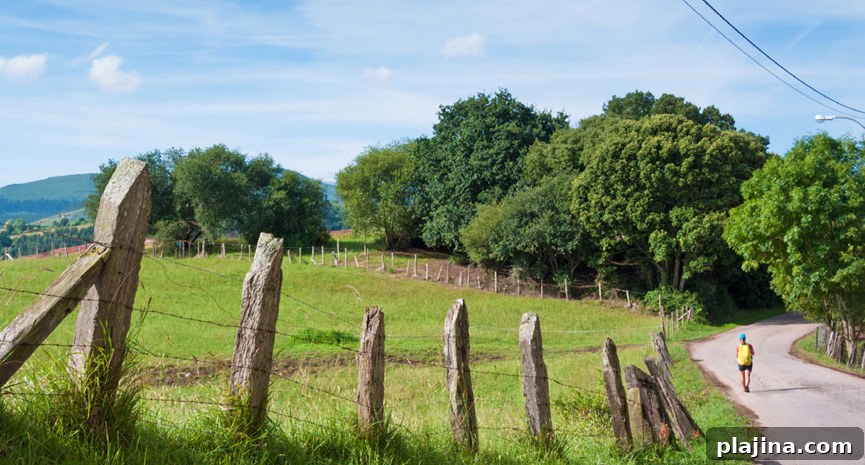
The way of the pilgrim often begins with a single step out the door, and from there the journey unfolds in a thousand unexpected ways.
Pilgrims travel the Camino de Santiago across Spain, choosing from eight officially recognized routes that all converge on Santiago de Compostela, the ancient shrine of the Apostle James and a pilgrimage destination for nearly a millennium.
The Galician capital of roughly 90,000 people swells each year as more than 230,000 pilgrims arrive to receive a Compostela certificate, awarded to those who walk at least 100 kilometers (about 62 miles) or cycle 200 kilometers. Many others join the route for shorter stretches or come simply to feel the abiding energy of a centuries-old tradition still alive in the modern world.
According to tradition, the Apostle James preached in Spain between about 33 and 42 AD before returning to Jerusalem, where he was martyred around 44 AD. Devotees brought his remains back to the Iberian Peninsula, and the scallop shell that clung to the returning boat became the saint’s emblem.
In about 813 AD, the monk Pelayo followed a vision to a tomb believed to be James’s; today Santiago Cathedral stands on that spot. Over time pilgrimages to Compostela rose to the same prominence as journeys to Rome and Jerusalem. Currently, Americans rank fourth among modern pilgrims after Spaniards, Italians and Germans.
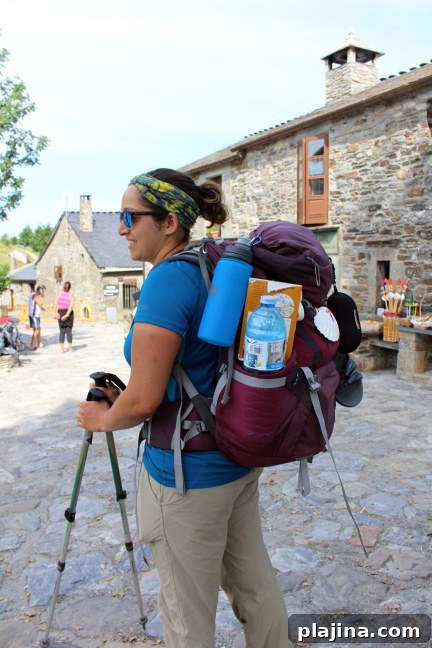
Pilgrim Suzie Greenman of New York pauses for a moment in O Cebreiro, cresting one of the last major peaks before Santiago. © BETSA MARSH
About two-thirds of modern pilgrims follow the French Way, a 790-kilometer (490-mile) route over the Pyrenees and across northern Spain. For Suzie Greenman of New York City, it was the graduation gift to herself after gaining admission to medical school.
Greenman endured bedbugs in some albergues and battled blisters, along with the repeated question from others: Why do the Camino? “I thought it would be a cool hike in Spain,” she said while pausing in O Cebreiro, one of the last major high points before Santiago. “But it’s much more spiritual, more fulfilling and satisfying than I thought.”
She began each morning with a gratitude walk, counting one blessing with each step. Raised in Jewish and Episcopalian traditions, she attended Saturday night services as a time for meditation and reflection: “Let’s praise God, let’s praise his glory.”
Each mile brings pilgrims closer to Santiago. Retiree Elizabeth Ward and her sister-in-law returned for a second Camino from Victoria, Australia, choosing the Portuguese Way, the route that attracts the second-largest number of walkers. They covered 76 kilometers (47 miles) from Porto.
“We’re not worried about the certificate,” Ward said of the Compostela. “We still went to the Cathedral, and it’s still thrilling to see so many people, so emotional. They were emotional because it’s damn hard! It’s hard physically and it’s hard emotionally.”
To spoil herself after the walk, Ward stayed at the Parador de Santiago de Compostela facing Plaza del Obradoiro and the Cathedral. The building traces its origins to a 1499 royal command to establish a pilgrim hospital and inn; today the parador surprises visitors with ecclesiastical details at every turn.
For pilgrims seeking their Compostela, the Pilgrim Office is the first stop upon arrival. There, walkers present their pilgrim passports and receive the Compostela certificates, often inscribed with their Latin names.
Many arriving pilgrims collapse in Plaza del Obradoiro, kiss the center stone and then file into the Cathedral. Inside, visitors pass the saint’s silver reliquary and often touch or embrace the seated statue of St. James.
“I cried when I saw the Cathedral, I cried in the Mass, especially when the organ started,” said Tyler Buckhout of North Grafton, Massachusetts, who set out on the Camino a few days after graduating college.
“I realized the Cathedral wasn’t the point,” Buckhout added. He spent 33 days on the French Way and kept a blog, even during a spell in the hospital after a bad empanada. “I was walking and thinking about the Cathedral, but it’s never about Santiago. It’s an ideal, and the physical place will never match up with what’s in your head.”
Pilgrims’ Mass at the Cathedral becomes a multilingual, emotion-filled moment. As worshippers come forward for communion, their walking sticks, hiking boots, bandages and backpacks tell the story of the journey behind them.
Nearby, the Benedictine sisters at the San Paio de Antealtares convent bake a celebrated Tarta de Santiago almond cake. At their modest window, a nun cheerfully sold a cake dusted with the sugary outline of St. James’s cross and sword.
For a memorable meal, many reserve a table at Casa Marcelo, Santiago’s only Michelin-starred restaurant. Dishes served family-style might include tomatoes brightened with pimento granité, pork dumplings that nod to eastern flavors, and an ocean perch fried until delicately crisp. Desserts have ranged from inventive tiramisu to coconut and avocado ice creams.
As pilgrims rested and reflected in Santiago, many—like Buckhout—considered what the Camino had taught them.
“I was not very religious coming here,” he said. “Now I don’t believe there are coincidences—just fated experiences.”
Like the countless walkers who came before, he found that each step on the Camino can change what you notice and how you feel, revealing a pilgrim’s perspective that lasts beyond the final mile.
INFO TO GO
Domestic and international flights arrive at Santiago de Compostela Lavacolla Airport, about 6.2 miles northeast of the city center. Bus and taxi services connect the airport to the city; a taxi ride to Santiago generally costs around $25.