There are two ways to develop a personal connection to a place. One is through lived experience, where a city or country becomes a keeper of memories. The other, increasingly common in a media-saturated age, is to fall in love with a place through books, songs, or films—and then go there to see whether the imagined place matches reality. How well does that connection hold up?
My relationship with Santiago, Chile, began in the second way: through movies. Years before I first set foot in the city, I formed two very different images of Santiago while working as a film critic in San Francisco. One image was dark and menacing; the other was tender and lyrical. Those impressions came from two very different films: Missing and Il Postino.
The films could not have been more dissimilar. Missing (1982), a political drama set in the aftermath of the 1973 military coup, dramatized the disappearance and death of a young American journalist and cast a long, troubling shadow over the city in my imagination. Il Postino (1994), by contrast, is a gentle romance set in Italy that fictionalizes the exile of Chilean poet Pablo Neruda. Its portrait of the poet’s spirit and longing created a quieter, more seductive image of Santiago.
These powerful, popular films left me with conflicted feelings about the city. Still, when the chance to visit arrived, I flew to Santiago with eager anticipation, curious to see the place that had lived in my mind for so long.
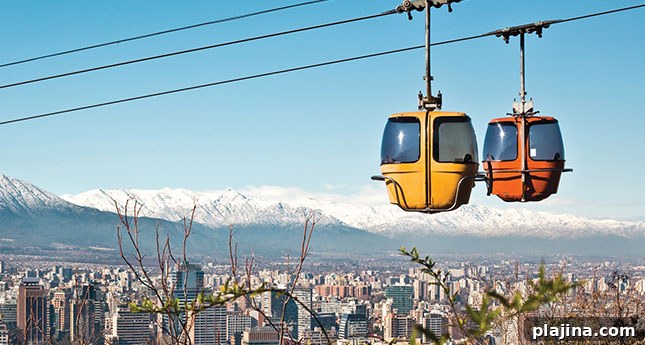
On arrival my wife and I found the city quieter than we expected. We drove along broad Avenida Presidente Kennedy past gardens of orange California poppies to the Grand Hyatt in Las Condes, an upscale district. From our room, sweeping windows framed a dramatic urban backdrop: the snow-draped Andes rising near the city. It was a breathtaking view.
Yet the neighborhood felt oddly empty that day. During dinner at the hotel’s Thai-themed Anakena restaurant, a staff member—speaking in a calm, reassuring tone—tied my wife Georgina’s purse to her chair as a precaution. His gesture, meant to comfort, felt oddly cautionary, and for a moment I wondered whether the city might be more complicated or risky than I’d imagined.
The next morning clarified everything. Las Condes filled with people celebrating Chile’s national day, and locals streamed toward the Centro Cultural district several miles away. We had unwittingly arrived on a holiday and, somewhat embarrassed, joined the crowds via the efficient, clean, and safe Metro de Santiago. Emerging from the subway, we found a modern, vibrant metropolis of about six million people. The city felt forward-looking and dynamic, and we never experienced threats to our safety.
The live city I saw was a far cry from the war-torn capital in Missing, and it didn’t quite match the Nerudian Santiago of Il Postino either. Still, it was easy to discover traces of the poetic city in the real place—most notably at La Chascona, Neruda’s house in Bellavista, Santiago’s most famous bohemian neighborhood. Now a museum, La Chascona is full of eccentric details: turrets, narrow stairways, and artworks by friends such as Diego Rivera. Walking those rooms, you can almost picture Neruda penning lines of passion and longing—verses that speak of thirst, fire, and the tenderness of spring.
In the city center we visited La Moneda, the presidential palace where Salvador Allende died during the 1973 assault that brought General Augusto Pinochet to power. Chile returned to democracy in 1990, and the modern republic has worked to reconcile memory with renewal. La Moneda’s inner courtyard now displays imaginative sculptures, and a photographic gallery under the adjacent plaza offers historical perspective—an approach that acknowledges the past without making the square unbearably grim.
Nearby we discovered the Museo Chileno de Arte Precolombino, housed in the 1807 former Royal Customs House. The museum presents pre-Columbian art from regions stretching from Mexico to Tierra del Fuego. Georgina, who runs a private school, bought a folk-music CD in the museum shop to share traditional Chilean music with her students. The melodies charmed us all; the CD became a tuneful souvenir we still play at home.
Modern Santiago surprised me in other ways too. Around our second hotel, the Santiago Ritz-Carlton in the El Golf neighborhood, contemporary architecture dominated the streetscape: high-rise office towers and residential buildings balanced with lower shops and cafés to preserve sightlines. The city’s planners and developers have emphasized elegant, artful forms and glass-and-steel façades, producing a polished, cosmopolitan district that adds another cultural layer to Santiago.
So how did my cinematic image compare with the real Santiago? The films had not lied, but they were incomplete and lacked nuance. Travel did more than add sights to a list; it altered how I saw the city. Santiago proved to be complex—at once modern and historical, mournful and celebratory, shaped by memory yet looking forward. That complexity is precisely what makes the city worth visiting and worth experiencing firsthand.