
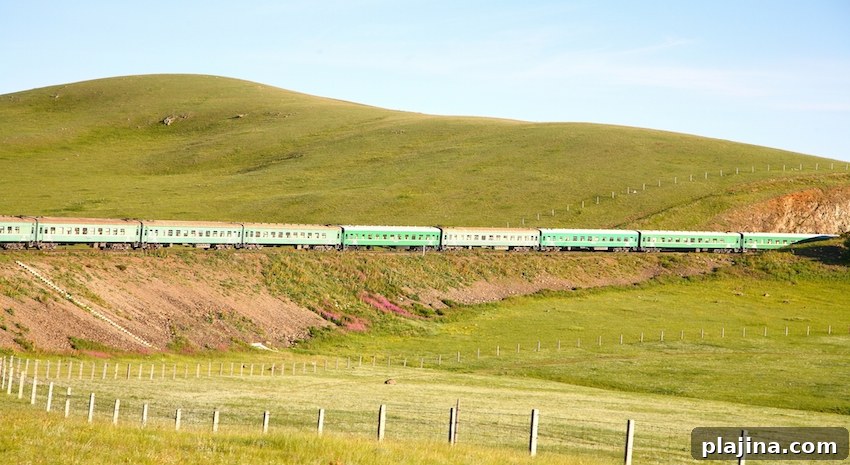
If Russian President Vladimir Putin succeeds, a single, continuous rail journey could eventually link London to Tokyo.
The proposed route would follow the Trans‑Siberian Railway and require building a roughly 28‑mile bridge to span the Sea of Japan, connecting Russia’s Sakhalin Island with Japan’s Hokkaido.
Supporters have called the plan “a bridge across history,” a reference to the long-standing absence of a formal peace treaty between Russia and Japan after World War II.
“We are seriously offering Japanese partners to consider the construction of a mixed road and railway passage from Hokkaido to the southern part of Sakhalin,” said Igor Shuvalov, a Russian vice‑premier.
Today, the Trans‑Siberian Railway terminates in Vladivostok. The proposal would extend the line eastward to Sakhalin, enabling through‑service toward Hokkaido and onward to Tokyo.
Proponents argue the link could boost trade, tourism and regional connectivity by creating a direct overland corridor between Europe and Japan. Construction of the bridge and rail connections would be a major engineering undertaking, requiring coordination on design standards, customs procedures and cross‑border operations.
Critics note substantial challenges: the technical complexity of building a long sea crossing in a seismically active area, environmental impacts on marine and island ecosystems, and the significant political and diplomatic hurdles between the two countries. Financing such a large infrastructure project would also demand clear commitments from both governments and potential international partners.
Beyond engineering and finance, practical issues would need resolution for seamless travel: gauge compatibility between rail networks, immigration and customs arrangements, and schedules for freight and passenger services. The plan would also depend on local support in Sakhalin and Hokkaido and alignment with Japan’s regional transportation priorities.
While ambitious, the concept of linking London to Tokyo by rail captures public imagination. If realized, it would create one of the world’s longest continuous rail routes and reshape transport options across Eurasia and into East Asia. For now, the proposal remains an outline that would require extensive study, negotiation and planning before construction could begin.