
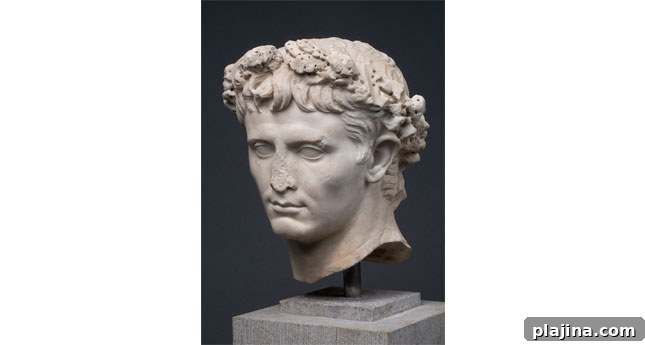
A striking new exhibition offers a rare look into the life and legacy of King Herod the Great. On display through Oct. 15 at the Israel Museum in Jerusalem, the show presents artifacts never before revealed to the public. Highlights include finds from the recently discovered tomb thought to belong to the king, such as components of his private bath from a palace in Cyprus. Titled King Herod’s Final Journey, the exhibition features three sarcophagi, restored frescoes, an imperial marble basin that may have been a personal gift from Augustus, and several carved stone elements recovered from the Temple Mount.
King Herod is widely regarded by archaeologists and historians as one of the most ambitious builders of his era. His major projects reshaped Judea: he transformed and enlarged the Second Temple in Jerusalem and constructed the important port city of Caesarea. Among his most impressive achievements is the desert fortress of Masada, a vast complex built atop an isolated plateau overlooking the Dead Sea. Masada contains a synagogue, extensive storehouses, and a full-scale Roman-style bathhouse, reflecting Herod’s investment in both military and civic architecture.
The Israel Museum’s exhibition draws together these archaeological discoveries to shed light on Herod’s political power, cultural influences, and personal life. Objects arranged around the reconstructed burial context and architectural fragments help visitors appreciate the scale of Herod’s building programs and the mixture of Roman, Hellenistic, and local traditions that defined his reign. Restored frescoes and finely carved stonework illustrate the artistic sensibilities of the period, while the sarcophagi and the imperial basin suggest connections between the Herodian court and the wider Roman world.
Visitors can expect an experience that balances scholarly research with evocative presentation. The exhibit emphasizes provenance and conservation, explaining how fragile materials were stabilized and restored for display. Panels and captions place each object within its historical setting, detailing excavation finds and the significance of items like the bath fittings from Cyprus or the Temple Mount stone elements. Together, these pieces offer a clearer picture of Herod’s personal tastes, religious policies, and architectural ambitions.
Beyond the artifacts themselves, the exhibition invites reflection on the complex legacy of Herod the Great. He is remembered both for monumental construction that altered the landscape of the region and for the political controversies of his rule. The show does not attempt to resolve debates about his character but instead provides material evidence that helps visitors form their own informed impressions.
Whether you are interested in archaeology, ancient history, or architectural heritage, the exhibition at the Israel Museum presents a compelling, well-documented portrait of a ruler whose projects left a lasting imprint on the Eastern Mediterranean. It is a rare opportunity to see newly revealed finds assembled in one place, giving fresh context to one of antiquity’s most influential builders.
You may also like:
After 5: Jerusalem