
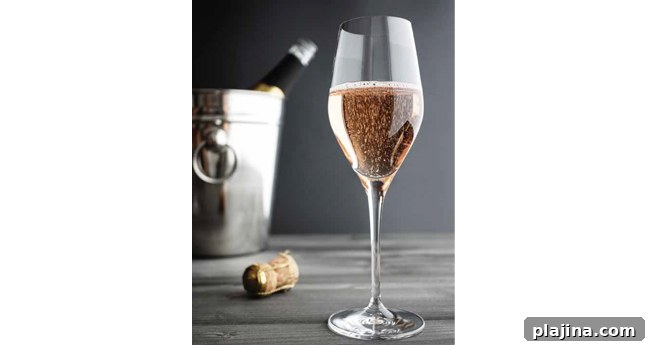
Mark Twain once observed, “Too much of anything is bad, but too much Champagne is just right.” Today, Americans are embracing rosé Champagne in growing numbers. Last year the United States imported roughly 3 million bottles of rosé Champagne, lifting pink bubbly to 16.2 percent of all Champagne shipped to the country.
That is a significant change from about two decades ago, when rosé was a minor player, representing less than 5 percent of shipments and often sold in sweeter styles. Now, most Champagne houses produce a brut (dry) rosé as part of their core lineup.
Champagne is made from up to three grape varieties: the white Chardonnay and the red Pinot Noir and Pinot Meunier. Many rosé Champagnes are blends centered on Pinot Noir combined with one or both of the other varieties, while some rosés are produced exclusively from Pinot Noir. Depending on the blend and winemaking choices, rosé Champagne can range in color from pale orange to delicate pink to deeper coral tones.
In general, non-vintage rosé Champagnes tend to carry a higher price than non-vintage white Champagnes, while vintage rosés are usually priced similarly to other vintage releases. The prices mentioned below are approximate and can vary by retailer and region.
I recently sampled thirteen rosé Champagnes at Brasserie in New York City and found many impressive examples. Ruinart Brut Rosé, a non-vintage blend of roughly 55 percent Pinot Noir with the remainder Chardonnay, shows a rose-petal hue and delivers a fruity, elegant profile (about $75). The non-vintage Henriot Brut Rosé, produced entirely from Pinot Noir, is full, crisp and delightfully vibrant (around $65). Gosset Grand Rosé, from a distinguished Champagne house, blends close to 55 percent Chardonnay with Pinot Noir, yielding a pale, richly fruited pink wine ($75).
G.H. Mumm Le Rosé (non-vintage) stands out for its crispness and lively mousse (about $70). Louis Roederer Rosé 2008 is subtle, pale and finely textured (approximately $76). Pol Roger Extra Cuvée de Réserve Rosé Brut 2006, with roughly 60 percent Pinot Noir, presents a big-bodied, solid structure (near $110). Taittinger Comtes de Champagne Rosé Brut 2005 is golden-pink, vibrant and deeply flavored — the oldest bottle in the tasting and still splendid.
Whether you prefer something delicate and floral or rich and structured, the current rosé Champagne scene offers many excellent choices. Here’s to rosé Champagne — to your health and enjoyment.