
Longing for a destination steeped in romance and enchanting history? In southwest Germany, a string of soaring castles and resplendent gardens invite travelers to explore stories of love, devotion and courtly intrigue. Begin your journey at the Sepulchral Chapel on Württemberg Hill above Stuttgart, which looks out over the Neckar Valley.
King Wilhelm I dedicated this elegant chapel to his wife, Queen Katharina von Württemberg, after her death as a lasting monument to their bond. Designed by Wilhelm I together with his architect Giovanni Battista Salucci, the building draws inspiration from Roman temples and stands on a hill that had been one of Katharina’s favorite places. The site combines serene views with a sense of personal remembrance.
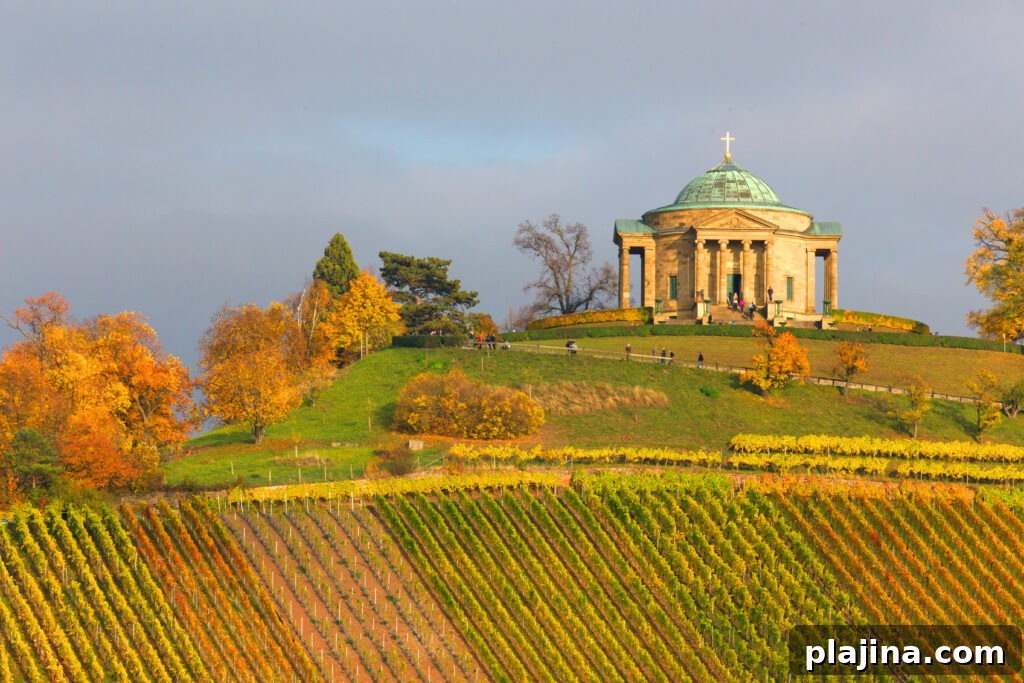
Stuggart Rotenberg © A Mende
Not far from there, the story of Duke Eberhard Ludwig of Württemberg and his long-time companion Wilhelmine von Grävenitz reads like a novel of courtly passion and political maneuvering. Wilhelmine, a young noblewoman from Mecklenburg, captured the duke’s attention with her beauty and voice. To keep her near, the duke arranged a marriage for her with his chief administrator so she could formally enter court life. Elevated to positions within the inner workings of the court, she became the duke’s acknowledged companion for many years. Though their public relationship changed over time, their connection left a lasting mark on Württemberg’s history and its grand residences, including the nearby Ludwigsburg Residential Palace, a lavish complex that reflects the era’s power and refinement.
Further southwest, Heidelberg Palace holds its own romantic legacy. A richly ornamented gate known as the Elisabethentor marks the entrance to a private garden created by Frederick V for his wife, Elizabeth Stuart. The gate, said in legend to have been fashioned as a birthday gift in a single night, stands as a testament to devotion expressed through architecture and craftsmanship. While visiting the palace, explore the historic apothecary tucked within the complex. Rows of glass, faïence and colorful majolica jars evoke a time when remedies and tinctures were carefully prepared by hand—items that stir the imagination and hint at the era’s fascination with love potions and remedies.
Across southwest Germany, these sites and stories offer more than picturesque views and ornate buildings; they invite visitors to step into moments of personal longing, political strategy and artistic expression. Whether tracing the grief that inspired a memorial chapel, the maneuvering that secured a courtly companion’s place, or the romantic gestures that shaped a palatial garden, travelers can follow threads of human emotion woven into the region’s architecture and landscapes.
Plan time to wander gardens, linger on terraces that look over river valleys, and imagine the lives of those who walked these halls centuries ago. Each palace and chapel adds a chapter to the larger story of love, ambition and memory that continues to draw visitors to this evocative corner of Germany.