
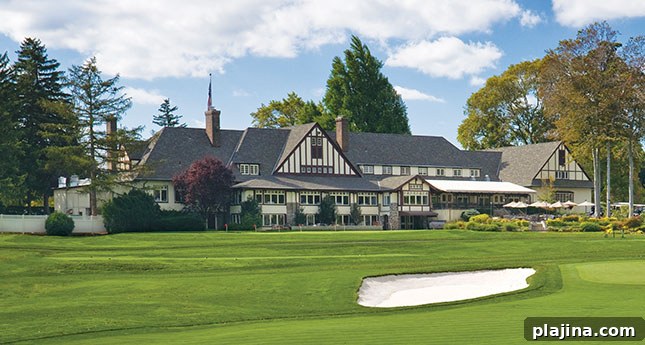
Philadelphia has long boasted some of the world’s finest golf courses—Merion, Aronimink and Pine Valley among them. Yet tucked away near the city is a lesser-known gem that rivals those famed layouts: Rolling Green Golf Club.
Founded in the Roaring Twenties by a group largely made up of local Quakers, Rolling Green sits on a rugged, hilly parcel just outside Philadelphia. Architect William Flynn began construction in 1925 and, by 1926, Howard Toomey had finalized the routing. Many of the holes were laid out with lengths that still challenge modern players. Flynn favored elevated greens over an abundance of water hazards, believing the recovery shot to be one of golf’s greatest tests. The long holes and uphill approaches reflect his athletic, strategic design principles.
In 2008, Forse Design Inc., known for restorations of classic courses, led a major renovation that returned Rolling Green to Flynn’s original intent. The project relied on careful historical research, including archived photographs and on-site detective work. An archaeological dig revealed that the original bunkers were often two to three feet deeper than more recent profiles, a detail that materially changed how the course plays and required thoughtful restoration to restore authentic playing angles and strategy.
Rolling Green is personal to many members and staff. For me, it helped pay for college and introduced me to the game; I worked summers there and enjoyed early-week rounds with the caddies. When I married after college, the clubhouse was the obvious place for our reception. Returning to the course always feels like coming home.
Hole 6 (205 yards, par 3)
This is a quintessential Flynn par 3. Only a near-perfect tee shot will hold the green, and it often requires more club than the tee box suggests. Many shots come up short and right, leaving a demanding chip to the green. Bunkers guard the forward positions and protect the green on both the right and left, so precision and club selection are essential.
Hole 2 (449 yards, par 4)
A dogleg left that begins with an elevated tee shot over a swale to an elevated fairway. There is room on the right at the turn, but many players try to cut the corner and end up in one of three fairway bunkers on the left. The approach is tricky: bunkers sit left and right of the green, and the surface slopes left to right and back to front, making a well-placed second shot crucial.
Hole 8 (442 yards, par 4)
This demanding hole plays from an elevated tee to an island-like fairway below. A creek crosses the fairway and then runs along the right side, forcing careful club selection off the tee—driver is often too much, and a fairway wood can be the smarter play. Errant tee shots frequently leave awkward lies near the creek and require a punch-out back to the fairway. The second shot to an elevated green is difficult: many balls land on the front and roll back down, leaving long comeback chips. Even well-struck approaches can run off a forward pin and tumble down the slope. Members watch and smile as visitors learn this hole the hard way; experience is the best teacher here.
Hole 9 (615 yards, par 5)
One of the most talked-about holes at Rolling Green, this long par 5 demands distance and accuracy. From the tee you must hit a powerful, controlled shot favoring the left side; the fairway’s large slope will often feed balls back right, so overcommitting left can land you in rough with an uncomfortable lie. The ideal second shot is a long, well-placed fairway wood toward the right-center landing area. The entire hole climbs to an elevated green that slopes back to front. When you’re halfway through, the snack bar at the halfway house makes for a welcome break.
Hole 10 (258 yards, par 3)
This short par 3 plays longer than its yardage and demands a bold tee shot—Jim Nagle of Forse Design dubbed it “the best short par 4 in Philadelphia.” Big carry is needed to hold the green; many shots come up short or find one of the three bunkers (two left, one right). Accuracy and confidence are rewarded.
Hole 12 (362 yards, par 4)
A fun but potentially stern hole that begins from an elevated tee and plays down into a valley. Three fairway bunkers on the right and a lone bunker left force an accurate, straight drive. The hole bends slightly right to an elevated green backed by the fieldstone greenskeeper’s house. Several bunkers guard the left side of the green, catching those who under- or over-club their approach.
Hole 13 (445 yards, par 4)
This hole showcases Flynn’s strategic genius. A long, well-placed drive—ideally left-center—sets up a manageable approach. A tee shot too far right narrows the angle to the green. A creek crosses about 100 yards short of the green, and the approach plays from an elevated fairway to a plateaued green. Proper placement off the tee is the key to a birdie opportunity.
Hole 18 (491 yards, par 4)
Marked on the scorecard as a par 4/5, this long dogleg right is a fitting closing challenge. Trees line both sides of the fairway, making recovery from errant shots difficult. Drive left-center without going too far into the trees or branches will block your next shot. The approach climbs to an elevated green guarded by three bunkers on the right where the hole turns and two more bunkers further along the right side. A solitary bunker sits left of the green, which slopes severely from back to front.