
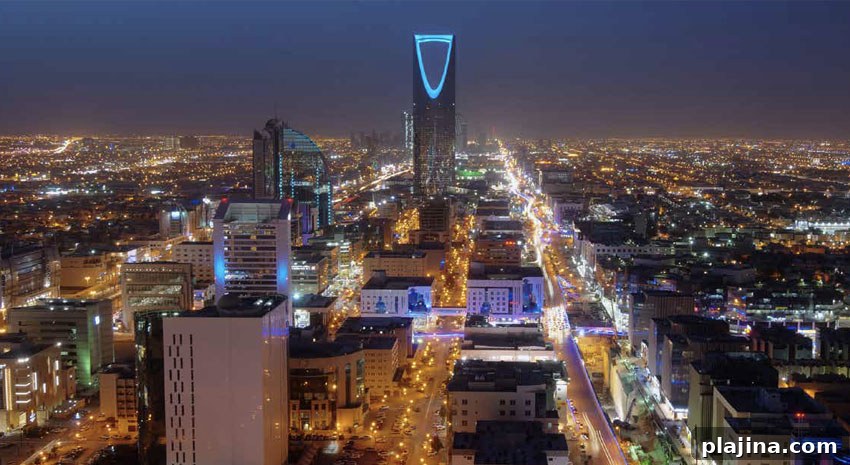
THE DIFFERENCE BETWEEN Riyadh’s two principal neighborhoods is day and night. Literally.
During the day Riyadh endures intense desert heat, its modern skyline often softened by heat haze, sand and pollution. From May through September temperatures frequently rise above 100°F (about 38°C), prompting residents and visitors to limit outdoor time. Most activities take place inside air-conditioned buildings, and travel is conducted in cooled vehicles to avoid the fierce sun.
After sunset the city transforms. Temperatures commonly fall by 10 degrees or more, and a vibrant night scene emerges. Sidewalks and parks that were empty and sun-bleached in daylight become lively gathering places filled with families and color. Neon signs illuminate streets, and the city takes on a more relaxed, social pace.
World Sights Park, just east of downtown near the Eastern Ring Road, is a popular spot for evening strolls and mingling with locals. A well-lit trail guides visitors past scaled replicas of global landmarks — the Taj Mahal, the Eiffel Tower, Egypt’s pyramids and Rome’s Colosseum — alongside replicas of notable Riyadh structures. The atmosphere is family-friendly and photogenic after dark.
Nearby, the Saqer-Aljazirah Aviation Museum showcases a remarkable collection of aircraft and aviation artifacts that trace Saudi Arabia’s aeronautical history. Exhibits are displayed both indoors and across the museum’s gardens, and visiting in the hour before sundown provides particularly attractive light for viewing the outdoor aircraft. The museum generally welcomes visitors in the evening hours, making it an excellent complement to a nocturnal itinerary.
Dining options are convenient in this district. Granada Center mall, within easy reach, offers a large food court with familiar international choices alongside Saudi chains such as Shawarmer, known for its kebabs and regional flavors. The mall and its eateries provide comfortable, air-conditioned spaces to eat and relax after an evening of sightseeing.
Riyadh is a vast, sprawling metropolis of more than seven million people, composed of diverse districts — some ultra-modern and commercial, others preserving fragments of the city’s past, and many that are primarily residential. As you explore and learn the layout, it becomes clear that the most meaningful distinction in Riyadh is not strictly geographic but temporal. The city’s character shifts dramatically from day to night, and for many visitors the most memorable neighborhood is the one that comes alive after sunset.