
You have to travel far to find a Canadian man who admits to disliking ice hockey. The only one I encountered was a lean, soft-spoken mountain guide I met on the Inca Trail in Bolivia. Beside a campfire we compared notes on sports.
“You must have played ice hockey growing up,” I said.
“Nope. Always hated it,” he replied. “Way too testosterone-y.”
He had a point. Ice hockey can routinely turn mild-mannered Canadians into zealous fans. In 1994 and again in 2011, Vancouver Canucks supporters caused major damage to their city after Stanley Cup defeats. In 1993, Montréal Canadiens fans rioted after a victory. The violence associated with hockey extends beyond the stands. In 1904, four players were killed in brawls during games, and across the following century many professional players in Canada and the United States have been suspended or prosecuted for violent conduct on the ice.
For prospective players, and especially for women, that brutish side of the sport is often a deterrent. In 1963, Sam Jacks, a sports administrator in North Bay, Ontario, set out to change that. Rather than simply modify hockey, he designed an entirely new team sport: ringette.
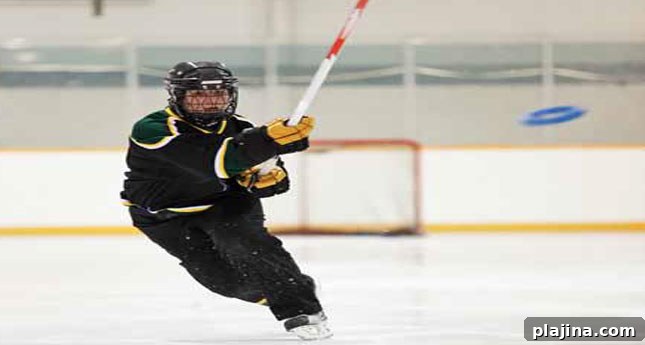
At first glance the two sports look similar. Two teams in uniforms and protective padding face off on a skating rink, and both aim to score goals. But the differences become clear on closer inspection. Only the goalies use conventional hockey sticks. The skaters—five on each team—use straight aluminum sticks with a tapered plastic tip. The puck becomes a hollow rubber ring about 6.5 inches in diameter, giving the sport its name.
Once play begins, ringette’s distinct rhythm is obvious. The game flows more freely: players skate rapidly around the rink, spear the ring with their sticks, and quickly pass or drive it toward the goal. The action is continuous. Fans often claim, with good reason, that ringette is the fastest sport on ice.
Many rink markings are borrowed from hockey, but they serve different tactical purposes. For example, the two blue lines that mark offside zones in hockey are used in ringette to limit dribbling: players are not allowed to carry the ring across those lines while in possession. They must make a pass. Because the ring can travel faster than any skater, possession and the focus of play can shift from one end of the rink to the other in a split second.
Ringette did not become a national pastime overnight. It began modestly and grew steadily in Ontario and neighboring Manitoba before spreading across Canada. By the late 1970s it had reached Finland and gradually established leagues in other parts of Europe and the United States.
In 2013, ringette celebrated its 50th anniversary. Today there are more than 50,000 female players in Canada and thriving competitions in the United States and Europe. While the sport remains predominantly female, men are increasingly drawn to its speed and skill, and male participation may continue to rise.
The appeal of ringette is clear. Strict no-contact rules keep the game safer than hockey, and the tactical flow resembles basketball more than a collision sport. Skating technique and agility are decisive; power and brute force are secondary. The result is a sport that is both gentler and, to many, more exciting than ice hockey.
You have to travel far to find a Canadian woman who admits to disliking ringette. I haven’t found one yet.