
I had wanted to play Royal County Down since my first trip to Ireland many years ago. Tourism Ireland and friends had urged me to visit, but it wasn’t until an unplanned spring golf outing that we finally secured a tee time. After a morning exploring Titanic Belfast and the ship’s dry dock, we took a shuttle to Murlough Nature Reserve. The course sits between the Mourne Mountains and the shores of Dundrum Bay, with the Irish Sea stretching beyond.
Royal County Down is consistently ranked among the world’s finest golf courses—alongside Pine Valley, Cypress Point and the Old Course at St. Andrews. Established in 1889 by prominent business figures and professionals from Belfast, its development is well documented. George L. Baillie, a Scotsman who championed the game, helped lay out the original nine holes, which opened on March 23, 1889. Old Tom Morris visited from St. Andrews to inspect and endorse the course, prompting the addition of more holes through 1890. The most notable redesign came in 1925 when Harry Colt reshaped the fourth and ninth holes—two of the most photographed on the planet. In 2004 a new 16th hole was introduced, framed by the Mourne Mountains.
The course has hosted prestigious events such as the Irish Open Amateur (1893), the Walker Cup (2007) and the Curtis Cup (1968). It’s admired by champions including Tiger Woods, Tom Watson, Arnold Palmer, Jack Nicklaus and, naturally, Northern Ireland’s Rory McIlroy. On our day, however, the spotlight belonged to our little group: me with caddie Andi; Gerry Gallagher of Texas, with caddie Ronan; Neil Curran from Florida, with caddie Conor; and John Kelley from Pennsylvania, with caddie Carlos. I was lucky to have Andi—an experienced Royal County Down caddie who had left the job for a time and then returned. He was fast, knowledgeable and always a few yards ahead, guiding every shot so we stayed on course and kept pace with the round.

First Tee: (Left to right) John Kelley, Francis X. Gallagher, Neil Curran and Gerry Gallagher © Francis X. Gallagher
HOLE 1
523 yards, par 5
Neil’s itinerary was fraught: a delayed flight from Palm Beach to Philadelphia caused him to miss his connection to Dublin. He arrived on a later Aer Lingus flight, but his clubs reached him only that evening, so he played the first round with a rental set. His par on the opening hole proved it’s the player, not the clubs. The rest of us struggled on our approaches and posted double bogeys.
The first hole is breathtaking—dunes and tall grass line the right, and the bay stretches beyond. We teed off under excellent weather and hit near-perfect drives, much to the caddies’ delight. The ideal second shot is a layup into a valley that sets up the approach; attempting to reach the green in two requires a precise shot into a narrow 14-yard entrance to a deep green. Many consider it among the best opening holes in the world.
HOLE 3
475 yards, par 4
Hole 3 is less frequently written about, overshadowed by other famed holes, yet it’s striking: the bay frames the tee shot and dunes protect the green. John Kelley navigated this hole memorably. After a patchwork approach that left him well off the green, his fourth shot reached the putting surface but sat far from the hole. With a long, confident stroke he sent a remarkable putt home—one of the longest I’ve seen—and converted what felt like a hard-earned bogey. The caddies erupted in cheers, celebrating the recovery rather than any flashy score.
HOLE 7
135 yards, par 3
A short par 3 can be deceptively brutal, and Hole 7 proved that. The card suggests simplicity, but a wide bunker guards the front of the green and rejection zones, including a hump on the right and a leftward sloping surface, can funnel good shots into the course’s deepest bunker. Gerry and John both carded triple bogeys, while Neil and I managed pars. Neil hit the green and two-putted, while I found the front bunker but, following Andi’s expert advice on the sand shot and the green’s subtle breaks, escaped with par.
HOLE 13
423 yards, par 4
Hole 13 is one of the most talked-about holes on the back nine, largely due to the natural terrain that guided the architects’ design. It presents blind shots and tricky angles—Andi positioned my second shot perfectly; without his direction I would have been at a loss. He advised landing left in the fairway for the best approach, but I erred to the right, leaving a blind shot. Andi moved ahead, raised a club to indicate the line, and I executed a clean strike that held and rolled onto the green.
Gerry’s tee shot found the left side and he, too, hit the green. The putting surface at 13 is notoriously difficult and can produce three-putts, yet the Gallaghers both two-putted and saved par—a testament to careful play and steady nerves.
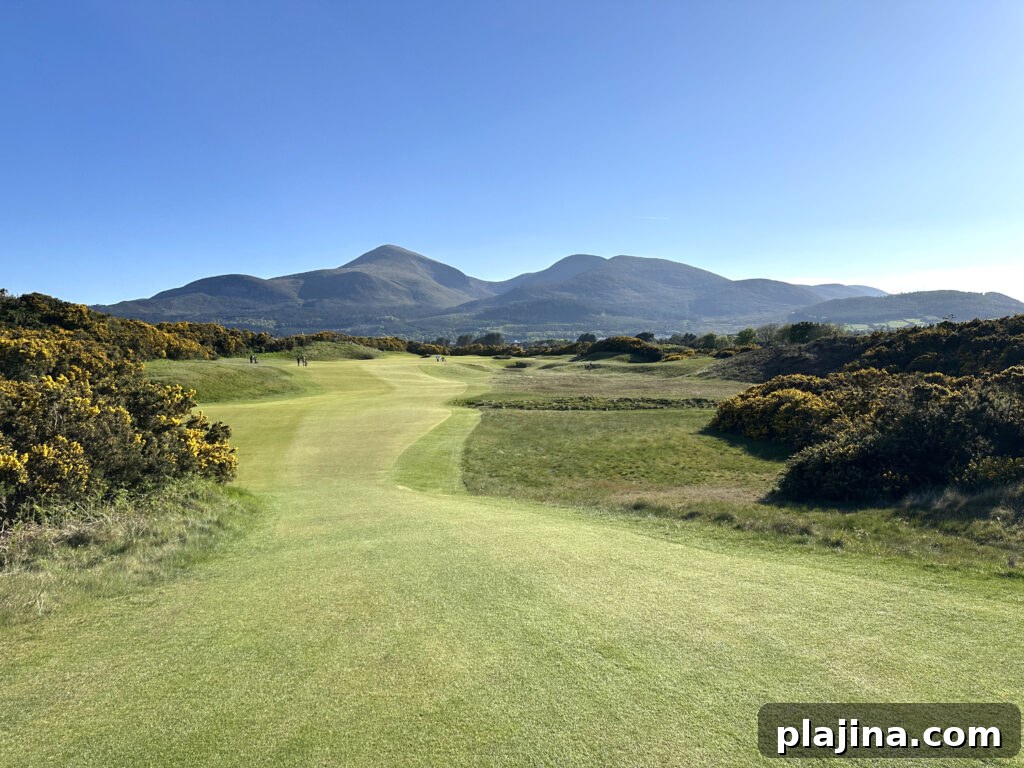
Hole 16 © Francis X. Gallagher
HOLE 16
318 yards, par 4
Hole 16 is often called the only “drivable” par 4 at Royal County Down. I know a few players who might risk it, but our group opted for conservative strategy. We played safely and kept the ball in play. Neil’s enthusiasm for the rental clubs waned, while Gerry struck more turf than ball at times, but Andi’s steady guidance helped me record a par.
HOLE 18
548 yards, par 5
Royal County Down opens and closes with a par 5, ensuring focus through every hole. The 18th combines beauty with a stern challenge: dozens of bunkers frame the hole and the green slopes back to front. My drive flirted with a brilliant patch of yellow gorse on the right. Andi suggested a 3-wood for my next shot; I topped it and turned a potential par into a bogey while others in our group scored double bogeys. On the green, Andi and Conor discussed lines and reminded us the surface ran toward the tee. We finished, shook hands and celebrated at the club bar with a few pints of Guinness—undeniably better in Ireland. Neil tried to pay Conor with obsolete euros, which led to laughs and a quick settling of the caddie fee among friends.
Playing Royal County Down is an experience of dramatic landscapes, exacting strategy and expert caddie guidance. From the first tee to the final green, the course demands respect, rewards precise play and leaves you with memories of one of the game’s most special settings.