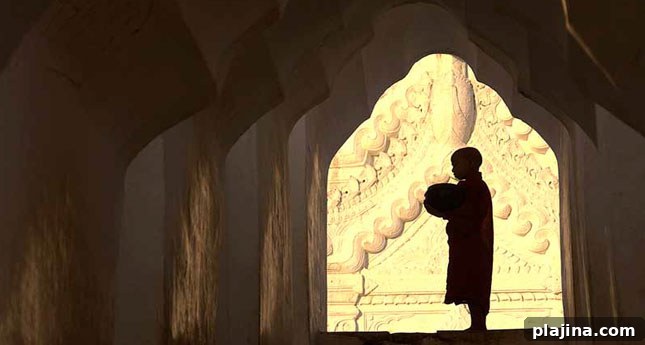
Myanmar is a land of vivid contrasts and unforgettable imagery. Lush landscapes, fairy-tale temples and pagodas, and lines of young monks in red robes carrying begging bowls at sunrise create scenes that linger in the mind. Farmers guiding ox-drawn carts share roads with teenagers on motor scooters, and warm, welcoming people populate towns and countryside alike. The country feels at once wild, sacred, exotic, mysterious, bustling and serene, often bathed in stunning, magical light that makes it a dream for photographers.
Bordered by Bangladesh, India, China, Laos and Thailand, Myanmar covers more than 402,000 square miles, making it the second-largest country in Southeast Asia.
A common question among visitors is whether to call the country Burma or Myanmar. In 1989 the ruling military government changed many place names, including the country’s English name from Burma to Myanmar. That renaming remains politically charged: many opposition and ethnic groups rejected the junta’s authority to impose new names. Today, both names are used, and while some prefer one over the other for political or cultural reasons, many travelers accept either. Some visitors are still drawn to the traditional resonance of Burma.
Despite the warm hospitality many travelers encounter, Myanmar has experienced long periods of political tension and conflict. After independence in 1948, ethnic unrest and civil war affected many regions. A 1962 coup established military rule characterized by widespread human rights abuses and isolation that discouraged tourism for decades. Travel restrictions and sanctions aimed to pressure the regime but also made life harder for ordinary people.
Major political changes began following the 2010 general election and the release of prominent political prisoners, including Aung San Suu Kyi. Reforms gradually improved the country’s international standing: trade sanctions were eased, foreign aid resumed, and diplomatic ties were reestablished. As a result, travel to Myanmar increased significantly during the 2010s.
To photograph the country effectively, I traveled with Burmese photographer Win Kyaw Zan of Asia Photo. As a local photographer and guide, he knew the best locations, timing and light for images and served as an excellent translator.
My journey began in Yangon, the country’s largest city, formerly called Rangoon under British rule. Home to almost five million people, Yangon buzzes with energy and is seeing a surge in new hotels and hospitality services. One standout place to stay that blends history and comfort is the Kandawgyi Palace Hotel, originally built in 1934 as the Rangoon Rowing Club. Renovated with teak and careful attention to its original architectural style, the hotel sits in a mango grove by Kandawgyi Lake — a peaceful contrast to downtown Yangon.
No visit to Yangon is complete without seeing the iconic Shwedagon Pagoda. Often photographed and deeply revered, Shwedagon is the country’s most sacred Buddhist site. Its origins trace back many centuries, with notable rebuilding and embellishments in the 15th and 16th centuries. The complex gleams with gilt and ornate detail. Visitors follow local custom by removing their shoes and moving clockwise through the sacred precincts. The pagoda has also been a focal point for political expression: in 2007 thousands of monks and nuns marched at Shwedagon in one of the largest protests in decades.
Shwedagon Pagoda in Yangon © Ellen Clark
From Yangon we flew to Bagan, an ancient city spread across the plains beside the Irrawaddy River. Bagan’s landscape is scattered with roughly 2,000 surviving pagodas and temples within a compact area of about 16 square miles. At its height, the region contained many more monuments, but invasions, natural decay and the passage of time have reduced their number. Still, the remaining temples — many set among verdant foliage — offer abundant opportunities for exploration and photography.
Sulamani Temple, built in the 12th century from red brick, displays layered murals spanning several centuries, and its arches channel sunlight into the central interior, producing striking photographic light. Ananda Pagoda, another 12th-century masterpiece, stands as one of Bagan’s largest and best-preserved sites, with vast carved teak doors and gilded Buddhas at its entrances.
After a day of temple-hopping under strong sun, it’s a relief to return to comfortable lodgings. The Bagan Hotel River View sits along the Irrawaddy with landscaped grounds and mature trees, offering a tranquil vantage point to admire nearby temples while enjoying modern comforts.
One of the highlights of my visit was a sunrise hot-air balloon flight over Bagan’s temple-studded plains. Floating above the landscape as morning light swept across ancient stupas is an unforgettable experience and a photographer’s dream.
From Bagan I flew to Mandalay. The city evokes a classic, storied image, and one of its most photographed scenes is sunset at U Bein Bridge. Stretching roughly three-quarters of a mile, U Bein is reputed to be the longest teak bridge in the world and dates back about two centuries. At dusk, locals cross homeward on foot and by bicycle while the sky shifts from gold to deep crimson, producing dramatic silhouettes of monks, fishermen and commuters. For the best shots, small boat hires along the river give photographers the ideal perspective from the water.
A hot-air balloon over the temples of Bagan © Ellen Clark
On my final day a larger boat carried us to Mingun, an ancient capital site that houses the striking Hsinbyume Pagoda and a gigantic ringing bell weighing an estimated 90 tons. The white tiers of Hsinbyume, with their sweeping, ornate curves, resemble a massive wedding cake and provide an evocative backdrop for portraits. After a small donation to a local monastery, Win persuaded a few young monks to pose in their red robes and lacquer bowls among the pagoda’s white ornamentation, creating memorable images.
Reflecting on the trip, Win observed that with Myanmar reopening after political reforms, travelers can experience the country’s many charms without the downsides often associated with other destinations. While opinions about politics and history vary, Myanmar remains a place of extraordinary visual and cultural richness. For anyone drawn to history, spirituality and striking landscapes, a visit can be deeply rewarding.
Myanmar Info to Go
Yangon International Airport, the country’s primary international gateway, is located in Mingaladon Township about nine miles north of downtown Yangon. The runway has been extended to accommodate larger aircraft, and airport capacity increased in recent years to welcome more passengers. There are no nonstop flights from the United States to Myanmar; most travelers connect through Asian carriers with one or more stopovers. Taxis are the standard way to reach downtown Yangon from the airport, with fares typically in the $10–15 range depending on the destination.
Read more about Balloons Over Bagan.