
A crisp, cool morning breeze rustled the dense stands of totora reeds along the northern shore of Lake Titicaca. Small waves from our bow wake gently rocked the clumps of grass as we motored into open water, winding through a narrow channel in the reed bed.
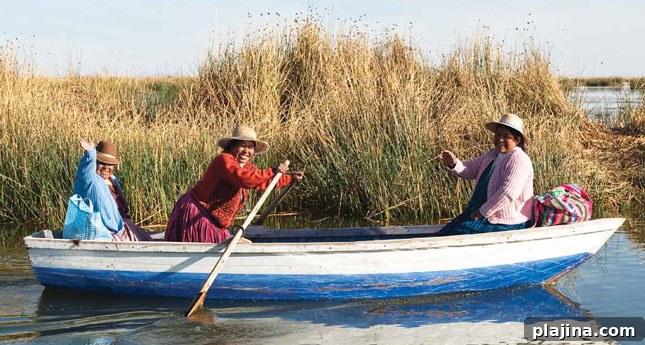
About 30 minutes into our outing, we met three Uros women in a small wooden boat piled with colorful woven bags of provisions. They smiled and waved, their long black braids spilling from beneath traditional felt fedoras, the soft sunlight highlighting their tanned, weathered faces.
I was struck by the woman in the center who rowed the boat. At 12,500 feet above sea level, even switching seats to get a better photo made my heart race, so I could only imagine how demanding rowing must be. Yet she smiled broadly and stroked the oars with effortless rhythm, heading out into the lake as if it were second nature.
Lake Titicaca is the highest commercially navigable lake in the world and the traditional home of the Uros, a pre-Incan people who live on roughly 42 floating islands a few miles out on the water. The Uros build these islands by bundling dried totora reeds together and anchoring them with long poles to the lakebed, creating surprisingly stable platforms that bob gently with each passing wake.
An hour after leaving Puno’s dock, we pulled up to one such island to visit an Uros family. Two elderly women with welcoming smiles helped us ashore and introduced their large household. The reed surface felt firmer than I expected yet still gave a waterbed-like bounce. When a passing motorboat sent a wake across the island, it rocked just enough to make me stumble; the children erupted in delighted giggles at my unsteady steps.
The Uros use totora reeds for nearly everything: homes, boats and even beds. While wooden rowboats have largely replaced the traditional reed balsa, families who host visitors often keep a small reed boat for demonstration. After paddling a balsa for 10 minutes and barely making progress, it was easy to see why sturdier wooden boats are preferred for daily use.
During our visit the family offered freshly roasted corn and sang local songs. I enjoyed their warmth and good humor, and I suspect the children enjoyed watching me teeter across the island. The Uros are among the warmest, most sincere people I encountered in South America. Many subsist on small-scale farming and selling exquisite handwoven textiles to visitors. I repaid their hospitality by purchasing a beautifully hand-knitted chullo—an earflap hat—made from vicuña wool for a modest sum.
When travelers think of Peru, Machu Picchu often comes to mind first, but the country offers a rich variety of historic sites and cultural experiences beyond the famous citadel. Although Peru is roughly three times larger than California, an efficient network of highways, railways and domestic flights makes it surprisingly easy and affordable to travel between regions.
My journey began in Lima, a sprawling capital of nearly nine million that preserves a treasure trove of history. Founded by Francisco Pizarro on Jan. 18, 1535, the coastal city retains a colonial vice-regal ambiance that makes it an ideal gateway for exploring Peru’s cultural and geographic diversity. Declared a UNESCO World Heritage site in 1991, Lima’s historic center is a living collection of centuries of architecture. The Plaza de Armas, ringed by Baroque cathedrals and Spanish mansions, is a fine place to start.
A short distance away in Plaza Bolívar is the National Museum of Archaeology, Anthropology and History of Peru, which houses more than 100,000 artifacts, textiles and ceramics spanning the country’s long human history. It’s one of South America’s most compelling museums and an excellent primer for visits to archaeological sites across the country.
In the modern Miraflores neighborhood, the Huaca Pucllana complex features a three-story clay and adobe pyramid that served as a pre-Incan administrative and ceremonial center from about A.D. 200 to 700. The site illustrates how Peru’s urban landscapes blend contemporary life with ancient heritage.
From Lima I traveled to Puno and Lake Titicaca, then continued north by coach to Cuzco, crossing the 14,225-foot Feliz Viaje Pass in the high Andes. En route I visited the Sillustani chullpas, ancient burial towers overlooking Lake Umayo, a reed-filled lake home to more than 60 species of high-altitude water birds, including the striking Andean flamingo.
I spent three days in Cuzco acclimating to 10,800 feet and exploring the city the Spanish named La Ciudad Imperial. Occupied since at least 2000 B.C. and the capital of the Inca Empire by around A.D. 1200, Cuzco is often considered the oldest continuously inhabited settlement in South America. After the Spanish conquest in the mid-1500s, conquistadors reused many Incan stone blocks to build colonial palaces and cathedrals, but elements of the original walls remain visible around the main square. UNESCO designated Cuzco a World Heritage site in 1983.
Perched above the city, the fortress of Sacsayhuamán remains one of the most impressive Incan construction feats. The enormous interlocking stone walls—comprised of blocks weighing between 200 and 300 tons in some places—deterred the Spanish from dismantling the main structure, and today the sunrise view over the Cuzco valley from these ramparts is unforgettable.
Cuzco also serves as the gateway to Machu Picchu, the iconic Incan citadel rediscovered by American archaeologist Hiram Bingham in 1911. I took the four-hour train from Cuzco to Aguas Calientes, the small town at the base of Machu Picchu. While it’s possible to do a day trip—taking an early train up, touring the ruins and returning by evening—I recommend staying at least a couple of days to properly explore the site and enjoy nearby hikes along parts of the Inca Trail.
From Aguas Calientes, tourist buses shuttle visitors up a steep, twisty dirt road to the park entrance, followed by a half-mile climb to the ruins. At 8,000 feet the thin air makes the ascent feel far harder than the distance suggests, but the first glimpse of Machu Picchu more than compensates for the effort.
What astonishes most visitors is the sheer improbability of constructing such a complex city on precipitous mountain slopes. The precision of Incan ashlar masonry—stone blocks cut and fitted so tightly that a knife blade cannot be inserted between them—continues to baffle scholars and inspire admiration.
Machu Picchu is vast enough to require a full day to explore properly, and staying longer paid off for me: rain obscured the site on my first day, leaving clear weather for a full day of exploration and another for memorable Andean hikes.
My ten-day tour only scratched the surface of Peru’s richness, but visiting Lake Titicaca and Machu Picchu provided unforgettable bookends to an adventure-filled trip in a country that stands out for its deep historical significance and cultural diversity.
Info to Go
Flights arrive daily at Jorge Chávez Lima-Callao International Airport (LIM) from major U.S. gateways. Local and international tour operators offer a wide range of land, air and water adventures, including hiking, river rafting and Amazon jungle cruises. Peru’s hotel groups operate properties in convenient locations across the country. For visitors planning a trip, researching official national tourism resources and reputable local operators will provide current travel, accommodation and activity options.