
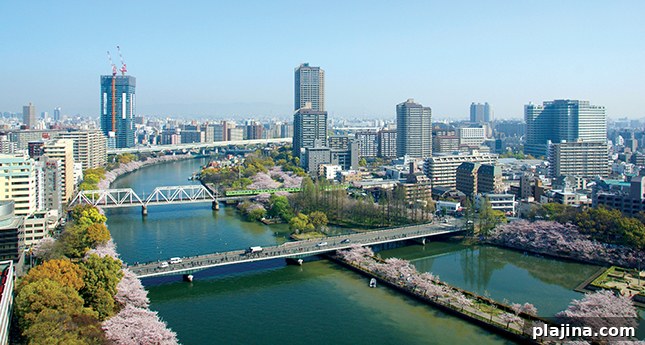
On March 10, Osaka stood as Japan’s third-largest city and one of its busiest ports. Home to nearly 100 corporate headquarters — including Asahi Broadcasting, Hitachi Zosen, Panasonic, Daihatsu, Mitsubishi, Sanyo Shimano and Tsubakimoto Chain — the city was recognized for its business-friendly environment, second only to Tokyo. Renowned among Japanese and international visitors alike for its cuisine, Osaka has long been nicknamed “Japan’s kitchen” (tenka no daidokoro), a reputation dating back to the Edo period when the country’s first rice market was established there. Today, Osaka’s culinary strength is underscored by its large number of Michelin-starred restaurants.
Everything changed on March 11, when a massive earthquake and tsunami struck northeastern Japan, heavily affecting Sendai and surrounding areas and triggering the Fukushima Daiichi nuclear crisis. With Tokyo suffering structural damage, transportation disruptions and concerns about possible radiation exposure, Osaka quickly became an alternative hub. Companies, government agencies, international businesses, travelers and air carriers moved operations and people from Tokyo to Osaka, farther from the disaster zone.
Tokyo experienced rolling blackouts, halted long-distance trains and even the temporary closure of Tokyo Disneyland; many flights were diverted from Narita to Kansai International Airport. Osaka, whose infrastructure remained intact, became a host city: hotels welcomed an influx of displaced residents, families reunited as relatives arrived from other regions, and expectant mothers concerned about radiation temporarily relocated to live with friends and family in Osaka.
As more people stayed in Osaka for weeks and months, the city’s image broadened beyond its business identity. Its hospitality, redeveloped waterways, striking architecture and efficient transport systems — air, rail, road and sea — impressed those who found refuge there. In addition to providing shelter, Osaka became a logistical and humanitarian center: trucks and cargo flights transported food, clothing and medical supplies northward to impacted areas, and the city shifted focus from commercial news to relief and recovery efforts.
Osaka’s importance in Japanese history dates back to the seventh century when it was designated the nation’s first capital. Although later capitals were established in Nara, Kyoto and Tokyo, Osaka remained a major center of commerce and politics. Its most famous landmark, Osaka Castle, was built in 1583 by Toyotomi Hideyoshi, a key figure in Japan’s unification.
Modern Osaka blends historical pockets with contemporary urban life. Traditional 19th-century streets remain in neighborhoods such as Jinaimachi, and temple gardens offer tranquil retreats. At the same time, a sprawling metropolis of about 2.5 million residents stretches along rivers, canals and Osaka Bay, merging into the nearby cities of Kobe and Kyoto and numerous satellite towns to form a metro area of more than 19 million people. The combined Osaka/Kobe/Kyoto region has a gross domestic product that places it among the world’s most productive metropolitan economies.
Rebuilt after heavy damage in World War II, Osaka’s postwar growth produced a mix of concrete structures, elevated highways and rapid suburban expansion. Today the city presents striking contrasts: serene places like Hombo Gardens at Shitennoji Temple sit amid vibrant districts such as Dotonbori, known for its neon-lit nightlife and dynamic street scenes that can feel like a cinematic backdrop.
Over the past decade, public and private investment has driven substantial urban renewal, resulting in office, retail and residential projects that showcase architectural innovation and green technology. Renowned architect Tadao Ando, a native of Osaka, left his mark with notable buildings and cultural facilities. Waterfront revitalization since events like 2009’s “Aqua Metropolis Osaka” has transformed wharves into dining, entertainment and river-cruise destinations. Projects such as the Tombori Riverwalk have added shops, open-air cafés and concert spaces that attract locals and visitors alike.
One of the city’s largest redevelopment efforts, Osaka Station City, is being built in phases by a consortium of Japanese firms and will include office towers, residential apartments, retail space and a deluxe InterContinental hotel with residences. The first phase, a renovated Osaka Station — the city’s busiest rail terminal — opened recently, and subsequent phases will add pedestrian streets, green spaces and water features. The overall project budget is roughly $2.5 billion.
Looking ahead, Japan is considering additional high-speed rail improvements. Plans proposed by Central Japan Railway Co. envision a superconducting maglev line between Osaka and Tokyo by mid-century, with top speeds near 300 mph and an expected travel time of about 67 minutes, significantly reducing current shinkansen travel times.
Diversions
With 33 waterways threading the city, Osaka is often called the “Water Metropolis.” Aqua-Liner tour boats run regularly from downtown piers, offering waterborne views of Osaka Castle, Nakanoshima, Osaka Business Park and other riverside landmarks.
Osaka Castle (1-1 Osakajo, Chuo-ku) is best explored on foot: the imposing gates, turrets, decorative roof tiles and high white stone walls make it a striking historical site.
Shopping districts range from the long strip of small shops along Tenjimbashi-Suji to the Kuromon Ichiba fresh produce market (also known as Black Gate Market), a longtime source for meat, vegetables and seafood favored by local chefs. Trendy Minami Semba offers boutiques and cafés popular with younger crowds. The historic Hankyu Department Store (opened 1929) remains a flagship destination, with notable food halls on the lower levels.
The National Museum of Art showcases traditional and contemporary Japanese art, while the Umeda Sky Building features a 510-foot observation deck that connects two towers. For panoramic views, the Cosmo Tower’s high-floor jazz bar offers a 360-degree perspective of the city. Namba Parks, designed as a mixed-use complex with a rooftop park and layered green spaces, symbolizes Osaka’s effort to blend nature with urban living — a recurring theme in the city’s evolving landscape.
Info To Go
Kansai International Airport (KIX), built on an artificial island about 30 miles from downtown, opened in 1994. Travel to the city center takes roughly 35–60 minutes by train, 50–95 minutes by bus or about 50–60 minutes by taxi. Note that Osaka International Airport (ITM) is the city’s domestic airport. For current visitor information, consult official Osaka tourism resources.
Lodging
RIHGA Royal Hotel Osaka
This flagship property offers executive floors, spa facilities, a fitness center, conference rooms and the highly regarded Restaurant Chambord. 5-3-68 Nakanoshima, Kita-ku. $$$$
The Ritz-Carlton, Osaka
Located within walking distance of Osaka Station, this luxury hotel features Michelin-starred dining options, an indoor pool, saunas and business facilities. 2-5-25 Umeda, Kita-ku. $$$$
Swissôtel Nankai Osaka
A deluxe hotel with 548 rooms, an Amrita Spa, executive club floors, a rooftop Sky Bar and multiple restaurants. 5-1-60 Namba, Chuo-ku. $$$
Dining
Hanagatami
Located at The Ritz-Carlton, Hanagatami serves refined kaiseki along with sushi, tempura and teppanyaki in private tatami rooms, with expert sake pairings and attentive service. 2-5-25 Umeda, Kita-ku. $$$$
Miyoshiya
Known for handmade udon made with natural ingredients, Miyoshiya offers a casual yet authentic experience and even udon cooking lessons. 9-17 Namba Sennichimae, Chuo-ku. $$
Taian
A small, intimate restaurant recently elevated to three Michelin stars, Taian serves a tightly curated tasting experience with limited seating; reservations through phone or concierge are recommended. 1-21-2 Shimanouchi, Chuo-ku. $$$$