A group of Japanese men in black business suits sat patiently, palms resting on their knees, while musicians under a nearby portico tuned wooden instruments. A Shinto priest shuffled forward on his platform clogs and began a steady chant, the monotone incantation weaving with the plaintive sounds of lyres and flutes.
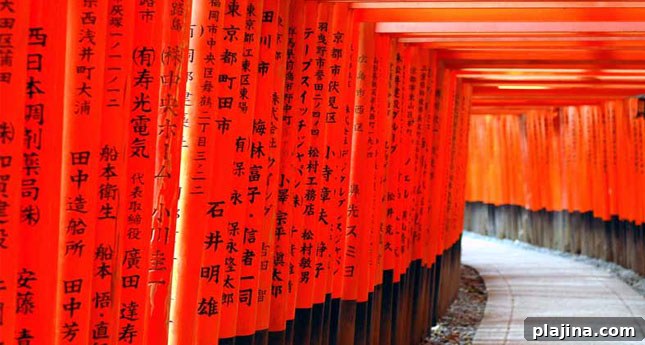
My husband and I were visiting Fushimi-Inari Taisha, a shrine originally dedicated to the deity of rice and saké dating back to the eighth century. As we wandered the wooded trails draped with thousands of saffron- and sable-colored torii gates, we kept crossing paths with men carrying briefcases, oddly out of place in the shrine’s mountain setting.
Over time the domain of the goddess Inari shifted from agriculture to commerce as Japan’s economy evolved in the 19th century. Today many businessmen from Osaka take the 15-minute train to Inari Station on the outskirts of Kyoto to walk beneath the wooden torii — each donated by a different company — and pray for prosperity in business.
It makes sense that the most popular Inari shrine is within easy reach of Osaka. Historically Japan’s commercial center, Osaka remains home to major companies and a leading futures exchange. While it may not have the temples of Kyoto or the museums of Tokyo, Osaka is celebrated as Japan’s food capital, drawing visitors with fresh squid, saucy comfort fare and vibrant street food traditions.
When we arrived in late February the city was already waking from a mild winter. Parks and sidewalks pulsed with activity. In the Osaka Castle plum orchard, delicate pink and white blossoms were beginning to appear. Retirees with tripods and long lenses jostled for the best shots, gray-haired women painted with watercolors in the shade, vendors sold miniature plum trees in pots, and a man in a fedora fed two live canaries perched on his hat while his wife slurped a bowl of noodles.
Osaka Castle is just one legacy of Toyotomi Hideyoshi, the 16th-century general who unified Japan’s warring territories. Rising from peasant origins to the highest ranks of nobility, Hideyoshi’s dramatic ascent and ostentatious tastes — local lore claims he built a tea room of solid gold — made him a much-admired figure in the region.
Compared with Tokyoites, Osakans are often described as relaxed, good-humored and boisterous — traits that may stem from the city’s long history as a busy port and trading hub. Riding an elevated train toward Osaka Bay, skyscrapers and overpasses gave way to low houses, narrow alleys and glimpses of busy container terminals.
The seaside area near Osaka Aquarium bustled on a Saturday afternoon with toddlers nibbling ice cream accompanied by grandfathers, and swarms of teenagers in matching outfits hunched over smartphones. Under the shadow of a 367-foot Ferris wheel, a food court sold rows of takoyaki, the fried octopus balls for which the city is famous. We ordered a half-dozen and used chopsticks to pierce the steaming, doughy centers.
Housed in an eight-floor cube, the Osaka Aquarium is among the world’s finest. Its star attraction, a whale shark named Yu-chan, shares a central tank with manta rays, giant spider crabs and other unusual species. As we spiraled downward through the exhibits, we watched dolphins push basketballs with their noses, sea otters race while rubbing their faces, and a cluster of television personalities filming in front of the tanks. The final gallery showcased colorful jellyfish, some with hues as delicate as crème brûlée.
For dinner we headed to Dotonbori, Osaka’s neon-lit shopping and entertainment district. Along the Dotonbori River, enormous signs for beer, candy and arcades burst with color. Three-dimensional mechanical figures — dragons, crabs, octopuses and blowfish — waved above restaurant entrances.
Signs light up the Dotonbori neighborhood. © Allison Voigts
The scene felt like a futuristic cityscape; steam rose from street-level eateries as we settled into a ramen shop and were served deep bowls sprinkled with ground sesame and pickled ginger while shoppers and club-goers flowed past outside.
Leaving the main thoroughfare’s department stores and nightclubs, we turned into a maze of alleys lined with tiny, polished-wood bars scarcely large enough for a handful of standing patrons. Inside one such bar we ordered foamy pints of Sapporo draft. Through the glass door we saw a group of suited men laughing beneath a luminous whale sign pointing to a long, intriguing menu.
After Dotonbori’s theatrical energy, Kita, Osaka’s modern Central Business District, felt comparatively restrained. We were relieved to return to The Ritz-Carlton, where the hotel’s location atop a glass-and-steel skyscraper contrasts with its interior’s Old World elegance. From our 30th-floor room we watched neighboring office lights go out and the neon cityscape shimmer beneath us.
Osaka Info to Go
Kansai International Airport (KIX), which handles international flights, is located about 24 miles southwest of Osaka Station on Osaka Bay. Express trains on JR West and Nankai Electric Railway link the airport to downtown Osaka. Osaka Itami Airport (ITM) serves domestic flights and is connected by the Osaka Monorail. High-speed Shinkansen trains link Osaka with Tokyo (about three hours) and Kyoto (approximately 14 minutes).
Where to Stay in Osaka
Hilton Osaka — Its extensive meeting facilities and location across from Osaka Station make it a popular choice for business travelers. 1-8-8 Umeda, Kita-ku $$$
The Ritz-Carlton, Osaka — Spacious guestrooms and suites blend traditional elegance with sweeping views of the Central Business District. 2-5-25 Umeda, Kita-ku $$$$
The St. Regis Osaka — Contemporary rooms incorporate Japanese design touches such as Kawashima silk headboards. 3-6-12 Honmachi, Chuo-ku $$$$
Restaurants in Osaka
La Baie — Warm, dark wood paneling sets the tone for Michelin-starred French cuisine and an acclaimed wine list. The Ritz-Carlton, Osaka, 2-5-25 Umeda, Kita-ku $$$$
Koryu — Chef Shintaro Matsuo’s inventive approach to local seafood earned his intimate, 12-seat restaurant top culinary recognition. 1-5-1 Dojima, Kita-ku $$$$
Mizuno — A popular Dotonbori lunch counter where okonomiyaki — a savory pancake of green onions, egg, seafood and more — is cooked in front of diners. 1-4-15 Dotonbori, Chuo-ku $$
For visitors interested in local specialties, takoyaki and okonomiyaki provide quintessential Osaka flavors and vibrant street-food experiences.