
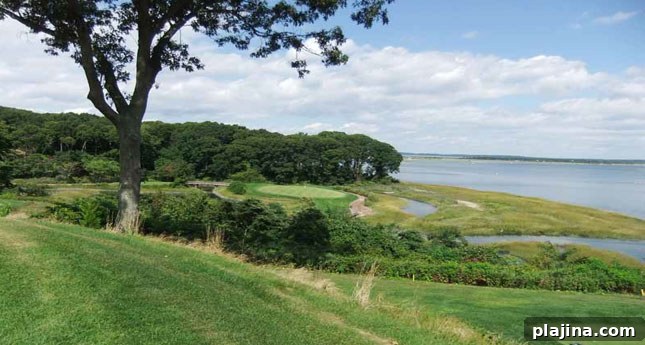
Nissequogue brings back many memories, especially from the years when I was launching Global Traveler. As we approach the 10th anniversary of the magazine’s debut, a revisit to Nissequogue feels appropriate.
My mentor, Dixon Hunter, was a golfer and quintessential “man’s man” who pushed me to start the magazine. “You can do it,” he told me. “You don’t need anyone.” Many of those conversations happened at Nissequogue, often with prospective clients. Dixon passed away more than five years ago, and I still miss his booming drives and the jokes that had me laughing before the punch line. Nissequogue will always hold a special place in my heart, and I hope new members recognize what a spectacular setting it is on Long Island’s North Shore.
Dixon once suggested, jokingly and persistently, that we use his 55-foot boat docked at Chelsea Piers in New York as GT’s first office so we could entertain clients in New York Harbor. That was classic Dixon — bold and a little outrageous — and I’m glad I declined.
The course was established in 1966 on 120 acres of the former William J. Ryan estate; Ryan was the publisher of The Literary Digest. The clubhouse is Ryan’s 1929 mansion from the publication’s heyday. Renovations by architect Stephen Key in 1999 shaped the present 6,643-yard, par-72 championship layout. Recently I teed off at Nissequogue with Lucky Bob Hancock, Jimmy the Cop and IBM John to hit a few balls and relive those good old days.
Hole 2 | 547 yards, par 5
This long, downhill par 5 has a green tucked to the right and plenty of trouble areas. Off the tee you need a straight drive that favors the left side of the fairway while avoiding the right-side trap and the trees to the left. A wild right shot can carry you out of play and toward the clubhouse road. My tee shot ended up too far right and near the bunker, so I overcooked the second and flew through to the rough on the adjacent hole. I managed to wedge back over the trees but misjudged the distance and came up short. A shallow valley in front of the green tends to collect shots; you need a bit more club to avoid just trickling onto the putting surface. The green slopes from front to back, so placing your ball below the pin is the smart play.
Hole 5 | 316 yards, par 4
This is the famous hole where Dixon once cut the corner and aced it. At the tee I urged him to go for it, and he did — even hitting a provisional because we thought the ball might have sailed over the green. After searching rough and behind the green, I looked in the cup and there it was — an incredible hole-in-one. For the rest of us, the safer choice is to aim short of the front bunkers and play a wedge to the green.
Hole 6 | 219 yards, par 3
A straightforward par 3 with the green nearly level with the tee, this hole is guarded by bunkers left and right that catch many tee shots, including John’s. Lucky Bob and I both hit lovely shots that mysteriously came up short and landed side by side a yard off the green. While I debated whether to putt or chip, Bob chipped in for birdie. I chose the putter, struck a firm putt that hit the flagstick and dropped — another birdie. We high-fived and headed back to the cart, content while our teammates struggled.
Hole 16 | 477 yards, par 5
A dramatic and picturesque hole, this tee offers a sweeping view of the bay and the 17th green. The tee box sits roughly 100 feet above the fairway, which rises again toward an elevated green overlooking St. James Bay. As a member guest with Dixon in years past, we would tee off from the patio after dinner for a longest-drive challenge to the fairway below while the assistant pro judged from his cart.
Avoid the hill on the right — I’ve lost many balls there. On this clear late-summer day John’s drive landed in that slope and disappeared. From the fairway, hit a strong shot to the green; you’ll likely be short but have a manageable chip. Bob and I missed our chips but two-putted for par. John recovered with a determined par, while Jimmy made a bogey.
Hole 17 | 207 yards, par 3
Over the years I’ve lost countless balls in the tidal marsh that frames this one of Long Island’s most scenic holes. Ironically, none of us found the green on this round. With an elevated tee and a small, postage-stamp green, it should be straightforward — but the marsh and wind can humiliate you. I can still hear Dixon urging me to “hit another.”
The fairway at Hole 18 © Francis X. Gallagher
Hole 18 | 406 yards, par 4
After the humiliation of 17, the closing hole can be unforgiving. Many players, myself included, try to hug the right side only to find the carry too long and end up in reeds and marsh. The prudent play is to favor the left for a cleaner approach. Years of experience at Nissequogue paid off for me — I aimed left and avoided trouble while others returned to the tee after losing balls on the right. My approach was a near-perfect 3-wood to the left side of the green, but elevation left it short of the greenside bunker. John, in typical fashion, launched a bold shot that bounced off the back of the green and into the thicket. That ball, like many memories of Dixon Hunter, stayed at Nissequogue.
Nissequogue Golf Club
21 Golf Club Road
St. James, NY 11780-2159
tel 631 584 7733
nissequoguegolf.com