
This July, the work of late kinetic sculptor, experimental filmmaker and native New Zealander Len Lye will be showcased in a new building created in his honor. Fascinated by what he called the “art of motion,” Lye made large-scale kinetic pieces, including the 147-foot Wind Wand installed in New Plymouth, New Zealand. A contemporary and friend of poets such as Dylan Thomas and Laura Riding, Lye also produced written work and made wartime informational films for the British General Post Office Film Unit.
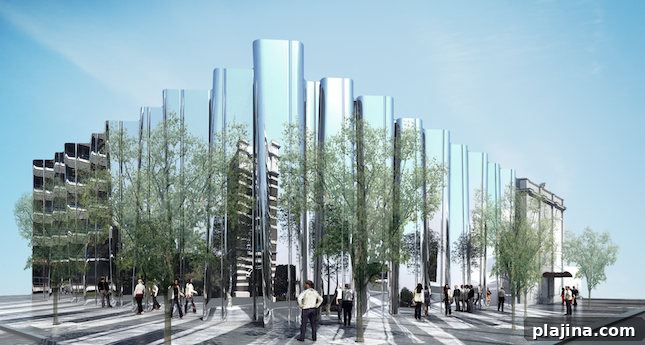
On July 25, the Len Lye Centre will open as part of the Govett-Brewster Art Gallery in Aotearoa, New Zealand. The gallery has cared for Lye’s work since his death and bequest in 1980, and the new centre provides a dedicated space to present his legacy. The exhibition galleries will display a range of the artist’s sculptures and moving-image works, complemented by a curated moving-image program shown in the centre’s 62-seat cinema. With its curved exterior walls clad in reflective stainless steel, the Len Lye Centre is New Zealand’s first museum dedicated to the work of a single artist.
The centre’s design emphasizes the relationship between Lye’s moving sculptures and the surrounding environment. The reflective exterior interacts with light and weather, echoing the dynamism of his kinetic pieces and drawing attention to motion as a guiding principle of the artist’s practice. Inside, visitors will find spaces arranged to highlight both large-scale installations and film-based works, allowing close study of Lye’s experiments with movement, rhythm and the visual possibilities of film.
Len Lye’s career spanned multiple disciplines. He is best known for kinetic sculpture that relies on wind, motors or viewer interaction to produce continuous motion, often generating changing patterns of shadow and reflection. His filmmaking explored abstract animation and direct-on-film techniques, producing short films that emphasize rhythm, texture and the physical qualities of film itself. During World War II, Lye’s film work included informational pieces made for the General Post Office Film Unit in Britain, combining practical messaging with his distinctive visual approach.
Found throughout New Zealand and internationally, Lye’s public works and films have influenced generations of artists interested in movement, sound and the possibilities of mechanical and optical processes. The new Len Lye Centre aims to preserve and present that influence by offering a site for display, research and public programming. The centre’s cinema and exhibition schedule will be used to present retrospectives, newly curated screenings and educational programs that explore Lye’s methods and his impact on contemporary art and filmmaking.
For visitors, the Len Lye Centre provides both a formal museum experience and an encounter with artworks that move and respond to their surroundings. The combination of sculptural installation and screened works underscores Lye’s interdisciplinary spirit, inviting audiences to experience motion in multiple forms. As a museum dedicated to a single artist, the centre creates focused opportunities to study Lye’s innovations in kinetic art and film while celebrating his contribution to New Zealand’s cultural landscape.