
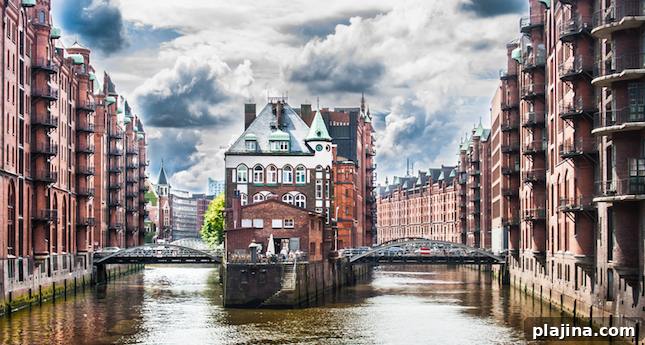
Hamburg’s historic Speicherstadt and Chilehaus — together with the Kontorhaus office and warehouse district — have been inscribed on the UNESCO World Heritage list. The designation recognizes the area as an exceptional example of port-related urban development and warehouse architecture.
Covering roughly 64 acres in the port, the Speicherstadt is the world’s largest continuous warehouse complex. Its red-brick Wilhelmine Gothic buildings, set on massive oak pilings, form a striking ensemble of gables, turrets and canal-side façades. The complex comprises 17 major buildings and more than 3.2 million square feet of floor space that historically stored tea, coffee, cocoa, spices, tobacco and fine carpets. Today the Speicherstadt is one of Hamburg’s most visited areas, home to museums and attractions such as Miniatur Wunderland, the Hamburg Dungeon and the Speicherstadtmuseum.
Adjacent to the warehouse quarter, the Kontorhaus district represents one of continental Europe’s first purpose-built office and commercial zones. Developed in the 1920s and 1930s, the district includes landmark buildings like the Chilehaus, the Messberghof and the Sprinkenhof. The Chilehaus, an outstanding example of German Brick Expressionism, is particularly notable for its sharp, ship‑like prow and dramatic brickwork.
The combined site illustrates the close relationship between trade, shipping and urban architecture: warehouses and offices were purposefully designed to serve the demands of a bustling port economy while also creating a coherent architectural identity. The UNESCO recognition highlights both the technical achievements of constructing heavy masonry buildings on oak piles and the cultural significance of this port landscape in Europe’s commercial history.
Visitors to the area can explore a mix of industrial heritage and urban beauty: canals and bridges thread between the brick façades, museums preserve the memory of global trade goods once handled here, and the Kontorhaus district demonstrates early 20th-century approaches to office planning and monumental civic architecture. Together the Speicherstadt and Kontorhaus quarter form a well-preserved testimony to Hamburg’s role as a major international trading center.