
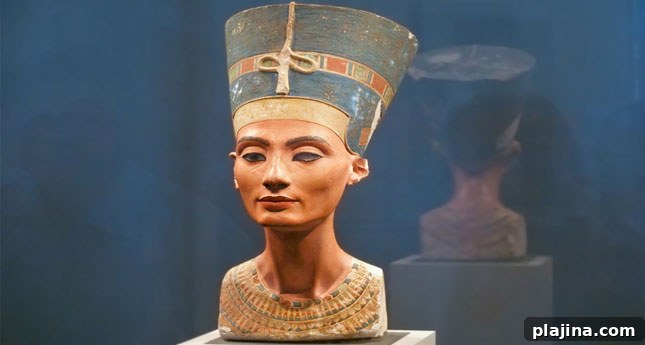
I first encountered a photograph of the bust of Nefertiti, the ancient Egyptian queen, when I was about twelve. From that moment she embodied my idea of beauty. Actresses, singers, celebrities, even modern beauty queens—all seemed to fall short compared with this 3,500-year-old sculpture. I did not see the original until a few months ago, when I finally visited Berlin. There she stands in the Neues Museum, positioned alone at the center of Gallery 210, the North Dome Room.
Approaching the gallery, I hesitated. I paused at the doorway and nearly turned away. Dreams, idols and long-held images so often disappoint when confronted by reality: photographs can mislead, childhood impressions can collapse. Yet when I entered Gallery 210, there she was—serene, majestic and quietly commanding in person just as she is in the picture. Yes, she is beautiful.
The bust rests on a tall base and is protected by glass. I stood before it and walked slowly around the case. Over the centuries she has lost her left eye, but unlike many Egyptian figures that appear rigid or stylized, the sculptor Thutmose carved her between about 1351 and 1334 B.C. with unmistakable humanity. There is a subtle tension in her neck, a tiny line at the corner of her mouth, small details that make her feel alive. She seems poised to turn her head, to speak, to smile.
Historical notes accompany the sculpture: she was married to Akhenaten and had six daughters. Her name carries dual meanings—“the beautiful one has come” and “perfect are the beauties of the Aten”—and both descriptions feel apt. The bust fulfills the promise of the photograph and the imagination: she is strikingly, quietly perfect.